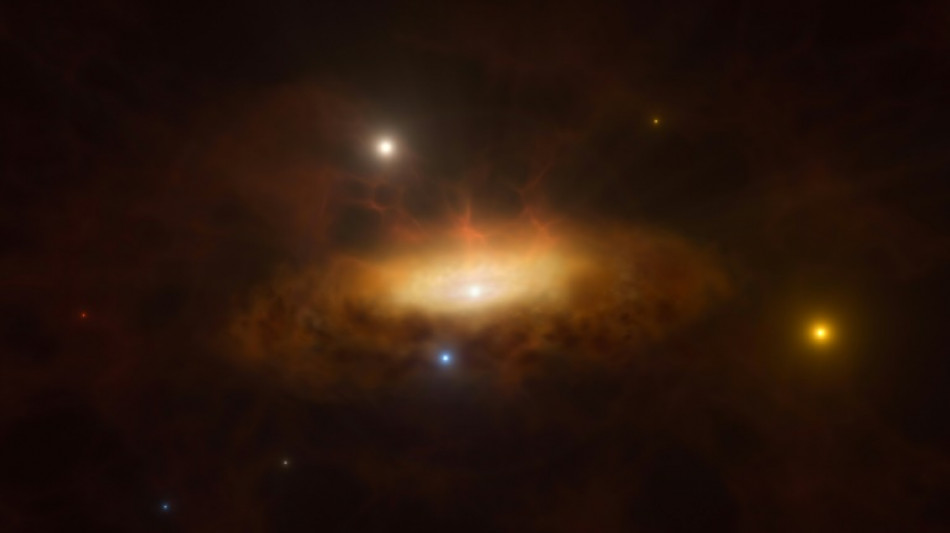
Black hole observed 'awakening' for the first time / Photo: ESO/M. Kornmesser - European Southern Observatory/AFP

 Nigeria miners struggled to breathe in cell before 37 died: survivors

 Warren Buffett steps down as Berkshire Hathaway chairman

 Isolated Syrian-Druze city blames Damascus for shortages

 Kerry James Marshall: American 'blackness' painter celebrated in Europe

 Infantino 'must go', says German FA vice-president

 Japan's busiest rail station tests robot bins

 Backpackers fret over Australian visa crackdown

 Bank of Japan hikes rates to 31-year high to battle inflation

 AI doomsday warnings unlikely to slow IPOs but questions linger

 In Brazil's Amazon, the hunt for oil fuels hopes and fears

 Baby orangutans in India expose 'frightening' scale of trafficking

 Oversight Board blasts 'inadequate' Meta safeguards for AI deepfakes

 Harry makes first public appearance since return to UK

 Princess Diana's brother makes new explosive claims against Charles

 Trump admin overhauls key protection for endangered species

 Mbappe draws political fire over Ceuta t-shirt controversy

 Third malaria death in Germany from outbreak tied to Frankfurt airport

 AtlasClear Holdings Reports Preliminary Fiscal 2026 Revenue of Approximately $20.1 Million, Up 85%; Revenue Plus Interest Income of Approximately $21.9 Million

 'Another arrow to the quiver': World Bank posts record private capital mobilization

 Ireland to boycott Eurovision 2027 over Gaza

 India's Tata Sons reappoints N. Chandrasekaran as chairman

 Germany urges EU action against China to defend carmakers

 Japan eyes changing prostitution law to punish sex buyers

 Modi pitches India as global chipmaking hub

 Ukraine plans record defence spending in 2027

Astronomers have been able to observe a supermassive black hole waking up and setting the heart of its host galaxy alight for the first time, the European Southern Observatory said on Tuesday.
The galaxy 300 million light years from Earth in the Virgo constellation had been quiet for decades until late 2019, when it suddenly began to shine brighter than ever before.
The centre of the galaxy -- where a supermassive black hole is believed to be squatting -- since then has been radiating a variety of rays.
"This behaviour is unprecedented," Paula Sanchez Saez, an European Southern Observatory astronomer and first author of a new study in the journal Astronomy & Astrophysics, said in a statement.
The "most tangible option" to explain this brightening is that the astronomers were watching "the activation of a massive black hole in real time", study co-author Lorena Hernandez Garcia said.
Most galaxies -- including our own Milky Way -- are believed to have a supermassive black hole at their centre.
These cosmic behemoths are by definition invisible -- not even light can escape the pull of their awesome power.
The only way to observe black holes is when they destroy something huge that lets off light in its death throes: such as a star that wandered too close being torn apart.
"These giant monsters usually are sleeping," study co-author Claudio Ricci explained.
But for the galaxy SDSS1335+0728, "we were able to observe the awakening of the massive black hole, (which) suddenly started to feast on gas available in its surroundings, becoming very bright," the astrophysicist added.
Initial observations indicate the black hole has 1.5 million times more mass than the Sun, enough for it to be classified as a supermassive black hole.
But it is still on the lighter side, as the true heavyweights easily exceed a billion times the Sun's mass.
The international team of astronomers is analysing data from a number of telescopes hoping to determine whether the black hole's activity is temporary -- perhaps caused by a star being ripped apart -- or whether it will continue to be active for a long time.
"This is something that could happen also to our own Sgr A*," the Milky Way's supermassive black hole, Hernandez Garcia said.
But fortunately for us, our own black hole remains fast asleep.
P.Kolisnyk--CPN