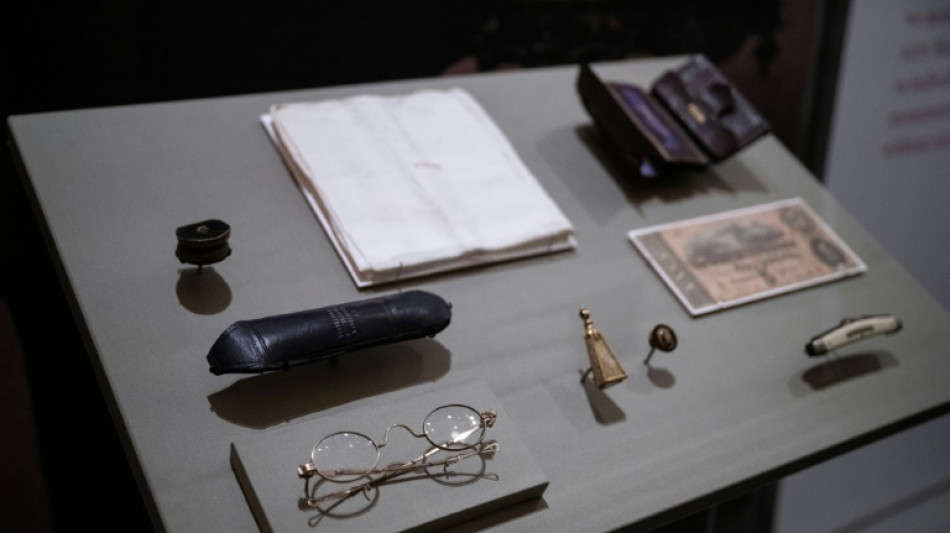
US Library of Congress spotlights its American 'treasures' / Photo: Drew ANGERER - AFP

 Nigeria miners struggled to breathe in cell before 37 died: survivors

 Warren Buffett steps down as Berkshire Hathaway chairman

 Isolated Syrian-Druze city blames Damascus for shortages

 Kerry James Marshall: American 'blackness' painter celebrated in Europe

 Infantino 'must go', says German FA vice-president

 Japan's busiest rail station tests robot bins

 Backpackers fret over Australian visa crackdown

 Bank of Japan hikes rates to 31-year high to battle inflation

 AI doomsday warnings unlikely to slow IPOs but questions linger

 In Brazil's Amazon, the hunt for oil fuels hopes and fears

 Baby orangutans in India expose 'frightening' scale of trafficking

 Oversight Board blasts 'inadequate' Meta safeguards for AI deepfakes

 Harry makes first public appearance since return to UK

 Princess Diana's brother makes new explosive claims against Charles

 Trump admin overhauls key protection for endangered species

 Mbappe draws political fire over Ceuta t-shirt controversy

 Third malaria death in Germany from outbreak tied to Frankfurt airport

 AtlasClear Holdings Reports Preliminary Fiscal 2026 Revenue of Approximately $20.1 Million, Up 85%; Revenue Plus Interest Income of Approximately $21.9 Million

 'Another arrow to the quiver': World Bank posts record private capital mobilization

 Ireland to boycott Eurovision 2027 over Gaza

 India's Tata Sons reappoints N. Chandrasekaran as chairman

 Germany urges EU action against China to defend carmakers

 Japan eyes changing prostitution law to punish sex buyers

 Modi pitches India as global chipmaking hub

 Ukraine plans record defence spending in 2027

The US Library of Congress houses more than just books, with a new exhibit opening this week highlighting some of the institution's most diverse and symbolic treasures from the nation's history.
From the contents of Abraham Lincoln's pockets the night of his assassination to early Spiderman sketches, a hundred treasures from the United States and beyond are on display from Thursday.
The library, located in a vast and elegant building in the heart of Washington, will showcase, for example, the first map of the newly independent United States compiled, printed and published in America by an American, which was printed in 1784 by engraver Abel Buell.
Also on hand are jaw-dropping photos of the first atomic explosion in the New Mexico desert, under the eyes of the "father" of the bomb, Robert Oppenheimer.
"The Library of Congress holds more than 178 million items in its collections, perhaps the most comprehensive collection of human knowledge ever assembled in one place," said its director, Librarian of Congress Carla Hayden.
The exhibit, officially titled "Collecting Memories: Treasures from the Library of Congress," features only a tiny fraction of the institution's vast troves of millions of books, audio documents and photographs, as well as objects of all kinds, including numerous musical instruments.
The library, opened in 1800, is home to the largest collection of flutes in the world, says Carol Lynn Ward Bamford, who takes care of instrument collections in the library's music division.
However, only one is a part of the exhibition, a crystal flute that belonged to former US president James Madison, who lived from 1751-1836.
The instrument is particularly symbolic because it was saved from the White House when it was burned by British troops in 1814.
Entrusted to the library by Madison's family, it was exceptionally taken out of storage in 2022 to be played by US hip hop star and classically trained flautist Lizzo.
- Glasses and press clippings -
Also on display are another president's belongings -- Abraham Lincoln's glasses, his handkerchief and his wallet, recovered from him following his assassination at a theater in April 1865.
Stephanie Stillo of the library's rare book division called the objects "definitely some of the most iconic that we're going to have in the gallery."
"There's kind of a mythology around Abraham Lincoln, and this is all very humanizing, I think in many ways. So we have a glasses case, this little circular object up here is a glasses cleaner," she went on, enumerating other belongings the 16th president had on him.
He was also carrying glowing press articles about himself, which he always kept with him, Stillo said. These clippings, which are not part of the exhibit for conservation reasons, could be shown in a few months, she explained.
This hodgepodge of objects on display, above all, embodies the lives of ordinary people through the centuries, she said.
From images filmed during a wedding in 1944 to contemporary testimonies about the Covid-19 pandemic to the story of a Japanese professor who survived the bombing of Hiroshima, the library examines how to preserve individual and collective memories.
Ch.Lefebvre--CPN