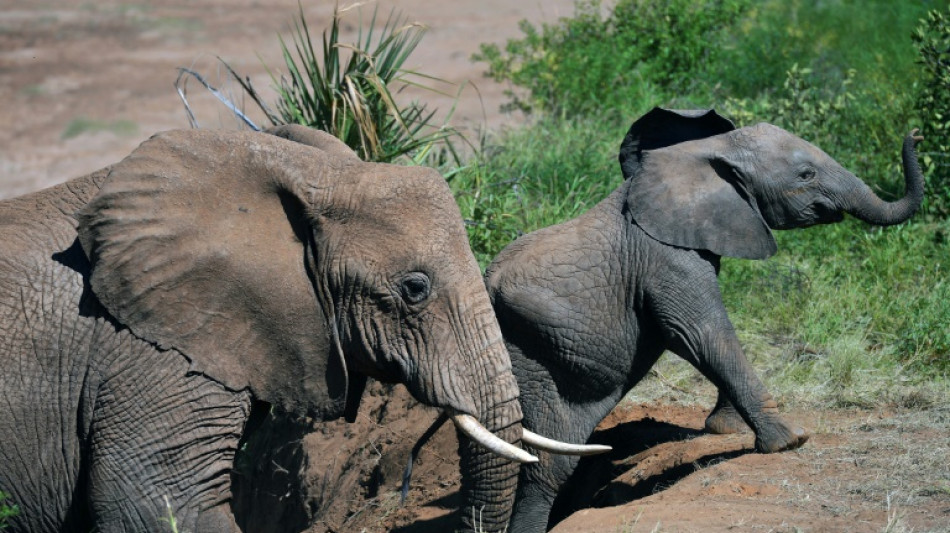
Elephants call each other by name, study finds / Photo: CARL DE SOUZA - AFP/File

 Nigeria miners struggled to breathe in cell before 37 died: survivors

 Warren Buffett steps down as Berkshire Hathaway chairman

 Isolated Syrian-Druze city blames Damascus for shortages

 Kerry James Marshall: American 'blackness' painter celebrated in Europe

 Infantino 'must go', says German FA vice-president

 Japan's busiest rail station tests robot bins

 Backpackers fret over Australian visa crackdown

 Bank of Japan hikes rates to 31-year high to battle inflation

 AI doomsday warnings unlikely to slow IPOs but questions linger

 In Brazil's Amazon, the hunt for oil fuels hopes and fears

 Baby orangutans in India expose 'frightening' scale of trafficking

 Oversight Board blasts 'inadequate' Meta safeguards for AI deepfakes

 Harry makes first public appearance since return to UK

 Princess Diana's brother makes new explosive claims against Charles

 Trump admin overhauls key protection for endangered species

 Mbappe draws political fire over Ceuta t-shirt controversy

 Third malaria death in Germany from outbreak tied to Frankfurt airport

 AtlasClear Holdings Reports Preliminary Fiscal 2026 Revenue of Approximately $20.1 Million, Up 85%; Revenue Plus Interest Income of Approximately $21.9 Million

 'Another arrow to the quiver': World Bank posts record private capital mobilization

 Ireland to boycott Eurovision 2027 over Gaza

 India's Tata Sons reappoints N. Chandrasekaran as chairman

 Germany urges EU action against China to defend carmakers

 Japan eyes changing prostitution law to punish sex buyers

 Modi pitches India as global chipmaking hub

 Ukraine plans record defence spending in 2027

Elephants call out to each other using individual names that they invent for their fellow pachyderms, a study said on Monday.
While dolphins and parrots have been observed addressing each other by mimicking the sound of others from their species, elephants are the first non-human animals known to use names that do not involve imitation, the researchers suggested.
For the new study, a team of international researchers used an artificial intelligence algorithm to analyse the calls of two wild herds of African savannah elephants in Kenya.
The research "not only shows that elephants use specific vocalisations for each individual, but that they recognise and react to a call addressed to them while ignoring those addressed to others," lead study author Michael Pardo said.
"This indicates that elephants can determine whether a call was intended for them just by hearing the call, even when out of its original context," the behavioural ecologist at Colorado State University said in a statement.
The researchers sifted through elephant "rumbles" recorded at Kenya's Samburu National Reserve and Amboseli National Park between 1986 and 2022.
Using a machine learning algorithm, they identified 469 distinct calls, which included 101 elephants issuing a call and 117 receiving one.
Elephant make a wide range of sounds, from loud trumpeting to rumbles so low they cannot be heard by the human ear.
Names were not always used in the elephant calls. But when names were called out, it was often over a long distance, and when adults were addressing young elephants.
Adults were also more likely to use names than calves, suggesting it could take years to learn this particular talent.
The most common call was "a harmonically rich, low-frequency sound," according to the study in the journal Nature Ecology & Evolution.
- Say my name -
When the researchers played a recording to an elephant of their friend or family member calling out their name, the animal responded positively and "energetically," the researchers said.
But the same elephant was far less enthusiastic when played the names of others.
Unlike those mischievous parrots and dolphins, the elephants did not merely imitate the call of the intended recipient.
This suggests that elephants and humans are the only two animals known to invent "arbitrary" names for each other, rather than merely copying the sound of the recipient.
"The evidence provided here that elephants use non-imitative sounds to label others indicates they have the ability for abstract thought," senior study author George Wittemyer said.
The researchers called for more research into the evolutionary origin of this talent for name-calling, given that the ancestors of elephants diverged from primates and cetaceans around 90 million years ago.
Despite our differences, humans and elephants share many similarities such as "extended family units with rich social lives, underpinned by highly developed brains," Save the Elephants CEO Frank Pope said.
"That elephants use names for one another is likely only the start of the revelations to come."
O.Ignatyev--CPN