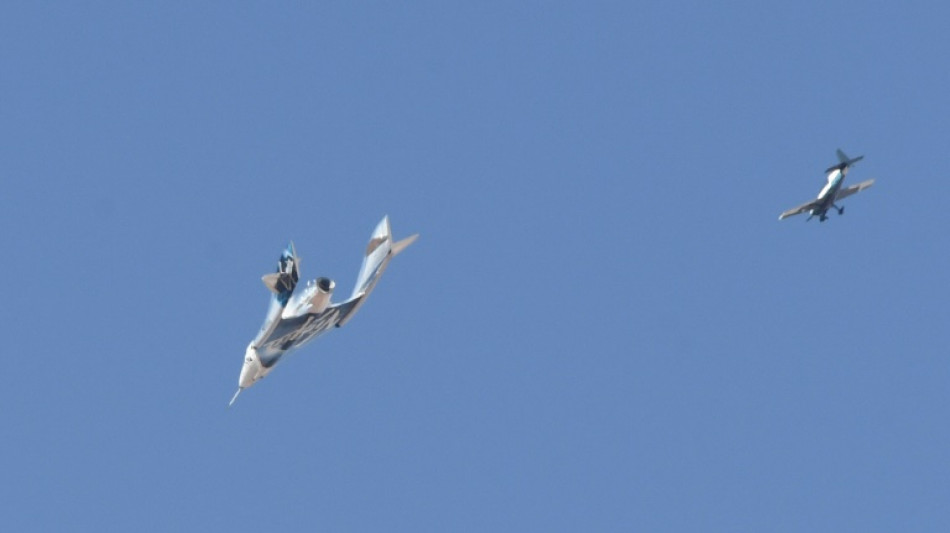
Virgin Galactic completes final spaceflight before two-year pause / Photo: Patrick T. FALLON - AFP

 Nigeria miners struggled to breathe in cell before 37 died: survivors

 Warren Buffett steps down as Berkshire Hathaway chairman

 Isolated Syrian-Druze city blames Damascus for shortages

 Kerry James Marshall: American 'blackness' painter celebrated in Europe

 Infantino 'must go', says German FA vice-president

 Japan's busiest rail station tests robot bins

 Backpackers fret over Australian visa crackdown

 Bank of Japan hikes rates to 31-year high to battle inflation

 AI doomsday warnings unlikely to slow IPOs but questions linger

 In Brazil's Amazon, the hunt for oil fuels hopes and fears

 Baby orangutans in India expose 'frightening' scale of trafficking

 Oversight Board blasts 'inadequate' Meta safeguards for AI deepfakes

 Harry makes first public appearance since return to UK

 Princess Diana's brother makes new explosive claims against Charles

 Trump admin overhauls key protection for endangered species

 Mbappe draws political fire over Ceuta t-shirt controversy

 Third malaria death in Germany from outbreak tied to Frankfurt airport

 AtlasClear Holdings Reports Preliminary Fiscal 2026 Revenue of Approximately $20.1 Million, Up 85%; Revenue Plus Interest Income of Approximately $21.9 Million

 'Another arrow to the quiver': World Bank posts record private capital mobilization

 Ireland to boycott Eurovision 2027 over Gaza

 India's Tata Sons reappoints N. Chandrasekaran as chairman

 Germany urges EU action against China to defend carmakers

 Japan eyes changing prostitution law to punish sex buyers

 Modi pitches India as global chipmaking hub

 Ukraine plans record defence spending in 2027

Virgin Galactic on Saturday successfully completed its last spaceflight before heading into a two-year pause on commercial operations to upgrade its fleet, as the space tourism company seeks to finally turn a profit.
"Galactic07 is back on terra firma, now as astronauts!" the company said on X, formerly Twitter, referring to a team of two pilots and two passengers. "Our pilots, crew and spaceship have landed safely at Spaceport America, New Mexico."
A huge carrier plane took off from the runway at 8:31 am Mountain Time and climbed to an altitude of some 44,500 feet (13,500 meters) over approximately 50 minutes.
After that, it released from under its wings a spaceplane that soared at supersonic speed to the edge of space, where the passengers were able to enjoy a few minutes of weightlessness and admire the Earth's curve.
It landed on the same runway at 9:41 am, having accelerated to Mach 2.96, almost three times the speed of sound.
One of the private was Tuva Atasever, a Turkish space agency astronaut whose seat was contracted through another space company, Axiom, while the names of the other three were revealed only after landing.
They were Anand "Andy" Harish Sadhwani, a propulsion engineer at SpaceX, New York real estate developer and airplane pilot Irving Izchak Pergament and Italian investment advisor Giorgio Manenti.
During the flight, Atasever wore custom headgear with brain activity monitoring sensors to collect physiological data, a dosimeter, and two commercially available insulin pens to examine the ability to administer accurate insulin doses in microgravity, Virgin said in a statement.
- Last flight before pause -
It was the seventh commercial flight for the company founded in 2004 by British tycoon Richard Branson, in an emerging suborbital tourism market where its main competitor is Blue Origin, owned by Amazon billionaire Jeff Bezos.
It was also the final flight for its current spaceplane called VSS Unity, which it intends to replace with two next-generation "Delta class" ships, currently under construction in Arizona, with test flights due in 2025 before commercial operations in 2026.
The future of the company is at stake as it seeks at long last to get into the black. Virgin is burning through cash, losing more than $100 million in each of the past two quarters, with its reserves standing at $867 million at the end of March.
It also laid off 185 people, or 18 percent of its workforce, late last year. Its shares are currently trading at 85 cents, down from $55 in 2021, the year Branson himself flew, garnering global headlines.
While similar in appearance to Unity, the Delta ships will carry six passengers, compared to the current four. Seat prices will be set at $600,000 and up to 125 flights are projected per year, the company says, hoping to turn around its fortunes.
Some are skeptical, however.
"Virgin Galactic investors can look forward to owning a stock generating essentially zero revenue for the next 18 to 30 months -- and that's if everything goes as planned, and the Delta program doesn't get delayed," The Motley Fool wrote in a note to investors this week.
Blue Origin, which launches on a small suborbital rocket, resumed crewed flights in May after its own hiatus of nearly two years, though it experienced an anomaly with one of the three landing parachutes failing to fully inflate, which could delay the next mission.
H.Meyer--CPN