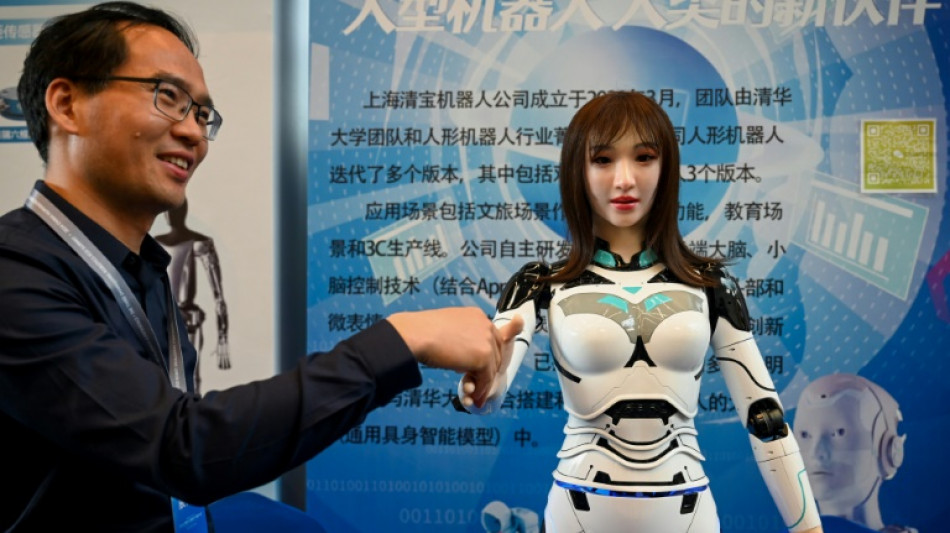
Chinese robot developers hope for road out of 'uncanny valley' / Photo: STR - AFP

 Nigeria miners struggled to breathe in cell before 37 died: survivors

 Warren Buffett steps down as Berkshire Hathaway chairman

 Isolated Syrian-Druze city blames Damascus for shortages

 Kerry James Marshall: American 'blackness' painter celebrated in Europe

 Infantino 'must go', says German FA vice-president

 Japan's busiest rail station tests robot bins

 Backpackers fret over Australian visa crackdown

 Bank of Japan hikes rates to 31-year high to battle inflation

 AI doomsday warnings unlikely to slow IPOs but questions linger

 In Brazil's Amazon, the hunt for oil fuels hopes and fears

 Baby orangutans in India expose 'frightening' scale of trafficking

 Oversight Board blasts 'inadequate' Meta safeguards for AI deepfakes

 Harry makes first public appearance since return to UK

 Princess Diana's brother makes new explosive claims against Charles

 Trump admin overhauls key protection for endangered species

 Mbappe draws political fire over Ceuta t-shirt controversy

 Third malaria death in Germany from outbreak tied to Frankfurt airport

 AtlasClear Holdings Reports Preliminary Fiscal 2026 Revenue of Approximately $20.1 Million, Up 85%; Revenue Plus Interest Income of Approximately $21.9 Million

 'Another arrow to the quiver': World Bank posts record private capital mobilization

 Ireland to boycott Eurovision 2027 over Gaza

 India's Tata Sons reappoints N. Chandrasekaran as chairman

 Germany urges EU action against China to defend carmakers

 Japan eyes changing prostitution law to punish sex buyers

 Modi pitches India as global chipmaking hub

 Ukraine plans record defence spending in 2027

A disembodied woman's head mugged and grimaced, aping the facial expressions of a user on a nearby laptop as visitors to the China Humanoid Robot Developer Conference watched in fascinated unease.
The wide, slightly frantic eyes left no doubt the technology was firmly in "uncanny valley" territory but the field is nonetheless attracting increasing attention in China, both from investors and the government.
Outside the conference meeting rooms on Thursday, around 30 companies displayed bionic hands, flickering faces and bipedal robots that stomped around the room, steadying themselves when demonstrators knocked them off balance.
"I feel the humanoid robot industry is booming... These displays are no longer just concepts. Many of them are already physical and interactive," visitor Jiang Yunfei told AFP.
A crowd gathered at a demonstration for Fourier Intelligence, which has started mass production of its GR-1 bipedal robot in what it says is a world first.
Chinese President Xi Jinping met Fourier's leaders on an inspection tour in Shanghai in December, a sign of the growing importance the central government has assigned to emerging technologies such as robotics.
Fourier's founder told the South China Morning Post that Xi had asked whether it was possible to talk to the bipedal robot and get it to perform basic tasks.
Beijing is not the only interested party.
"These will be widely in use in two or three years," an optimistic investor told AFP, gesticulating at a similar robot manufactured by a different company.
He said he expected them to be mainly used to take care of the elderly, a function some see as vital as China's huge population ages and care options dwindle.
At the disembodied head booth, the team said their ultimate goal was to make impersonal robots such as the GR-1 seem more human.
"We hope that they can enter the household service industry," said Zhu Yongtong, a member of the Shanghai DROID ROBOT team.
Another company's attempt at humanisation was to equip robots with visors that projected video-generated eyes.
"As a parent, you can implant your own digital doppelganger image into this robot to make a presentation, which will allow this robot to have a friendlier human-robot dialogue with your child," Ennio Zhang, marketing and sales director of GravityXR, told AFP.
The mood at this week's conference was optimistic, with sights set firmly on the future.
"I think China's humanoid robots have developed to a very cutting-edge position and can compete with other manufacturers in the world," said a 27-year-old visitor surnamed Wang.
"Now a lot of robots still look 'clumsy', they still look like robots, but once we collect a lot more data... the robot will become more and more humanoid," said Jiang.
A.Leibowitz--CPN