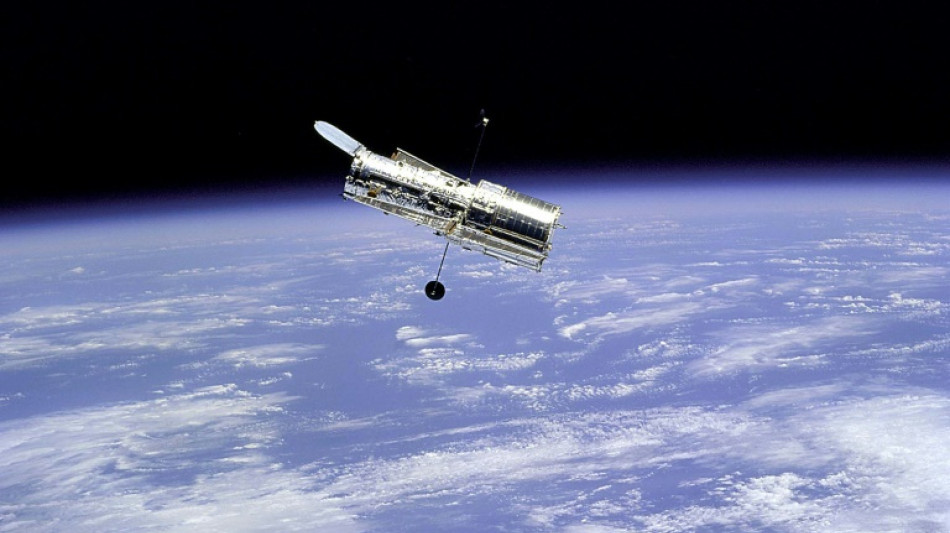
Hubble trouble: Veteran space telescope forced to take it easy / Photo: NASA - NASA/AFP/File

 Cuba hit with seventh major blackout of the year

 Nigeria miners struggled to breathe in cell before 37 died: survivors

 Warren Buffett steps down as Berkshire Hathaway chairman

 Isolated Syrian-Druze city blames Damascus for shortages

 Kerry James Marshall: American 'blackness' painter celebrated in Europe

 Infantino 'must go', says German FA vice-president

 Japan's busiest rail station tests robot bins

 Backpackers fret over Australian visa crackdown

 Bank of Japan hikes rates to 31-year high to battle inflation

 AI doomsday warnings unlikely to slow IPOs but questions linger

 In Brazil's Amazon, the hunt for oil fuels hopes and fears

 Baby orangutans in India expose 'frightening' scale of trafficking

 Oversight Board blasts 'inadequate' Meta safeguards for AI deepfakes

 Harry makes first public appearance since return to UK

 Princess Diana's brother makes new explosive claims against Charles

 Trump admin overhauls key protection for endangered species

 Mbappe draws political fire over Ceuta t-shirt controversy

 Third malaria death in Germany from outbreak tied to Frankfurt airport

 AtlasClear Holdings Reports Preliminary Fiscal 2026 Revenue of Approximately $20.1 Million, Up 85%; Revenue Plus Interest Income of Approximately $21.9 Million

 'Another arrow to the quiver': World Bank posts record private capital mobilization

 Ireland to boycott Eurovision 2027 over Gaza

 India's Tata Sons reappoints N. Chandrasekaran as chairman

 Germany urges EU action against China to defend carmakers

 Japan eyes changing prostitution law to punish sex buyers

 Modi pitches India as global chipmaking hub

The venerable Hubble Space Telescope, which has revolutionized astronomical discovery since its launch in 1990, will ease into retirement with a scaled-back observing schedule, NASA officials said Tuesday.
One of the three gyroscopes that control the direction in which the telescope points has become unstable in recent months, leading to intermittent "safe mode" episodes -- most recently on May 24.
"After completing a series of tests and carefully considering our options, we have made the decision that we will transition Hubble to operate using only one of its three remaining gyros," said NASA's Mark Clampin, director of the astrophysics division.
The other gyro will be kept powered up in reserve for potential future use.
The transition, which should be completed by mid-June, will reduce Hubble's efficiency at carrying out science observations by 12 percent, dropping from 85 orbits a week to 74, said Patrick Crouse, project manager for the Hubble Space Telescope mission.
Over the course of a year, it will still be able to view the full night sky. It will no longer be able to track objects that are closer than Mars -- though such targets were rare anyway, added Crouse.
NASA calculates there is a greater than 70 percent chance of operating with this configuration through 2035. At the end of the telescope's life, the US space agency plans to safely de-orbit or otherwise dispose of the popular science instrument.
"We do not see Hubble as being on its last legs, we do think it's a very capable observatory, (poised) to do exciting science with other observatories in orbit and those that will join us in orbit," said Crouse.
- Most distant star -
Named for astronomer Edwin Hubble, the telescope was launched in 1990 and operates about 320 miles (515 kilometers) above Earth.
Between 1993 and 2009 astronauts visited Hubble five times on repair missions.
NASA and SpaceX previously said they were studying a possible mission that would re-boost Hubble's orbit, which gradually decays over time due to Earth's gravitational pull, and part of that review also considered ways to mitigate against the loss of gyros.
But Clampin said ideas of adding extra gyros to the outside of the telescope were "just notional concepts -- we never even got to the point of actually looking at what that would look like, and how we would do that."
Arguably among the most valuable instruments in scientific history, Hubble continues to make important discoveries, including in 2022 when it detected the farthest individual star ever seen -- Earendel, whose light took 12.9 billion years to reach us.
Clampin said despite its diminished capacity, Hubble keeps performing a "breadth of great science," from investigating objects in our solar system to studying early galaxies to collaborating with the newer James Webb Space Telescope to probe the atmospheres of exoplanets.
While Webb, now the premier space telescope, excels in infrared detection, Hubble's primary focus on visible light provides a complementary capability, enhancing their combined scientific impact.
Ch.Lefebvre--CPN