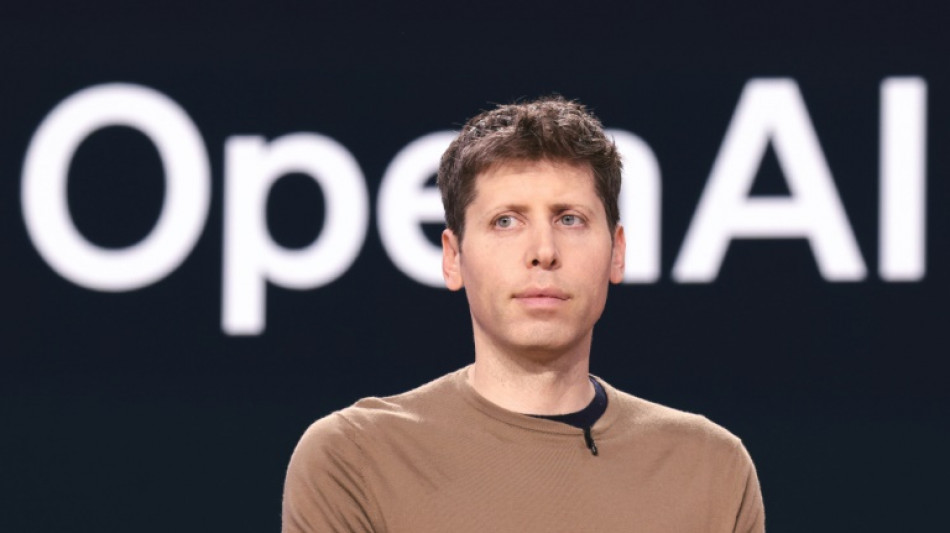
OpenAI insiders blast lack of AI transparency / Photo: Jason Redmond - AFP/File

 Cuba hit with seventh major blackout of the year

 Nigeria miners struggled to breathe in cell before 37 died: survivors

 Warren Buffett steps down as Berkshire Hathaway chairman

 Isolated Syrian-Druze city blames Damascus for shortages

 Kerry James Marshall: American 'blackness' painter celebrated in Europe

 Infantino 'must go', says German FA vice-president

 Japan's busiest rail station tests robot bins

 Backpackers fret over Australian visa crackdown

 Bank of Japan hikes rates to 31-year high to battle inflation

 AI doomsday warnings unlikely to slow IPOs but questions linger

 In Brazil's Amazon, the hunt for oil fuels hopes and fears

 Baby orangutans in India expose 'frightening' scale of trafficking

 Oversight Board blasts 'inadequate' Meta safeguards for AI deepfakes

 Harry makes first public appearance since return to UK

 Princess Diana's brother makes new explosive claims against Charles

 Trump admin overhauls key protection for endangered species

 Mbappe draws political fire over Ceuta t-shirt controversy

 Third malaria death in Germany from outbreak tied to Frankfurt airport

 AtlasClear Holdings Reports Preliminary Fiscal 2026 Revenue of Approximately $20.1 Million, Up 85%; Revenue Plus Interest Income of Approximately $21.9 Million

 'Another arrow to the quiver': World Bank posts record private capital mobilization

 Ireland to boycott Eurovision 2027 over Gaza

 India's Tata Sons reappoints N. Chandrasekaran as chairman

 Germany urges EU action against China to defend carmakers

 Japan eyes changing prostitution law to punish sex buyers

 Modi pitches India as global chipmaking hub

A group of current and former employees from OpenAI on Tuesday issued an open letter warning that the world's leading artificial intelligence companies were falling short of necessary transparency and accountability to meet the potential risks posed by the technology.
The letter raised serious concerns about AI safety risks "ranging from the further entrenchment of existing inequalities, to manipulation and misinformation, to the loss of control of autonomous AI systems potentially resulting in human extinction."
The 16 signatories, which also included a staff member from Google DeepMind, warned that AI companies "have strong financial incentives to avoid effective oversight" and that self-regulation by the companies would not effectively change this.
"AI companies possess substantial non-public information about the capabilities and limitations of their systems, the adequacy of their protective measures, and the risk levels of different kinds of harm," the letter said.
"However, they currently have only weak obligations to share some of this information with governments, and none with civil society. We do not think they can all be relied upon to share it voluntarily."
That reality, the letter added, meant that employees inside the companies were the only ones who could notify the public, and the signatories called for broader whistleblower laws to protect them.
"Broad confidentiality agreements block us from voicing our concerns, except to the very companies that may be failing to address these issues," the letter said.
The four current employees of OpenAI signed the letter anonymously because they feared retaliation from the company, The New York Times reported.
It was also signed by Yoshua Bengio, Geoffrey Hinton and Stuart Russell, who are often described as AI "godfathers" and have criticized the lack of preparation for AI's dangers.
OpenAI in a statement pushed back at the criticism.
"We’re proud of our track record of providing the most capable and safest AI systems and believe in our scientific approach to addressing risk," a statement said.
"We agree that rigorous debate is crucial given the significance of this technology and we'll continue to engage with governments, civil society and other communities around the world."
OpenAI also said it had "avenues for employees to express their concerns including an anonymous integrity hotline" and a newly formed Safety and Security Committee led by members of the board and executives, including CEO Sam Altman.
The criticism of OpenAI, which was first released to the Times, comes as questions are growing around Altman's leadership of the company.
OpenAI has unveiled a wave of new products, though the company insists they will only get released to the public after thorough testing.
An unveiling of a human-like chatbot caused a controversy when Hollywood star Scarlett Johansson complained that it closely resembled her voice.
She had previously turned down an offer from Altman to work with the company.
St.Ch.Baker--CPN