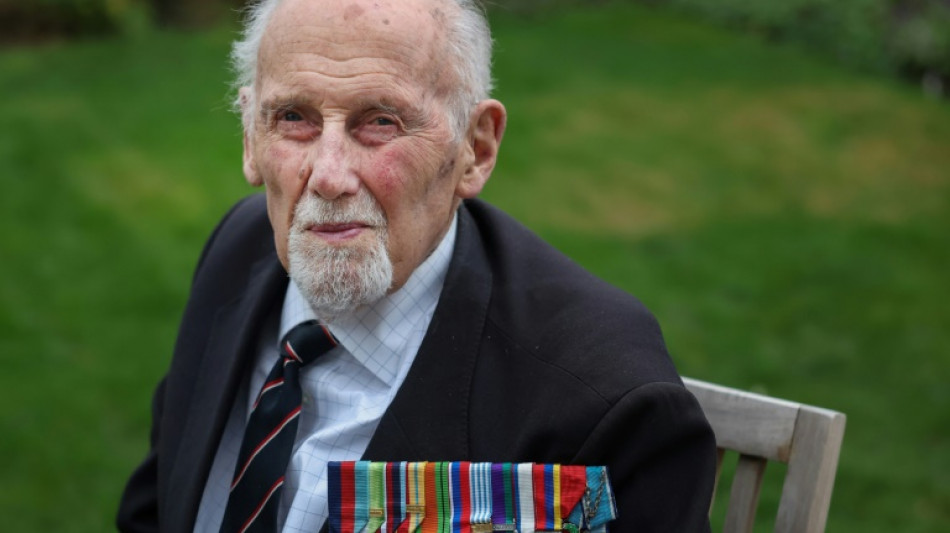
'This is what we've been fighting for.' British veteran remembers D-Day / Photo: Daniel LEAL - AFP

 Cuba hit with seventh major blackout of the year

 Nigeria miners struggled to breathe in cell before 37 died: survivors

 Warren Buffett steps down as Berkshire Hathaway chairman

 Isolated Syrian-Druze city blames Damascus for shortages

 Kerry James Marshall: American 'blackness' painter celebrated in Europe

 Infantino 'must go', says German FA vice-president

 Japan's busiest rail station tests robot bins

 Backpackers fret over Australian visa crackdown

 Bank of Japan hikes rates to 31-year high to battle inflation

 AI doomsday warnings unlikely to slow IPOs but questions linger

 In Brazil's Amazon, the hunt for oil fuels hopes and fears

 Baby orangutans in India expose 'frightening' scale of trafficking

 Oversight Board blasts 'inadequate' Meta safeguards for AI deepfakes

 Harry makes first public appearance since return to UK

 Princess Diana's brother makes new explosive claims against Charles

 Trump admin overhauls key protection for endangered species

 Mbappe draws political fire over Ceuta t-shirt controversy

 Third malaria death in Germany from outbreak tied to Frankfurt airport

 AtlasClear Holdings Reports Preliminary Fiscal 2026 Revenue of Approximately $20.1 Million, Up 85%; Revenue Plus Interest Income of Approximately $21.9 Million

 'Another arrow to the quiver': World Bank posts record private capital mobilization

 Ireland to boycott Eurovision 2027 over Gaza

 India's Tata Sons reappoints N. Chandrasekaran as chairman

 Germany urges EU action against China to defend carmakers

 Japan eyes changing prostitution law to punish sex buyers

 Modi pitches India as global chipmaking hub

John Roberts was a 20-year-old British Royal Navy officer during the D-Day landings 80 years ago and remembers making light of the daring mission at the time.
The former sub-lieutenant was aboard the destroyer HMS Serapis during the Allied invasion of France on June 6, 1944, protecting minesweepers during the crossing of the Channel.
"I have a letter now that I wrote to my mother at that time and I said, 'It's all good fun'," Roberts, now aged 100 and one of Britain's few remaining D-Day veterans, told AFP.
"I had just had my 20th birthday and at that age, one was oblivious to the dangers. And one wouldn't have missed being in this for the rest of one's life."
Roberts' vessel provided cover for around 25 minesweepers tasked with clearing explosive devices from the Channel.
"The minesweepers only go at six or seven knots, very slow, so we were going very slowly with them," he recalled.
"And then we got to about eight miles from the coast at about 6:00 am. And it was just beginning to get light then and in the distance I could see France.
"I thought, 'This is what we've been fighting for. It was Poland to begin with and then France. And there it is'."
Hundreds of Allied aircraft, including around 500 US Boeing B-17 Flying Fortresses, turned the sky dark as they flew along Sword Beach on the Normandy coast, where British troops landed.
Then they "let loose their bombs, so the whole beach became a mass of flames", said Roberts.
"At 7:00 am we started bombarding the coast. And at 7:35 am, I think, that was the hour when the first soldiers stepped ashore," he added.
- Ghastly -
Arriving at the beach was a relief for many soldiers, despite the dangers ahead, due to the rough waters that had left many seasick.
Roberts, who joined the Royal Navy at the age of 13 and served until 1978, remained on board HMS Serapis but still had some close scrapes.
"We had one or two times when shells landed near us. If we were a bit careless and went too close to the coast, a German gun would open up," he said.
"But the moment we saw a German gun opening up, we fired back and they soon stopped."
Roberts, who turned 100 in April, drew parallels with the German soldiers' loyalty to Adolf Hitler and the current war between Russia and Ukraine.
"It was pretty grim. The Germans didn't give in easily," he said.
"It reminds me of (Russian President Vladimir) Putin, which is not a good thing to do. Like Russians have allegiance to Putin, the Germans all had allegiance to Hitler."
The ongoing war in Eastern Europe, along with other major conflicts, were "very sad," he added.
"At the end of World War I as well as World War II, everybody said, 'Well thank God that's over.' They'd both been so ghastly that we thought we'd never have another one."
S.F.Lacroix--CPN