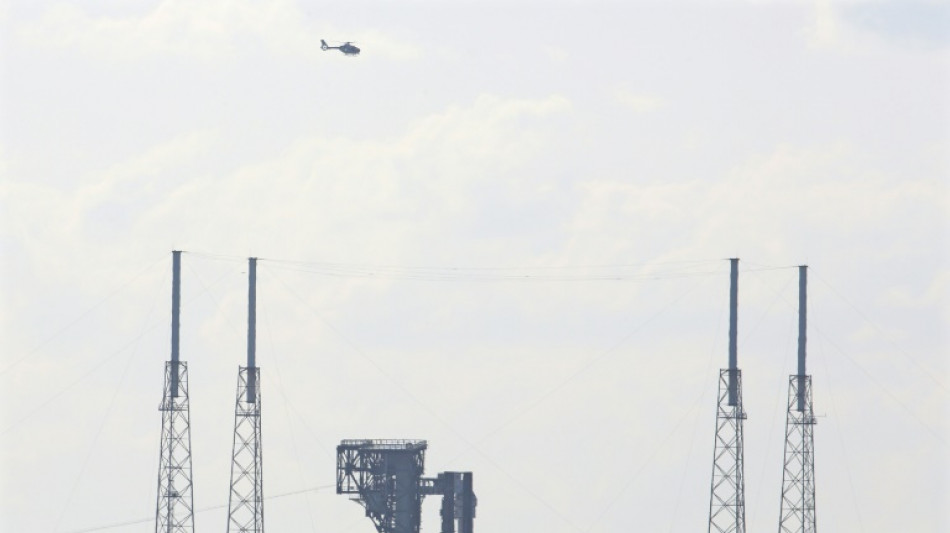
Boeing Starliner launch scrubbed in final minutes of countdown / Photo: Gregg Newton - AFP

 Cuba hit with seventh major blackout of the year

 Nigeria miners struggled to breathe in cell before 37 died: survivors

 Warren Buffett steps down as Berkshire Hathaway chairman

 Isolated Syrian-Druze city blames Damascus for shortages

 Kerry James Marshall: American 'blackness' painter celebrated in Europe

 Infantino 'must go', says German FA vice-president

 Japan's busiest rail station tests robot bins

 Backpackers fret over Australian visa crackdown

 Bank of Japan hikes rates to 31-year high to battle inflation

 AI doomsday warnings unlikely to slow IPOs but questions linger

 In Brazil's Amazon, the hunt for oil fuels hopes and fears

 Baby orangutans in India expose 'frightening' scale of trafficking

 Oversight Board blasts 'inadequate' Meta safeguards for AI deepfakes

 Harry makes first public appearance since return to UK

 Princess Diana's brother makes new explosive claims against Charles

 Trump admin overhauls key protection for endangered species

 Mbappe draws political fire over Ceuta t-shirt controversy

 Third malaria death in Germany from outbreak tied to Frankfurt airport

 AtlasClear Holdings Reports Preliminary Fiscal 2026 Revenue of Approximately $20.1 Million, Up 85%; Revenue Plus Interest Income of Approximately $21.9 Million

 'Another arrow to the quiver': World Bank posts record private capital mobilization

 Ireland to boycott Eurovision 2027 over Gaza

 India's Tata Sons reappoints N. Chandrasekaran as chairman

 Germany urges EU action against China to defend carmakers

 Japan eyes changing prostitution law to punish sex buyers

 Modi pitches India as global chipmaking hub

The first crewed flight of Boeing's Starliner spaceship was dramatically called off Saturday with just under four minutes left on the launch countdown clock, for reasons that aren't yet clear.
It was the second time the test mission to the International Space Station was scrubbed with the astronauts strapped in and ready to lift off, and yet another setback for the troubled program, which has already faced years of delays and safety scares.
Astronauts Butch Wilmore and Suni Williams are waiting to be safely removed from the capsule. Mission commander Wilmore had earlier given a short but rousing speech telling tens of thousands of people tuning into the live feed that "It's a great day to be proud of your nation."
The former US Navy test pilots, who each have two spaceflights under their belts, were previously called back to quarantine after an aborted launch attempt on May 6 due to a faulty valve on the United Launch Alliance Atlas V rocket.
A backup date is available for Sunday, but it's not yet known whether the Starship will be ready to launch.
Starliner is poised to become just the sixth type of US-built spaceship to fly NASA astronauts, following the Mercury, Gemini and Apollo programs in the 1960s and 1970s, the Space Shuttle from 1981 to 2011, and SpaceX's Crew Dragon from 2020.
- Vital test -
NASA is looking to certify Boeing as a second commercial operator to ferry crews to the ISS -- something Elon Musk's SpaceX has already been doing for the US space agency for four years.
Both companies received multibillion-dollar contracts in 2014 to develop their gumdrop-shaped, autonomously piloted crew capsules, following the end of the Space Shuttle program in 2011 that left the US temporarily reliant on Russian rockets for rides.
Boeing, with its 100-year history, was heavily favored over its then-upstart competitor, but its program fell badly behind amid embarrassing setbacks that mirrored the myriad problems afflicting its commercial airline division.
These ranged from a software bug that put the spaceship on a bad trajectory on its first uncrewed test, to the discovery that the cabin was filled with flammable electrical tape after the second.
While teams were working to replace the faulty valve that postponed the previous launch attempt, a small helium leak located in one of the spacecraft's thrusters came to light.
But rather than replace the seal, which would require taking Starliner apart in its factory, NASA and Boeing officials declared it safe enough to fly as is.
- Manual flying -
Earlier Saturday, Wilmore and Williams emerged from the historic Neil A. Armstrong Operations and Checkout Building, exchanging thumbs-up signs and waves with their families before boarding a van that took them to their launch pad.
When they do fly, they will be tasked with putting Starliner through the wringer, including taking manual control of the spacecraft.
Starliner is set to dock with the ISS for eight days as the crew carry out tests, including simulating whether the ship can be used as a safe haven in the event there is a problem on the orbital outpost.
After undocking, it will re-enter the atmosphere and carry out a parachute and airbag-assisted landing in the western United States.
A successful mission would offer Boeing a much-needed reprieve from the intense safety concerns surrounding its 737 MAX passenger jets.
It's also important for more immediate reasons: the Urine Processor Assembly on the ISS, which recycles water from astronauts' urine, suffered a failure this week and its pump needs to be replaced, Dana Weigel, NASA's ISS program manager, told reporters.
This mission is thus tasked with carrying spare equipment, which weighs around 150 pounds (70 kilograms). To make way for it, two astronauts' suitcases containing clothes and toiletries had to be pulled off, meaning they'll need to rely on backup supplies kept on the station.
C.Smith--CPN