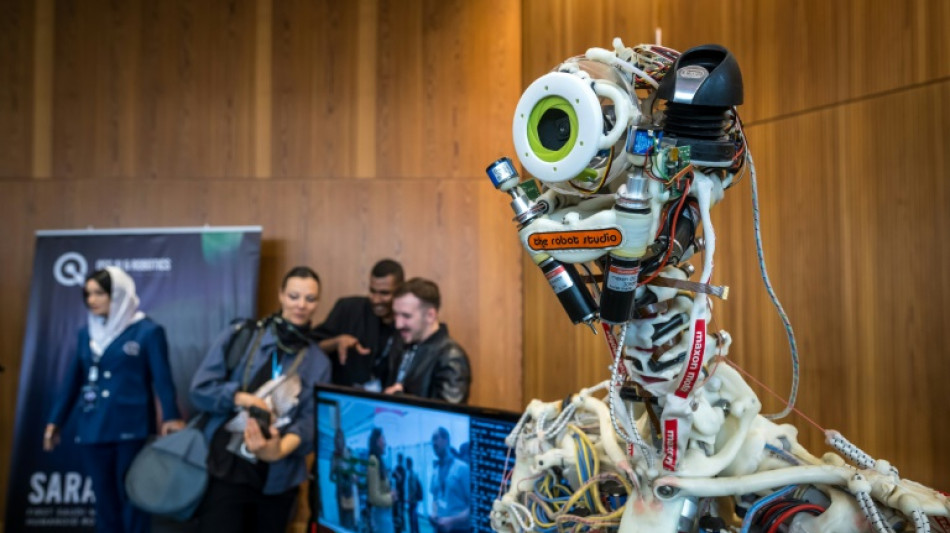
Humanity in 'race against time' on AI: UN / Photo: Fabrice COFFRINI - AFP

 Cuba hit with seventh major blackout of the year

 Nigeria miners struggled to breathe in cell before 37 died: survivors

 Warren Buffett steps down as Berkshire Hathaway chairman

 Isolated Syrian-Druze city blames Damascus for shortages

 Kerry James Marshall: American 'blackness' painter celebrated in Europe

 Infantino 'must go', says German FA vice-president

 Japan's busiest rail station tests robot bins

 Backpackers fret over Australian visa crackdown

 Bank of Japan hikes rates to 31-year high to battle inflation

 AI doomsday warnings unlikely to slow IPOs but questions linger

 In Brazil's Amazon, the hunt for oil fuels hopes and fears

 Baby orangutans in India expose 'frightening' scale of trafficking

 Oversight Board blasts 'inadequate' Meta safeguards for AI deepfakes

 Harry makes first public appearance since return to UK

 Princess Diana's brother makes new explosive claims against Charles

 Trump admin overhauls key protection for endangered species

 Mbappe draws political fire over Ceuta t-shirt controversy

 Third malaria death in Germany from outbreak tied to Frankfurt airport

 AtlasClear Holdings Reports Preliminary Fiscal 2026 Revenue of Approximately $20.1 Million, Up 85%; Revenue Plus Interest Income of Approximately $21.9 Million

 'Another arrow to the quiver': World Bank posts record private capital mobilization

 Ireland to boycott Eurovision 2027 over Gaza

 India's Tata Sons reappoints N. Chandrasekaran as chairman

 Germany urges EU action against China to defend carmakers

 Japan eyes changing prostitution law to punish sex buyers

 Modi pitches India as global chipmaking hub

Humanity is in a race against time to harness the colossal emerging power of artificial intelligence for the good of all, while averting dire risks, a top UN official said Thursday.
"We've let the genie out of the bottle," said Doreen Bogdan-Martin, head of the United Nations' International Telecommunications Union (ITU).
"We are in a race against time," she told the opening of a two-day AI for Good Global Summit in Geneva.
"Recent developments in AI have been nothing short of extraordinary."
The thousands gathered at the conference heard how advances in generative AI are already speeding up efforts to solve some of the world's most pressing problems, such as climate change, hunger and social care.
"I believe we have a once-in-a-generation opportunity to guide AI to benefit all the world's people," Bogdan-Martin told AFP ahead of the summit.
But she lamented Thursday that one-third of humanity still remains completely offline, and is "excluded from the AI revolution without a voice".
"This digital and technological divide is no longer acceptable."
Bogdan-Martin highlighted that AI holds "immense potential for both good and bad", stressing that it was vital to "make AI systems safe".
- Concentrated power -
She said that was especially important given that "2024 is the biggest election year in history", with votes in dozens of countries, including in the United States.
She flagged the "rise of sophisticated deep fakes disinformation campaigns" and warned that the "misuse of AI threaten democracy (and) also endangers young people's mental health and compromises cyber-security."
Other experts at Thursday's conference agreed.
"We have to understand what we're steering towards," said Tristan Harris, a technology ethicist who co-founded the Center for Humane Technology.
He pointed to lessons from social media -- initially touted as a way to connect people and give everyone a voice, but which also brought addiction, viral misinformation, online harassment and ballooning mental health issues.
Harris warned the incentive driving the companies rolling out the technology risked dramatically swelling such negative impacts.
"The number one thing that is driving Open AI or Google behaviour is the race to actually achieve market dominance," he said.
In such a world, he said, "governance that moves at the speed of technology" is vital.
- Changing the social contract -
OpenAI chief Sam Altman, who rose to global prominence after OpenAI released ChatGPT in 2022, acknowledged the dangers.
Speaking via video-link, he told the gathering that "cyber-security" was currently the biggest concern when it came to negative impacts of the technology.
Further down the road, he said there would likely "be some change required to the social contract, given how powerful we expect this technology to be".
"I'm not a believer that there won't be any jobs... but I do think the whole structure of society itself will be (open to) some degree of debate and reconfiguration."
Overall though, he insisted that from the perspective of how new technologies evolve historically, the AI systems were "generally considered safe and robust".
While welcoming discussions around regulations to stem short-term negative impacts of AI, he warned that it was "difficult" to suggest regulations aimed at reining in future impacts.
"We don't know how society and this technology are going to co-evolve," he said.
Bogdan-Martin meanwhile hailed that governments and others had recently "raced to establish protections" and regulation around the use of AI.
On Wednesday the European Union announced the creation of an AI Office to regulate artificial intelligence under a sweeping new law.
"It's our responsibility to write the next chapter in the great story of humanity, and technology, and to make it safe, to make it inclusive and to make it sustainable," Bogdan-Martin said.
Y.Uduike--CPN