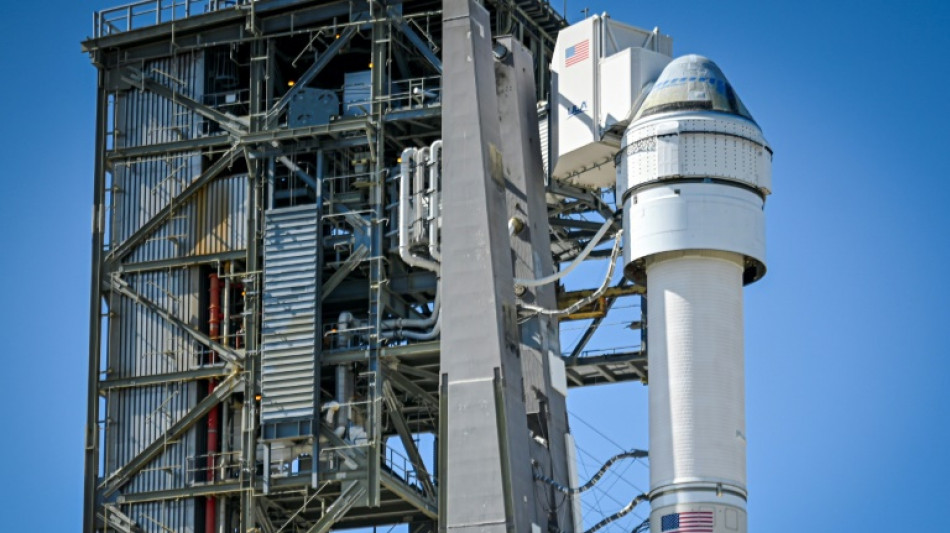
Boeing won't fix leaky Starliner before flying first crew to ISS / Photo: Miguel J. Rodriguez Carrillo - AFP/File

 Cuba hit with seventh major blackout of the year
 Nigeria miners struggled to breathe in cell before 37 died: survivors

 Warren Buffett steps down as Berkshire Hathaway chairman

 Isolated Syrian-Druze city blames Damascus for shortages

 Kerry James Marshall: American 'blackness' painter celebrated in Europe

 Infantino 'must go', says German FA vice-president

 Japan's busiest rail station tests robot bins

 Backpackers fret over Australian visa crackdown

 Bank of Japan hikes rates to 31-year high to battle inflation

 AI doomsday warnings unlikely to slow IPOs but questions linger

 In Brazil's Amazon, the hunt for oil fuels hopes and fears

 Baby orangutans in India expose 'frightening' scale of trafficking

 Oversight Board blasts 'inadequate' Meta safeguards for AI deepfakes

 Harry makes first public appearance since return to UK

 Princess Diana's brother makes new explosive claims against Charles

 Trump admin overhauls key protection for endangered species

 Mbappe draws political fire over Ceuta t-shirt controversy

 Third malaria death in Germany from outbreak tied to Frankfurt airport

 AtlasClear Holdings Reports Preliminary Fiscal 2026 Revenue of Approximately $20.1 Million, Up 85%; Revenue Plus Interest Income of Approximately $21.9 Million

 'Another arrow to the quiver': World Bank posts record private capital mobilization

 Ireland to boycott Eurovision 2027 over Gaza

 India's Tata Sons reappoints N. Chandrasekaran as chairman

 Germany urges EU action against China to defend carmakers

 Japan eyes changing prostitution law to punish sex buyers

 Modi pitches India as global chipmaking hub

Boeing is set to launch its first crewed space mission in June without fixing a small helium gas leak on its troubled Starliner spaceship, officials said Friday.
The vessel, under development since 2010, has been plagued by technical problems and has yet to fulfill its purpose of ferrying astronauts to the International Space Station, allowing Boeing's rival SpaceX to zoom ahead with its Crew Dragon capsule.
Starliner was supposed to finally fly astronauts Butch Wilmore and Suni Williams to the orbital outpost on May 6, but the mission was scrubbed hours before lift-off after a faulty valve was discovered on the United Launch Alliance rocket carrying it.
Since then, additional issues came to light, including a helium leak in the spacecraft's service module, which houses the propulsion system.
But while the rocket valve has been replaced, Boeing and NASA have made the decision to fly to the ISS without replacing a shirt button-sized seal on a leaking joint, officials told reporters.
"We can handle this particular leak if that leak rate were to grow even up to 100 times," said Steve Stich, manager of NASA's Commercial Crew Program. Moreover, it impacts just one of a set of 28 thrusters used to control the spaceship's attitude, he added.
Instead, teams will monitor the leak during the hours before launch, scheduled for June 1 at 12:25 pm (1625 GMT) from Cape Canaveral Space Force Station in Florida.
Asked why Boeing wouldn't just replace the seal, Mark Nappi, the company's vice president for the commercial crew program, said the process would be "quite involved" and require taking apart Starliner at its factory.
Stich added that it wasn't unheard of to fly with leaks -- space shuttles encountered similar problems at times, "and we've had a couple of cases with Dragon where we've had a few small leaks as well," he added.
The much-delayed mission comes at a challenging time for Boeing, as a safety crisis engulfs the century-old aerospace titan's commercial aviation arm.
NASA is banking on Starliner's success in order to achieve its goal of certifying a second commercial vehicle to carry crews to the ISS, which it has sought since the last space shuttle flew in 2011.
A successful mission would help dispel the bitter taste left by numerous setbacks in the Starliner program.
In 2019, during a first uncrewed test flight, a software defect meant the capsule failed to rendezvous with the ISS. A second software bug could have caused a catastrophic collision between its modules, but was caught and fixed just in time.
Then in 2021, with the rocket on the launchpad for a new flight, blocked valves forced another postponement.
The vessel finally reached the ISS in May 2022 in a non-crewed launch. But other problems including weak parachutes and flammable tape in the cabin that needed to be removed caused further delays to the crewed test.
Ch.Lefebvre--CPN