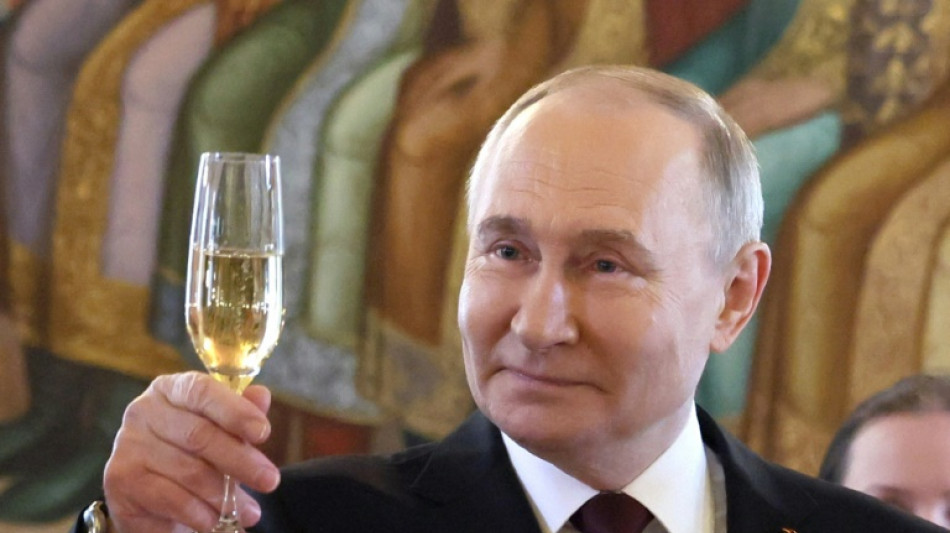
AI deepfake Putin film sells big at Cannes / Photo: Mikhail METZEL - POOL/AFP

 Cuba hit with seventh major blackout of the year

 Nigeria miners struggled to breathe in cell before 37 died: survivors

 Warren Buffett steps down as Berkshire Hathaway chairman

 Isolated Syrian-Druze city blames Damascus for shortages

 Kerry James Marshall: American 'blackness' painter celebrated in Europe

 Infantino 'must go', says German FA vice-president

 Japan's busiest rail station tests robot bins

 Backpackers fret over Australian visa crackdown

 Bank of Japan hikes rates to 31-year high to battle inflation

 AI doomsday warnings unlikely to slow IPOs but questions linger

 In Brazil's Amazon, the hunt for oil fuels hopes and fears

 Baby orangutans in India expose 'frightening' scale of trafficking

 Oversight Board blasts 'inadequate' Meta safeguards for AI deepfakes

 Harry makes first public appearance since return to UK

 Princess Diana's brother makes new explosive claims against Charles

 Trump admin overhauls key protection for endangered species

 Mbappe draws political fire over Ceuta t-shirt controversy

 Third malaria death in Germany from outbreak tied to Frankfurt airport

 AtlasClear Holdings Reports Preliminary Fiscal 2026 Revenue of Approximately $20.1 Million, Up 85%; Revenue Plus Interest Income of Approximately $21.9 Million

 'Another arrow to the quiver': World Bank posts record private capital mobilization

 Ireland to boycott Eurovision 2027 over Gaza

 India's Tata Sons reappoints N. Chandrasekaran as chairman

 Germany urges EU action against China to defend carmakers

 Japan eyes changing prostitution law to punish sex buyers

 Modi pitches India as global chipmaking hub

When Russian President Vladimir Putin was unavailable to star in his biopic, Polish director Patryk Vega turned to artificial intelligence.
The groundbreaking film, whose trailer starts with the leader cowering on a floor in diapers, uses a deepfake of the ruler's face transplanted onto the body of a real actor.
"To come extremely close to the dictator, we needed Putin, not an actor with make-up," Vega told AFP at the Cannes Film Festival, where he has been shopping the film to buyers.
"I called Putin and asked him if he wanted to play in my movie... No, that was a joke."
Vega -- a 47-year-old director, who has made several hit Polish films -- used AI to generate just the face, since he lacked enough high-resolution images for a full-body deepfake.
The results are uncanny.
The producers of the film, called simply "Putin", say it has already been sold in 50 countries ahead of its premiere in September.
The film follows the ruler's life over six decades from the age of 10 when he is seen being beaten by his stepfather.
"In the end I show his death. A happy end," said Vega.
The initial idea came to Vega during the first days of Russia's 2022 invasion of neighbouring Ukraine.
"First I wanted to do a movie about the Russian mafia. Then I decided to do it about the biggest gangster," he said.
He shrugged off any concerns about reprisals.
"Putin should be afraid of me," he said.
- Tech fears -
Having developed the tech, he wants to share it with others, saying directors can send him footage and he can add crowds, actors and many other elements.
Such ideas are a huge source of concern in Hollywood, where AI threatens to wipe out many jobs, particularly among special effects technicians and extras.
It was a key issue of the months-long strike by actors and writers last year, ending in a hard-fought deal with studios that included promises to pay actors if their AI-generated likenesses are used.
However, many studios already use AI extensively -- for instance, to de-age actors like Harrison Ford in the last "Indiana Jones" -- but are afraid to speak openly about it, according to The Hollywood Reporter.
Some uses are harder to vilify.
The Geena Davis Institute on Gender in Media developed an algorithm to scan screenplays for bias, including how often female characters speak and how many LGBTQ characters are included.
YouTube, a key partner for the film industry in promotion and distribution, has been using AI for a decade for things like automated subtitles and copyright protections, and is rapidly expanding the AI tools available to budding filmmakers.
Since April, it has been labelling AI-generated content and is ramping up its detection programmes.
"AI isn't going to take over creation," said YouTube France head Justine Ryst. "It's going to simplify the complex, and make possible the impossible.
"We need to want to be bold and disruptive, but also responsible," she added.
M.Anderson--CPN