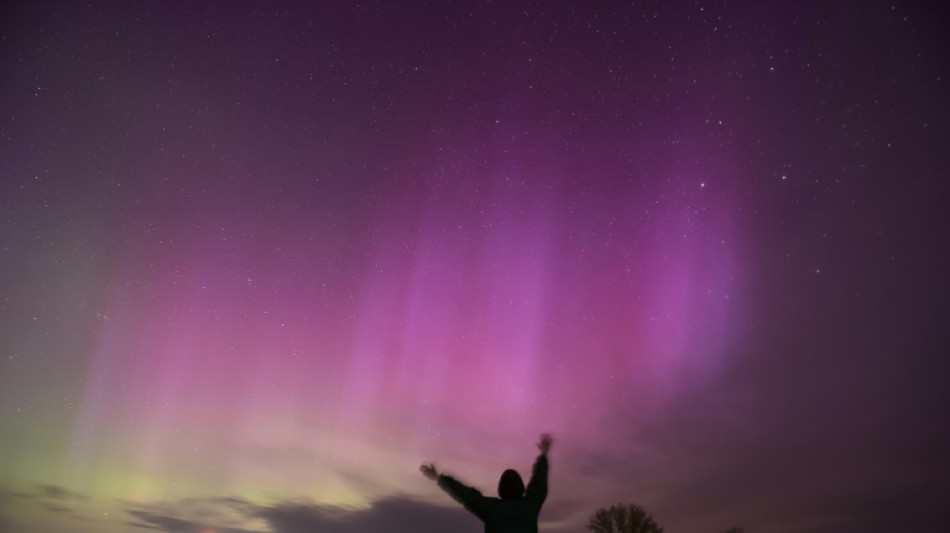
Third time could prove lucky for aurora viewers around the world / Photo: Vladimir NIKOLAYEV - AFP

 Cuba hit with seventh major blackout of the year

 Nigeria miners struggled to breathe in cell before 37 died: survivors

 Warren Buffett steps down as Berkshire Hathaway chairman

 Isolated Syrian-Druze city blames Damascus for shortages

 Kerry James Marshall: American 'blackness' painter celebrated in Europe

 Infantino 'must go', says German FA vice-president

 Japan's busiest rail station tests robot bins

 Backpackers fret over Australian visa crackdown

 Bank of Japan hikes rates to 31-year high to battle inflation

 AI doomsday warnings unlikely to slow IPOs but questions linger

 In Brazil's Amazon, the hunt for oil fuels hopes and fears

 Baby orangutans in India expose 'frightening' scale of trafficking

 Oversight Board blasts 'inadequate' Meta safeguards for AI deepfakes

 Harry makes first public appearance since return to UK

 Princess Diana's brother makes new explosive claims against Charles

 Trump admin overhauls key protection for endangered species

 Mbappe draws political fire over Ceuta t-shirt controversy

 Third malaria death in Germany from outbreak tied to Frankfurt airport

 AtlasClear Holdings Reports Preliminary Fiscal 2026 Revenue of Approximately $20.1 Million, Up 85%; Revenue Plus Interest Income of Approximately $21.9 Million

 'Another arrow to the quiver': World Bank posts record private capital mobilization

 Ireland to boycott Eurovision 2027 over Gaza

 India's Tata Sons reappoints N. Chandrasekaran as chairman

 Germany urges EU action against China to defend carmakers

 Japan eyes changing prostitution law to punish sex buyers

 Modi pitches India as global chipmaking hub

Anyone who missed the dazzling auroras dancing across night skies earlier this weekend will get another chance Sunday evening, as the powerful geomagnetic storm hitting the Earth is expected to intensify yet again.
"Several intense Coronal Mass Ejections are still anticipated to reach the Earth's outer atmosphere by later today," the US National Weather Service said.
Those ejections -- expulsions of plasma and magnetic fields from the Sun, known as CMEs -- have since Friday produced spectacular celestial shows across swaths of the Earth, far from the extreme latitudes where the auroras are normally seen.
But while many viewers have been disappointed -- at times because of overcast skies -- the latest prediction suggests their third time might just prove lucky.
The latest CMEs are expected to reach Earth late Sunday or early Monday, "causing severe or extreme geomagnetic storms once again and (offering) a very good chance to see magnificent aurorae much further south than normal," said Keith Ryden, who heads the Surrey Space Centre in England.
Or as one self-described "lighthunter" suggested on social media platform X, "Keep those pants on, coffee thermoses filled to the brim and fingers crossed!"
But scientists said the intensity of anything seen Sunday night might not reach the level of Friday's show.
"This is likely the last of the Earth-directed CMEs from this particular monster sunspot," Mathew Owens, a professor of space physics at the University of Reading, in England, told AFP.
Still, overall, he added, "the intensity of it has taken all of us by surprise."
The first of several CMEs came just after 1600 GMT Friday, according to the US-based National Oceanic and Atmospheric Administration (NOAA)'s Space Weather Prediction Center (SWPC).
It was later upgraded to an "extreme" geomagnetic storm -- the first since the "Halloween Storms" of October 2003 that caused blackouts in Sweden and damaged power infrastructure in South Africa.
Late Saturday evening, pictures again trickled onto social media as people in the United States reported sightings, though not as strong as Friday night's.
- 'You'd be amazed' -
Friday's storm was listed as hitting level five geomagnetic conditions -- the highest on the scale. Saturday saw G3 to G5 conditions, with G4 or higher conditions predicted Sunday and G3 conditions possible into Monday.
No major disruptions to power or communications networks appear to have been reported this time around.
But China's National Center for Space Weather issued a "red alert" Saturday, warning that communications and navigation could be affected in much of the country, state news agency Xinhua reported.
Excitement over the phenomenon -- and otherworldly photos of pink, green and purple night skies -- popped up across the world, from Mont Saint-Michel on the French coast to Australia's island state of Tasmania.
Unlike solar flares, which travel at the speed of light and reach Earth in around eight minutes, CMEs travel at a more sedate pace, with officials putting the current average at 800 kilometers (500 miles) per second.
People with eclipse glasses can look for the sunspot cluster during the day.
NOAA's Brent Gordon encouraged the public to try to capture the night sky with phone cameras even if they couldn't see auroras with their naked eyes.
"You'd be amazed at what you see in that picture," he said.
- Confused pigeons -
Fluctuating magnetic fields associated with geomagnetic storms induce currents in long wires, including power lines, which can lead to blackouts. Long pipelines can also become electrified.
Spacecraft are at risk from high doses of radiation, although the atmosphere prevents this from reaching Earth.
NASA can ask astronauts on the International Space Station to move to better-shielded places within the outpost.
O.Hansen--CPN