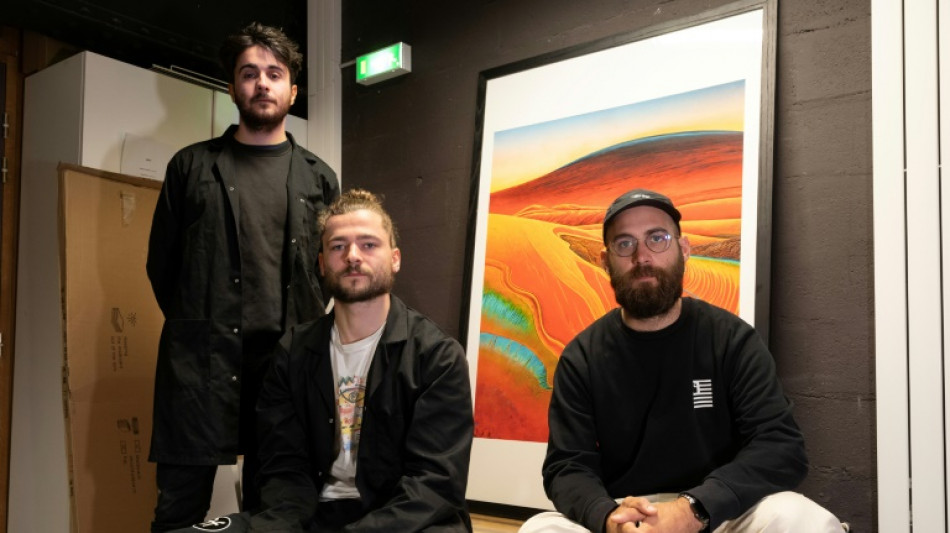
French art group uses brainwaves and AI to recreate landscapes / Photo: Thomas SAMSON - AFP

 Cuba hit with seventh major blackout of the year

 Nigeria miners struggled to breathe in cell before 37 died: survivors

 Warren Buffett steps down as Berkshire Hathaway chairman

 Isolated Syrian-Druze city blames Damascus for shortages

 Kerry James Marshall: American 'blackness' painter celebrated in Europe

 Infantino 'must go', says German FA vice-president

 Japan's busiest rail station tests robot bins

 Backpackers fret over Australian visa crackdown

 Bank of Japan hikes rates to 31-year high to battle inflation

 AI doomsday warnings unlikely to slow IPOs but questions linger

 In Brazil's Amazon, the hunt for oil fuels hopes and fears

 Baby orangutans in India expose 'frightening' scale of trafficking

 Oversight Board blasts 'inadequate' Meta safeguards for AI deepfakes

 Harry makes first public appearance since return to UK

 Princess Diana's brother makes new explosive claims against Charles

 Trump admin overhauls key protection for endangered species

 Mbappe draws political fire over Ceuta t-shirt controversy

 Third malaria death in Germany from outbreak tied to Frankfurt airport

 AtlasClear Holdings Reports Preliminary Fiscal 2026 Revenue of Approximately $20.1 Million, Up 85%; Revenue Plus Interest Income of Approximately $21.9 Million

 'Another arrow to the quiver': World Bank posts record private capital mobilization

 Ireland to boycott Eurovision 2027 over Gaza

 India's Tata Sons reappoints N. Chandrasekaran as chairman

 Germany urges EU action against China to defend carmakers

 Japan eyes changing prostitution law to punish sex buyers

 Modi pitches India as global chipmaking hub

The hypercolour image of a dark hill and lava flow is pretty enough -- but its high-tech artificial intelligence origins make it special.
It is the product of the brainwaves of one member of French art collective Obvious, collected in an MRI machine at the Brain Institute of the Pitie Salpetriere hospital in Paris.
"I was thinking very hard about a volcano," said Pierre Fautrel, one of the trio.
He admits the resulting work was not exactly what he had in mind, "but it has kept the basic elements: a flaming mountain with flowing lava and a landscape on a light background".
The trio of thirty-somethings, Fautrel, Hugo Caselles-Dupre and Gauthier Vernier, already gained international attention in 2018 by selling an AI-generated artwork at Christie's in New York for more than 400,000 euros.
For the latest project, "Mind to Image", they used an open-source programme, MindEye, which is able to retrieve and reconstruct viewed images from brain activity, combining it with their own AI programme to create artworks.
They tried two different versions -- one in which they looked at pictures and tried to replicate them simply through their brainwaves captured in the MRI.
They also tried recreating their invented images based on written descriptions.
For each, they repeated the process many times over 10 hours to create a database for their AI.
- Reconstructing 'imagined' images -
"We've known for around 10 years that it's possible to reconstruct a viewed image from the activity of the visual cortex," said Alizee Lopez-Persem, a researcher at the Brain Institute.
"But not an 'imagined' image -- that's a real challenge."
It took the team many hours to sort through the data collected in the MRI, before Obvious fed it into their own AI programme, which gives it a specific vibe influenced in part by Surrealism.
"Two years ago, I would never have believed that this could exist," said Charles Mellerio, a neuro-radiologist who assisted the project.
He credits huge advances in the quality of medical imaging, as well as the sudden emergence of generative AI, which can create images from written prompts.
"There are very real links between art and science," said Caselles-Dupre, while acknowledging that this technology "can be very scary if used in the wrong way".
The results of their project will be on display at the Danysz gallery in Paris in October and the group says they want to expand the project to sound and video.
St.Ch.Baker--CPN