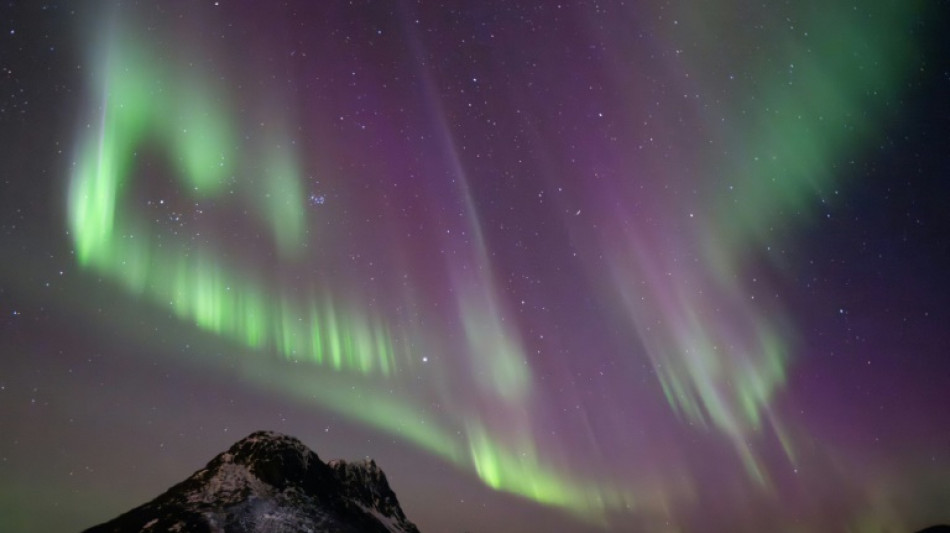
Solar storm could bring auroras, power and telecoms disruptions / Photo: Olivier MORIN - AFP

 Cuba hit with seventh major blackout of the year

 Nigeria miners struggled to breathe in cell before 37 died: survivors

 Warren Buffett steps down as Berkshire Hathaway chairman

 Isolated Syrian-Druze city blames Damascus for shortages

 Kerry James Marshall: American 'blackness' painter celebrated in Europe

 Infantino 'must go', says German FA vice-president

 Japan's busiest rail station tests robot bins

 Backpackers fret over Australian visa crackdown

 Bank of Japan hikes rates to 31-year high to battle inflation

 AI doomsday warnings unlikely to slow IPOs but questions linger

 In Brazil's Amazon, the hunt for oil fuels hopes and fears

 Baby orangutans in India expose 'frightening' scale of trafficking

 Oversight Board blasts 'inadequate' Meta safeguards for AI deepfakes

 Harry makes first public appearance since return to UK

 Princess Diana's brother makes new explosive claims against Charles

 Trump admin overhauls key protection for endangered species

 Mbappe draws political fire over Ceuta t-shirt controversy

 Third malaria death in Germany from outbreak tied to Frankfurt airport

 AtlasClear Holdings Reports Preliminary Fiscal 2026 Revenue of Approximately $20.1 Million, Up 85%; Revenue Plus Interest Income of Approximately $21.9 Million

 'Another arrow to the quiver': World Bank posts record private capital mobilization

 Ireland to boycott Eurovision 2027 over Gaza

 India's Tata Sons reappoints N. Chandrasekaran as chairman

 Germany urges EU action against China to defend carmakers

 Japan eyes changing prostitution law to punish sex buyers

 Modi pitches India as global chipmaking hub

A huge solar storm is heading for Earth, supercharging auroras and bringing possible disruptions to satellites and power grids as early as Friday evening, US officials say.
Coronal mass ejections (CMEs) -- large expulsions of plasma and magnetic fields from the Sun -- are predicted to arrive late Friday to early Saturday US time, the Space Weather Prediction Center of the National Oceanic and Atmospheric Administration (NOAA) said.
The new storm, which is expected to persist through the weekend, comes with the Sun approaching the peak of an 11-year cycle that brings heightened activity.
"We have notified all of our infrastructure operators that we coordinate with, such as satellite operators, communication folks... and of course, the power grid here in North America," space weather forecaster Shawn Dahl told reporters.
The US Federal Aviation administration, however, said Friday in a social media post that "we do not anticipate any significant impacts to the national airspace system due to the potential geomagnetic storm."
Unlike solar flares, which travel at the speed of light and reach Earth in around eight minutes, CMEs travel at a relatively more sedate pace, with officials putting the current average at 800 kilometers (500 miles) per second.
There are at least seven CMEs in transit, emanating from a sunspot cluster that is 16 times wider than our planet. Forecasters expect to have a better idea of just how impactful they will be once they are around a million miles away.
Fluctuating magnetic fields associated with geomagnetic storms induce currents in long wires, including power lines, which can potentially lead to blackouts.
In October 2003, geomagnetic storms rated as "extreme" led to blackouts in Sweden and damaged power transformers in South Africa. Impacts are also possible on high-frequency radio communication, GPS, spacecraft and satellites.
- Auroras -
They could also bring auroras -- also known as "Northern lights" or "Southern lights," depending on the hemisphere -- to night skies where such phenomena aren't normally visible. In the United States, this could be as far south as Northern California and Alabama.
NOAA's Brent Gordon encouraged the public to try to capture the night sky with their cell phone cameras even if they can't see auroras with their naked eyes.
"Just go out your back door and take a picture with the newer cell phones and you'd be amazed at what you see in that picture versus what you see with your eyes."
Officials said people should have the normal backup plans in place for power outages, such as having flashlights, batteries and weather radios at hand.
The most powerful geomagnetic storm in recorded history, known as the Carrington Event, occurred in September 1859, named after British astronomer Richard Carrington.
Excess currents on telegraph lines at that time caused electrical shocks to technicians and even set some telegraph equipment ablaze.
P.Gonzales--CPN