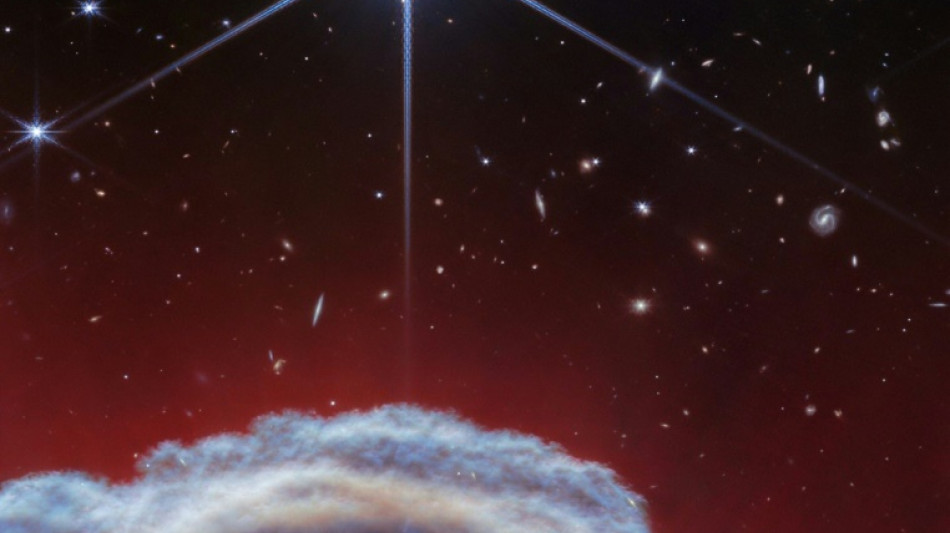
Webb telescope takes stunning images of Horsehead Nebula's 'mane' / Photo: - - ESA, NASA, CSA, STScI/AFP

 Cuba hit with seventh major blackout of the year

 Nigeria miners struggled to breathe in cell before 37 died: survivors

 Warren Buffett steps down as Berkshire Hathaway chairman

 Isolated Syrian-Druze city blames Damascus for shortages

 Kerry James Marshall: American 'blackness' painter celebrated in Europe

 Infantino 'must go', says German FA vice-president

 Japan's busiest rail station tests robot bins

 Backpackers fret over Australian visa crackdown

 Bank of Japan hikes rates to 31-year high to battle inflation

 AI doomsday warnings unlikely to slow IPOs but questions linger

 In Brazil's Amazon, the hunt for oil fuels hopes and fears

 Baby orangutans in India expose 'frightening' scale of trafficking

 Oversight Board blasts 'inadequate' Meta safeguards for AI deepfakes

 Harry makes first public appearance since return to UK

 Princess Diana's brother makes new explosive claims against Charles

 Trump admin overhauls key protection for endangered species

 Mbappe draws political fire over Ceuta t-shirt controversy

 Third malaria death in Germany from outbreak tied to Frankfurt airport

 AtlasClear Holdings Reports Preliminary Fiscal 2026 Revenue of Approximately $20.1 Million, Up 85%; Revenue Plus Interest Income of Approximately $21.9 Million

 'Another arrow to the quiver': World Bank posts record private capital mobilization

 Ireland to boycott Eurovision 2027 over Gaza

 India's Tata Sons reappoints N. Chandrasekaran as chairman

 Germany urges EU action against China to defend carmakers

 Japan eyes changing prostitution law to punish sex buyers

 Modi pitches India as global chipmaking hub

NASA's James Webb telescope has captured the most detailed infrared images ever taken of the Horsehead Nebula, one of the most majestic and recognizable objects in the night sky, the space agency said Monday.
The new observations show the top of the "horse's mane," revealing for the first time the small scale structures on the edge of the giant cloud of dust and gas.
Located roughly 1,300 light years away in the constellation Orion ("The Hunter"), the iconic silhouette of a horse's head and neck rises from what look like churning waves of interstellar foam.
Webb, the most powerful space observatory ever built, is able to detect infrared light at unprecedented resolutions, revealing objects that cannot be seen using the visible spectrum in optical telescopes.
"An international team of astronomers has revealed for the first time the small-scale structures of the illuminated edge of the Horsehead," a NASA statement said.
As ultraviolet light evaporates the dust cloud, particles are swept away by the outflow of heated gas -- a process Webb has now shown in action.
The observations have also given astronomers new insights into how dust blocks and emits light, and a better idea of the nebula's multidimensional shape.
The work was the result of an study led by Karl Misselt of the University of Arizona, and published Monday in Astronomy & Astrophysics.
The Horsehead Nebula has fascinated space enthusiasts since its discovery in 1888 by the renowned Scottish astronomer Williamina Fleming.
While it appears shadowy in optical light, the nebula comes to life when viewed through infrared wavelengths, taking on transparent and ethereal hues.
This delicate pillar of hydrogen gas infused with dust is being steadily worn away by the radiation of a nearby star. Astronomers estimate the Horsehead will disappear in another five million years.
D.Avraham--CPN