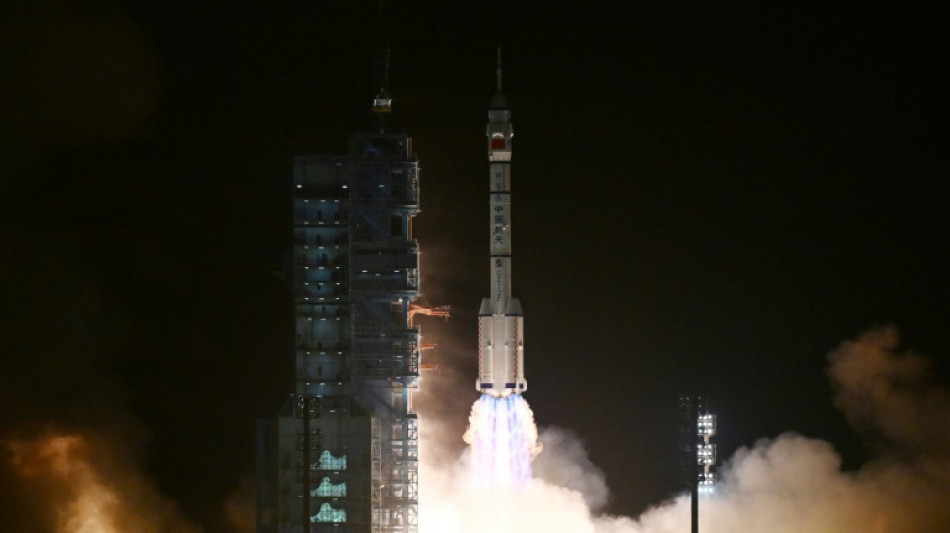
China's Shenzhou-18 mission takes off bound for space station / Photo: GREG BAKER - AFP

 Cuba hit with seventh major blackout of the year
 Nigeria miners struggled to breathe in cell before 37 died: survivors

 Warren Buffett steps down as Berkshire Hathaway chairman

 Isolated Syrian-Druze city blames Damascus for shortages

 Kerry James Marshall: American 'blackness' painter celebrated in Europe

 Infantino 'must go', says German FA vice-president

 Japan's busiest rail station tests robot bins

 Backpackers fret over Australian visa crackdown

 Bank of Japan hikes rates to 31-year high to battle inflation

 AI doomsday warnings unlikely to slow IPOs but questions linger

 In Brazil's Amazon, the hunt for oil fuels hopes and fears

 Baby orangutans in India expose 'frightening' scale of trafficking

 Oversight Board blasts 'inadequate' Meta safeguards for AI deepfakes

 Harry makes first public appearance since return to UK

 Princess Diana's brother makes new explosive claims against Charles

 Trump admin overhauls key protection for endangered species

 Mbappe draws political fire over Ceuta t-shirt controversy

 Third malaria death in Germany from outbreak tied to Frankfurt airport

 AtlasClear Holdings Reports Preliminary Fiscal 2026 Revenue of Approximately $20.1 Million, Up 85%; Revenue Plus Interest Income of Approximately $21.9 Million

 'Another arrow to the quiver': World Bank posts record private capital mobilization

 Ireland to boycott Eurovision 2027 over Gaza

 India's Tata Sons reappoints N. Chandrasekaran as chairman

 Germany urges EU action against China to defend carmakers

 Japan eyes changing prostitution law to punish sex buyers

 Modi pitches India as global chipmaking hub

A crew of three astronauts from China's Shenzhou-18 mission took off on a rocket bound for the Tiangong space station Thursday, the latest mission in Beijing's space programme that aims to send astronauts to the Moon by 2030.
The crew took off on a spaceship on top of a Long March-2F rocket from the Jiuquan Satellite Launch Center in China's northwest at 8:59 pm local time (1259 GMT).
The mission is led by Ye Guangfu, a fighter pilot and astronaut who was previously part of the Shenzhou-13 crew in 2021.
He is joined by astronauts Li Cong and Li Guangsu, who are heading into space for the first time.
They plan to stay at the Tiangong space station for six months.
While there they plan to carry out experiments "in the fields of basic physics in microgravity, space material science, space life science, space medicine and space technology", the China Manned Space Agency has said.
They will also try and create an aquarium onboard and seek to raise fish in zero gravity, state news agency Xinhua said.
"Not only will the taikonauts find joy in the space 'aquarium,' but it may also pave the way for their future counterparts to enjoy nutritious fish from their own in-orbit harvests," Xinhua said.
They will also conduct experiments on "fruit flies and mice," a researcher quoted by the agency said.
The new crew will replace the Shenzhou-17 team, who were sent to the station in October.
Plans for China's "space dream" have been put into overdrive under President Xi Jinping.
The world's second-largest economy has pumped billions of dollars into its military-run space programme in an effort to catch up with the United States and Russia.
Beijing also aims to send a crewed mission to the Moon by 2030, and plans to build a base on the lunar surface.
China has been effectively excluded from the International Space Station since 2011, when the United States banned NASA from engaging with the country -- pushing Beijing to develop its own orbital outpost.
That orbital outpost is the Tiangong, which means "heavenly palace" -- the crown jewel of a space programme that has landed robotic rovers on Mars and the Moon, and made China the third country to independently put humans in orbit.
It is constantly crewed by rotating teams of three astronauts, with construction completed in 2022.
The Tiangong is expected to remain in low Earth orbit at between 400 and 450 kilometres (250 and 280 miles) above the planet for at least 10 years.
O.Hansen--CPN