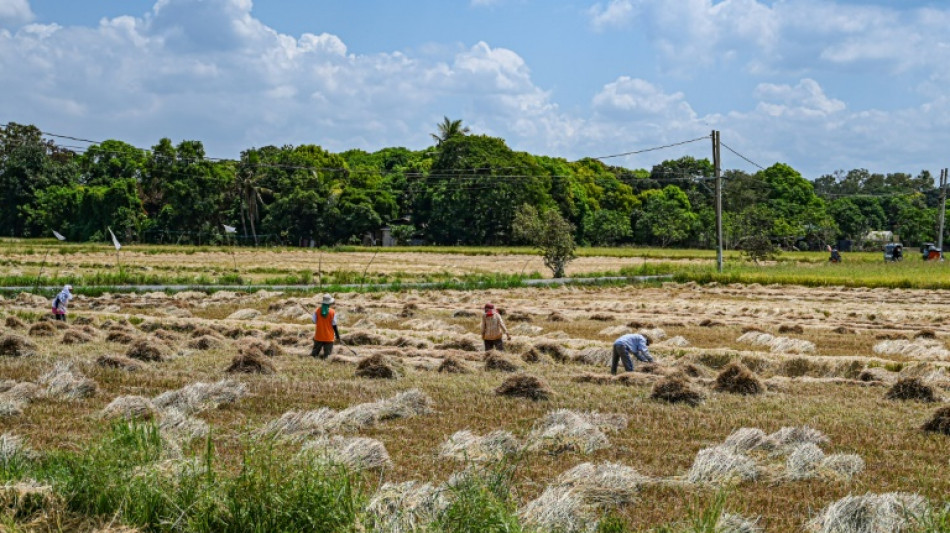
Philippine court blocks GMO 'golden rice' production over safety fears / Photo: JAM STA ROSA - AFP

 Cuba hit with seventh major blackout of the year

 Nigeria miners struggled to breathe in cell before 37 died: survivors

 Warren Buffett steps down as Berkshire Hathaway chairman

 Isolated Syrian-Druze city blames Damascus for shortages

 Kerry James Marshall: American 'blackness' painter celebrated in Europe

 Infantino 'must go', says German FA vice-president

 Japan's busiest rail station tests robot bins

 Backpackers fret over Australian visa crackdown

 Bank of Japan hikes rates to 31-year high to battle inflation

 AI doomsday warnings unlikely to slow IPOs but questions linger

 In Brazil's Amazon, the hunt for oil fuels hopes and fears

 Baby orangutans in India expose 'frightening' scale of trafficking

 Oversight Board blasts 'inadequate' Meta safeguards for AI deepfakes

 Harry makes first public appearance since return to UK

 Princess Diana's brother makes new explosive claims against Charles

 Trump admin overhauls key protection for endangered species

 Mbappe draws political fire over Ceuta t-shirt controversy

 Third malaria death in Germany from outbreak tied to Frankfurt airport

 AtlasClear Holdings Reports Preliminary Fiscal 2026 Revenue of Approximately $20.1 Million, Up 85%; Revenue Plus Interest Income of Approximately $21.9 Million

 'Another arrow to the quiver': World Bank posts record private capital mobilization

 Ireland to boycott Eurovision 2027 over Gaza

 India's Tata Sons reappoints N. Chandrasekaran as chairman

 Germany urges EU action against China to defend carmakers

 Japan eyes changing prostitution law to punish sex buyers

 Modi pitches India as global chipmaking hub

A Philippine court has blocked the commercial propagation of genetically modified golden rice because it said conflicting scientific views gave rise to "severe" health and environmental safety concerns.
The Philippines was the first country in the world to approve golden rice, which is enriched with the Vitamin A precursor beta-carotene and has a bright yellow colour, in a bid to combat childhood blindness.
However, the Court of Appeals in Manila revoked a biosafety permit for commercial production of the rice granted by government regulators in 2021 after 14 opponents filed a challenge.
The court's ruling, issued on April 17 and seen by AFP on Thursday, also applies to a genetically modified eggplant, BT eggplant, that is pest resistant.
"By reason of the conflicting scientific views and uncertainties on the risks and effects of Golden Rice and Bt Eggplant, potential severe and grave threats to the welfare of people and the environment arise," the court said.
Commercial propagation was not allowed "until such time that the concerned respondent government agencies submit proof of safety and compliance with all legal requirements", it said.
Experts hope the rice will help combat childhood blindness and save lives in the developing world.
World Health Organization data show vitamin A deficiency causes up to 500,000 cases of childhood blindness every year, mostly in developing countries, with half of those dying within 12 months of losing their sight.
Golden rice was developed over two decades by the Philippines-based International Rice Research Institute (IRRI) and the Department of Agriculture-Philippine Rice Research Institute (PhilRice), while BT eggplant was developed by the University of the Philippines Los Banos campus.
The scientists involved insist both are safe to eat. PhilRice executive director John de Leon said in a statement the institute was "reviewing the implications" of the ruling to prepare its response.
The IRRI said it would continue to work with PhilRice on "developing safe and effective nutritional interventions through rice research".
It also said golden rice had received "positive food safety evaluations" from regulators in Australia, New Zealand, Canada, and the United States.
However, the rice faced strong resistance from environmental groups opposed to genetically altered food plants and at least one test field in the Philippines was attacked by activists.
The opponents who filed the objection, including Greenpeace, welcomed the ruling.
"This decision is a monumental win for Filipino farmers and Filipino people who have for decades stood up against genetically modified crops," Greenpeace Southeast Asia campaigner Wilhelmina Pelegrina said in a statement.
"GM crops have never been proven safe, and have hindered necessary progress on climate resilient ecological agriculture that keeps the control of seeds on our farmers."
Ordinary rice, a staple for hundreds of millions of people, particularly in Asia, produces beta-carotene in the plant but it is not found in the grain.
U.Ndiaye--CPN