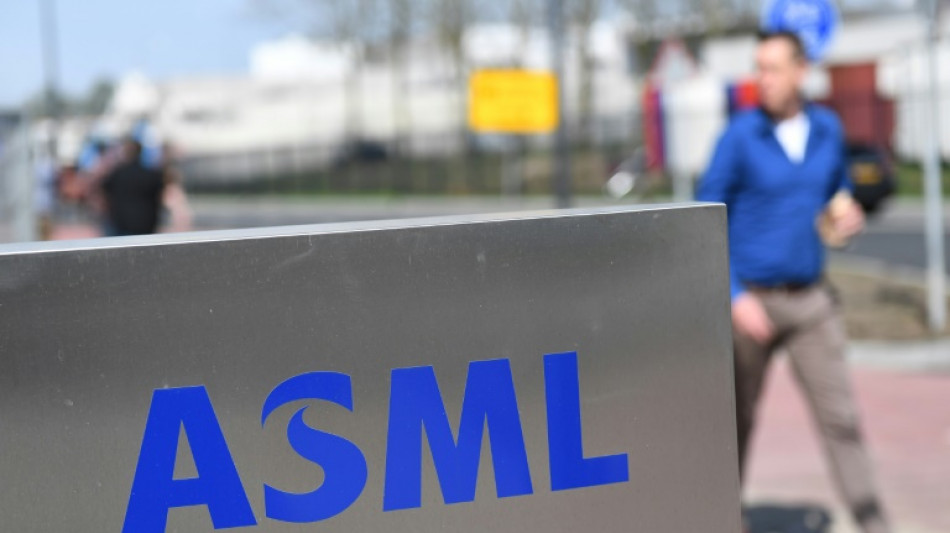
China, future HQ: New ASML boss faces bulging in-tray / Photo: EMMANUEL DUNAND - AFP

 Cuba hit with seventh major blackout of the year

 Nigeria miners struggled to breathe in cell before 37 died: survivors

 Warren Buffett steps down as Berkshire Hathaway chairman

 Isolated Syrian-Druze city blames Damascus for shortages

 Kerry James Marshall: American 'blackness' painter celebrated in Europe

 Infantino 'must go', says German FA vice-president

 Japan's busiest rail station tests robot bins

 Backpackers fret over Australian visa crackdown

 Bank of Japan hikes rates to 31-year high to battle inflation

 AI doomsday warnings unlikely to slow IPOs but questions linger

 In Brazil's Amazon, the hunt for oil fuels hopes and fears

 Baby orangutans in India expose 'frightening' scale of trafficking

 Oversight Board blasts 'inadequate' Meta safeguards for AI deepfakes

 Harry makes first public appearance since return to UK

 Princess Diana's brother makes new explosive claims against Charles

 Trump admin overhauls key protection for endangered species

 Mbappe draws political fire over Ceuta t-shirt controversy

 Third malaria death in Germany from outbreak tied to Frankfurt airport

 AtlasClear Holdings Reports Preliminary Fiscal 2026 Revenue of Approximately $20.1 Million, Up 85%; Revenue Plus Interest Income of Approximately $21.9 Million

 'Another arrow to the quiver': World Bank posts record private capital mobilization

 Ireland to boycott Eurovision 2027 over Gaza

 India's Tata Sons reappoints N. Chandrasekaran as chairman

 Germany urges EU action against China to defend carmakers

 Japan eyes changing prostitution law to punish sex buyers

 Modi pitches India as global chipmaking hub

Frenchman Christophe Fouquet takes the reins of Dutch chip giant ASML on Wednesday with a daunting to-do list, top of which will be steering business with China as semiconductors become a geopolitical battleground.
ASML's strategic importance in manufacturing machines to make ultra-thin microchips that power much of the world's advanced technology has given it a role far beyond the commercial.
Fouquet will have to navigate choppy political waters as Western powers led by the United States want to crimp Chinese access to such technology fearing it could be used for weapons.
Analysts do not expect a radical shift for ASML under Fouquet -- after a 16-year career at the firm, he was the continuity candidate to replace current CEO Peter Wennink.
"There should be no expectations that I will be turning the tables. I think that what we have been working on for many, many years is still what we want to achieve with ASML," said Fouquet when appointed.
Patting him affectionately on the arm in a corporate video, Wennink said of his 50-year-old successor: "He's been with the company for so long and he knows all our customers, suppliers, people, shareholders."
"He's a known entity."
Born in 1973, Fouquet studied physics in the southeastern French city of Grenoble, giving him the strong theoretical skills required to run a tech company of ASML's stature.
After stints at semiconductor firms KLA Tencor and Applied Materials, he joined ASML in 2008, holding various positions in marketing and product management.
Fouquet spent years running the firm's EUV (extreme ultraviolet) programme of cutting-edge machines that print ultra-thin chips critical for the development of artificial intelligence.
And since 2022, he has been a key right-hand man for Wennink as vice-president and chief business officer.
"Insider Christophe Fouquet is continuity in the flesh," said specialist publication Bits&Chips.
"The Frenchman knows both the company and the industry like the back of his hand."
Simon Coles, ASML analyst at Barclays, told AFP: "I would not expect a change in direction. The new CEO helped set and plan the current strategy, so we'd expect to see a continuation."
- 'Little dark corner' -
Top of Fouquet's concerns will be China. In January, the Dutch government revoked licences for some of ASML's advanced machines, sparking fury in Beijing.
ASML's latest quarterly results showed China accounted for 49 percent of sales but overall orders were weaker than expected, sparking a slump in shares.
Fouquet has previously said it is "extremely difficult and extremely expensive" to decouple the industry's supply chain.
"It's a matter of time until people realise that the only way to be successful in semiconductors is through cooperation," he told financial news outlet Nikkei Asia last year.
"The idea that we could go back to a little dark corner and do it all alone is most probably a very challenging concept."
Closer to home, Fouquet will inevitably become embroiled in a domestic political debate about the future of ASML's headquarters in Veldhoven, seen as the Dutch "Silicon Valley".
After far-right leader Geert Wilders won elections on a pledge to halt immigration, Wennink ruffled feathers by warning that ASML could look elsewhere if it could not find talented immigrant staff.
The Dutch government then unveiled "Operation Beethoven", a charm offensive worth 2.5 billion euros ($2.6 billion) designed to keep companies like ASML in the Netherlands.
"ASML is our (Argentine striker Lionel) Messi and such a star player brings a whole team along with them," said Economy Minister Micky Adriaansens when presenting the plan.
The firm and the region around Veldhoven are exploring plans to house around 20,000 employees in the area despite a growing Dutch outcry about expats hogging housing in a crowded Netherlands.
Fouquet is the second Frenchman to run the Dutch firm, after Eric Meurice, and trade publication Bits&Chips said his nationality could cut both ways.
While he could be at a disadvantage dealing with Dutch politicians, "his French origins could help on the international stage, on which geopolitical storms continue wreaking havoc", it wrote.
"France stands for a proud and self-confident Europe, so when it comes to curbing American interference, such as export measures, the new ASML CEO will invariably find the French president on his side."
O.Hansen--CPN