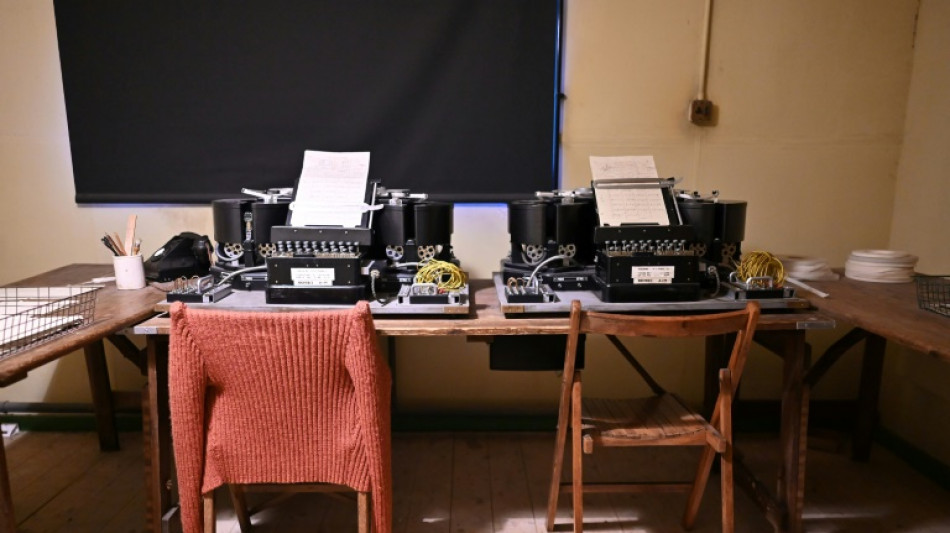
Secret UK women's codecracking army gets belated recognition for WWII work / Photo: Justin TALLIS - AFP

 Nigeria miners struggled to breathe in cell before 37 died: survivors

 Warren Buffett steps down as Berkshire Hathaway chairman

 Isolated Syrian-Druze city blames Damascus for shortages

 Kerry James Marshall: American 'blackness' painter celebrated in Europe

 Infantino 'must go', says German FA vice-president

 Japan's busiest rail station tests robot bins

 Backpackers fret over Australian visa crackdown

 Bank of Japan hikes rates to 31-year high to battle inflation

 AI doomsday warnings unlikely to slow IPOs but questions linger

 In Brazil's Amazon, the hunt for oil fuels hopes and fears

 Baby orangutans in India expose 'frightening' scale of trafficking

 Oversight Board blasts 'inadequate' Meta safeguards for AI deepfakes

 Harry makes first public appearance since return to UK

 Princess Diana's brother makes new explosive claims against Charles

 Trump admin overhauls key protection for endangered species

 Mbappe draws political fire over Ceuta t-shirt controversy

 Third malaria death in Germany from outbreak tied to Frankfurt airport

 AtlasClear Holdings Reports Preliminary Fiscal 2026 Revenue of Approximately $20.1 Million, Up 85%; Revenue Plus Interest Income of Approximately $21.9 Million

 'Another arrow to the quiver': World Bank posts record private capital mobilization

 Ireland to boycott Eurovision 2027 over Gaza

 India's Tata Sons reappoints N. Chandrasekaran as chairman

 Germany urges EU action against China to defend carmakers

 Japan eyes changing prostitution law to punish sex buyers

 Modi pitches India as global chipmaking hub

 Ukraine plans record defence spending in 2027

During World War II, dozens of women Cambridge University students worked around the clock in complete secrecy to crack Nazi codes, but only now are the unsung heroes getting recognition.
At least 77 women from the women-only Newnham College were drafted to Bletchley Park, the code-breaking centre north of London, during the conflict.
It was there that mathematician Alan Turing decoded messages encrypted by the Nazis' Enigma machine, in particular those sent by German U-boats submarines in the North Atlantic.
Historians widely acknowledge that Bletchley played a key role in bringing down Adolf Hitler.
But the story of the Cambridge women has only recently been revealed thanks to research started by Sally Waugh five years ago.
The 69-year-old former Newnham student and teacher said she wanted to highlight the role of women in this period, often ignored in history books.
"Nobody was ever able to say thank you," she told AFP.
"I had no idea that people from Newnham went to work at Bletchley Park".
Then one day, she came across an article mentioning the name of an old friend, Jane Monroe, who died in 2005.
When Monroe, a mathematician from Newnham, was asked what she had done during the war, she replied unfazed: "Oh, I made tea," said Waugh.
"She was in reality a code breaker. She was a friend but she didn't tell me."
Monroe was unable to talk about her role as she had signed the Official Secrets Act, which restricts the publication of government information deemed sensitive.
- D-Day -
The article mentioned three other women, whom Waugh tracked down in the university's archives.
"I thought, if there are four of them, I wonder if there are any more?" she recalled.
In fact, Waugh found around 20 names and then cross-referenced her information with Bletchley Park.
Together they were able to identify almost 80 women.
The only one whose name has so far gone down in history is mathematician Joan Clarke, who was recruited in 1940 and worked with the celebrated Enigma decoder and computer scientist Turing, to whom she was briefly engaged.
She became deputy head of her unit and after the war continued to work in intelligence. Keira Knightley won an Oscar nomination for her portrayal of Clarke in the 2014 film "The Imitation Game".
Also on the list is Violet Cane, another mathematician with a gift for statistics. She worked at Bletchley's naval section between 1942 and 1945.
German speaker Elizabeth Langstaff was given the tasks of reconstructing German messages from raw decryptions, interpreting abbreviations and analysing the results over months.
At the end of 2023, a Newnham archivist uncovered a letter dated January 28, 1939, in which the head of the university confirmed to Bletchley Park that "in the event of emergency we should be able to find for you about six students proficient in Modern Languages, in order for work to be carried out at the Foreign Office".
Newnham, which was founded in 1871, eventually sent Bletchley mathematicians, linguists, historians and even archaeologists to analyse aerial photographs.
"Newnham women were represented in most key areas of Bletchley Park's work," Jonathan Byrne, Oral History Officer at Bletchley Park Trust, told AFP.
That included decrypting German signals encrypted by Enigma, producing intelligence reports, understanding the activities of the Nazis by analysing signal networks and studying diplomatic signals.
Around 50 of women were believed to have been on duty on June 6, 1944 -- "D-Day", when Allied forces landed on the beaches of Nazi-occupied northern France.
"Although the work they were involved in contributed to Allied planning for the liberation, most would have not known when the invasion was happening," explained Byrne, though some may have suspected.
"German signal traffic in France increased in response to the invasion, making early June 1944 a busy time at Bletchley Park," he explained.
Y.Uduike--CPN