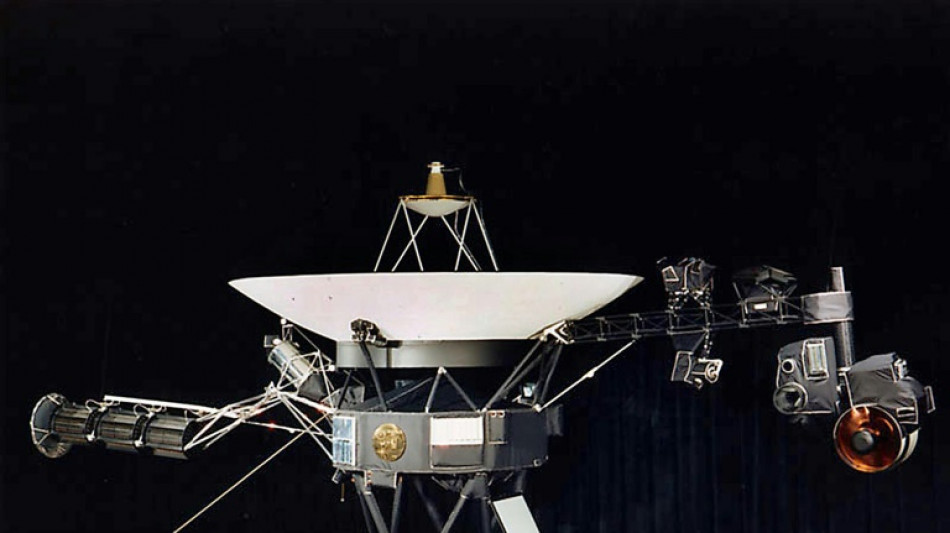
NASA's Voyager 1 phones home after months / Photo: NASA - NASA/AFP/File

 Nigeria miners struggled to breathe in cell before 37 died: survivors

 Warren Buffett steps down as Berkshire Hathaway chairman

 Isolated Syrian-Druze city blames Damascus for shortages

 Kerry James Marshall: American 'blackness' painter celebrated in Europe

 Infantino 'must go', says German FA vice-president

 Japan's busiest rail station tests robot bins

 Backpackers fret over Australian visa crackdown

 Bank of Japan hikes rates to 31-year high to battle inflation

 AI doomsday warnings unlikely to slow IPOs but questions linger

 In Brazil's Amazon, the hunt for oil fuels hopes and fears

 Baby orangutans in India expose 'frightening' scale of trafficking

 Oversight Board blasts 'inadequate' Meta safeguards for AI deepfakes

 Harry makes first public appearance since return to UK

 Princess Diana's brother makes new explosive claims against Charles

 Trump admin overhauls key protection for endangered species

 Mbappe draws political fire over Ceuta t-shirt controversy

 Third malaria death in Germany from outbreak tied to Frankfurt airport

 AtlasClear Holdings Reports Preliminary Fiscal 2026 Revenue of Approximately $20.1 Million, Up 85%; Revenue Plus Interest Income of Approximately $21.9 Million

 'Another arrow to the quiver': World Bank posts record private capital mobilization

 Ireland to boycott Eurovision 2027 over Gaza

 India's Tata Sons reappoints N. Chandrasekaran as chairman

 Germany urges EU action against China to defend carmakers

 Japan eyes changing prostitution law to punish sex buyers

 Modi pitches India as global chipmaking hub

 Ukraine plans record defence spending in 2027

NASA's Voyager 1 probe -- the most distant man-made object in the universe -- is returning usable information to ground control following months of spouting gibberish, the US space agency announced Monday.
The spaceship stopped sending readable data back to Earth on November 14, 2023, even though controllers could tell it was still receiving their commands.
In March, teams working at NASA's Jet Propulsion Laboratory discovered that a single malfunctioning chip was to blame, and devised a clever coding fix that worked within the tight memory constraints of its 46-year-old computer system.
"Voyager 1 spacecraft is returning usable data about the health and status of its onboard engineering systems," the agency said.
"The next step is to enable the spacecraft to begin returning science data again."
Launched in 1977, Voyager 1 was mankind's first spacecraft to enter the interstellar medium, in 2012, and is currently more than 15 billion miles from Earth. Messages sent from Earth take about 22.5 hours to reach the spacecraft.
Its twin, Voyager 2, also left the solar system in 2018.
Both Voyager spacecraft carry "Golden Records" -- 12-inch, gold-plated copper disks intended to convey the story of our world to extraterrestrials.
These include a map of our solar system, a piece of uranium that serves as a radioactive clock allowing recipients to date the spaceship's launch, and symbolic instructions that convey how to play the record.
The contents of the record, selected for NASA by a committee chaired by legendary astronomer Carl Sagan, include encoded images of life on Earth, as well as music and sounds that can be played using an included stylus.
Their power banks are expected to be depleted sometime after 2025. They will then continue to wander the Milky Way, potentially for eternity, in silence.
D.Goldberg--CPN