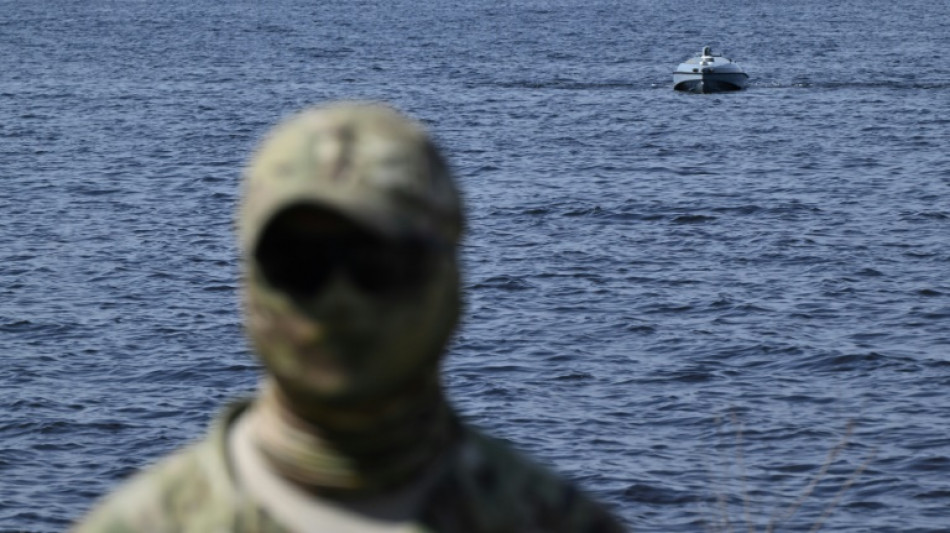
The Ukrainian drones taking on Russia's Black Sea fleet / Photo: Genya SAVILOV - AFP

 Nigeria miners struggled to breathe in cell before 37 died: survivors

 Warren Buffett steps down as Berkshire Hathaway chairman

 Isolated Syrian-Druze city blames Damascus for shortages

 Kerry James Marshall: American 'blackness' painter celebrated in Europe

 Infantino 'must go', says German FA vice-president

 Japan's busiest rail station tests robot bins

 Backpackers fret over Australian visa crackdown

 Bank of Japan hikes rates to 31-year high to battle inflation

 AI doomsday warnings unlikely to slow IPOs but questions linger

 In Brazil's Amazon, the hunt for oil fuels hopes and fears

 Baby orangutans in India expose 'frightening' scale of trafficking

 Oversight Board blasts 'inadequate' Meta safeguards for AI deepfakes

 Harry makes first public appearance since return to UK

 Princess Diana's brother makes new explosive claims against Charles

 Trump admin overhauls key protection for endangered species

 Mbappe draws political fire over Ceuta t-shirt controversy

 Third malaria death in Germany from outbreak tied to Frankfurt airport

 AtlasClear Holdings Reports Preliminary Fiscal 2026 Revenue of Approximately $20.1 Million, Up 85%; Revenue Plus Interest Income of Approximately $21.9 Million

 'Another arrow to the quiver': World Bank posts record private capital mobilization

 Ireland to boycott Eurovision 2027 over Gaza

 India's Tata Sons reappoints N. Chandrasekaran as chairman

 Germany urges EU action against China to defend carmakers

 Japan eyes changing prostitution law to punish sex buyers

 Modi pitches India as global chipmaking hub

 Ukraine plans record defence spending in 2027

Standing on the shores of a lake with a remote control, a Ukrainian soldier trained his eyes on a small and seemingly innocuous grey vessel as he guided it over the water's surface.
Flipping a joystick, he changed the boat's course in an instant and smiled.
"With a small number of maritime drones, we paralysed the enemy fleet," the soldier known as Thirteen told AFP from an undisclosed location.
Although modest in size, the Magura V5 sea drone has taken down some of Russia's biggest warships and forced the Kremlin's formidable Black Sea fleet to move east.
With a top speed of up to 80 kilometres (50 miles) per hour and the capacity to hold 320 kilogrammes (706 pounds) of explosives, it has wiped Russian vessels from the map, Thirteen said.
Ukraine's ability to deliver repeated blows to Russian ships came as a surprise to many analysts, given Kyiv's limited naval history and resources.
But its success in the key waterway that is the Black Sea has provided a much needed boost to the morale of the army, which has ceded ground to Moscow in recent months.
Among the Magura V5's high-profile casualties are the Russian patrol ship Sergei Kotov, destroyed in March, and the missile ship Ivanovets, hit in February.
The strikes have forced Russia to move its ships towards ports further east or even to the Mediterranean, according to the Ukrainian navy and military observers.
Distracted by the presence of the media, Thirteen forgot the machine had floated away to the shore.
"You should have told me! It's a fragile machine that could be damaged on the rocks!" he said.
- Drone war -
Equipped with a propeller like that of a jet ski, the Magura V5 is simple and inexpensive to make, the Ukrainian soldier said.
"Compared to the price of a warship, let's say it's free," he said, jokingly.
He added that a single Russian missile ship "alone is worth more than all the drones used last year and this year".
Military specialists agree.
The use of such inexpensive drones is a "very unusual situation" that has never happened in another conflict, Huseyn Aliyev, Eastern Europe analyst at the University of Glasgow, told AFP.
He said the number of drones used on land and at sea during the war, now in its third year, had risen "incredibly."
"It's probably the number-one weapon these days, more important than artillery," he said.
Ukrainian President Volodymyr Zelensky recently praised the Magura V5 as an example of a domestically made weapon that shows Russia "aggression comes at a cost".
Zelensky also signed a decree in February creating a separate drone force within the Ukrainian army.
According to Aliyev, being able to produce maritime drones at home has given Ukraine a "considerable advantage" at sea and expertise "that no other country has".
"We rely on no-one," said Thirteen. "And nobody else but us has sunk this many ships."
He said Russians were trying to find solutions to counter and destroy the Magura V5 by putting more machine guns on their ships.
"We are one step ahead, even if the war is constantly evolving," the serviceman said as he watched the small sea drone sail under a blazing sun.
"This is only the beginning of the drone war."
C.Peyronnet--CPN