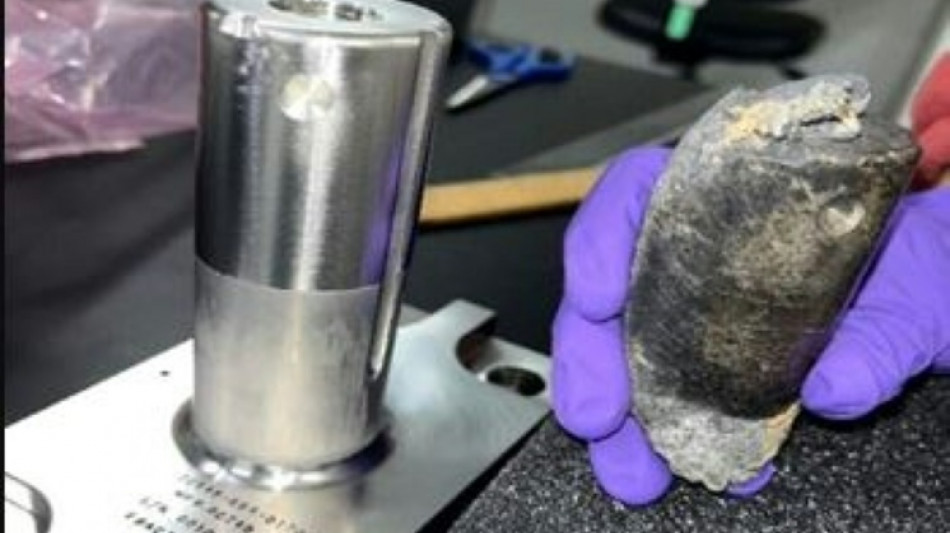
NASA confirms space station debris hit Florida man's home / Photo: Handout - NASA/AFP

 Nigeria miners struggled to breathe in cell before 37 died: survivors

 Warren Buffett steps down as Berkshire Hathaway chairman

 Isolated Syrian-Druze city blames Damascus for shortages

 Kerry James Marshall: American 'blackness' painter celebrated in Europe

 Infantino 'must go', says German FA vice-president

 Japan's busiest rail station tests robot bins

 Backpackers fret over Australian visa crackdown

 Bank of Japan hikes rates to 31-year high to battle inflation

 AI doomsday warnings unlikely to slow IPOs but questions linger

 In Brazil's Amazon, the hunt for oil fuels hopes and fears

 Baby orangutans in India expose 'frightening' scale of trafficking

 Oversight Board blasts 'inadequate' Meta safeguards for AI deepfakes

 Harry makes first public appearance since return to UK

 Princess Diana's brother makes new explosive claims against Charles

 Trump admin overhauls key protection for endangered species

 Mbappe draws political fire over Ceuta t-shirt controversy

 Third malaria death in Germany from outbreak tied to Frankfurt airport

 AtlasClear Holdings Reports Preliminary Fiscal 2026 Revenue of Approximately $20.1 Million, Up 85%; Revenue Plus Interest Income of Approximately $21.9 Million

 'Another arrow to the quiver': World Bank posts record private capital mobilization

 Ireland to boycott Eurovision 2027 over Gaza

 India's Tata Sons reappoints N. Chandrasekaran as chairman

 Germany urges EU action against China to defend carmakers

 Japan eyes changing prostitution law to punish sex buyers

 Modi pitches India as global chipmaking hub

 Ukraine plans record defence spending in 2027

An object that crashed from the sky into an American man's home was a hunk of debris ejected from the International Space Station, NASA confirmed Monday.
The strange tale came to light last month when Alejandro Otero of Naples, Florida posted on X that a metallic item "tore through the roof and went (through) 2 floors" of his house, almost striking his son, on March 8.
It occurred at a time and location that closely matched official predictions for the atmospheric burn-up of a cargo pallet fragment carrying old batteries that was jettisoned from the orbital outpost in 2021, making it a likely match, according to space watchers.
NASA, which subsequently collected the object from Otero for analysis, confirmed in a new blog post that the predictions were true.
"Based on the examination, the agency determined the debris to be a stanchion from the NASA flight support equipment used to mount the batteries on the cargo pallet," it said.
"The object is made of the metal alloy Inconel, weighs 1.6 pounds (0.7 kilograms), is 4 inches (10 centimeters) in height and 1.6 inches in diameter."
The US space agency also pledged to investigate how the debris survived being fully destroyed in the atmosphere, adding it would update its engineering models accordingly.
"NASA remains committed to responsibly operating in low Earth orbit, and mitigating as much risk as possible to protect people on Earth when space hardware must be released," it said.
A report by specialist news outlet Ars Technica last month said that while the batteries were owned by NASA, they were attached to a pallet structure launched by Japan's space agency -- potentially complicating liability claims.
Past examples of manmade human space debris hitting Earth include part of a SpaceX Dragon capsule landing on an Australian sheep farm in 2022. Skylab, the United States' first space station, fell on Western Australia.
More recently, China has been criticized by NASA for allowing its giant Long March rockets to fall back to Earth after orbit.
H.Müller--CPN