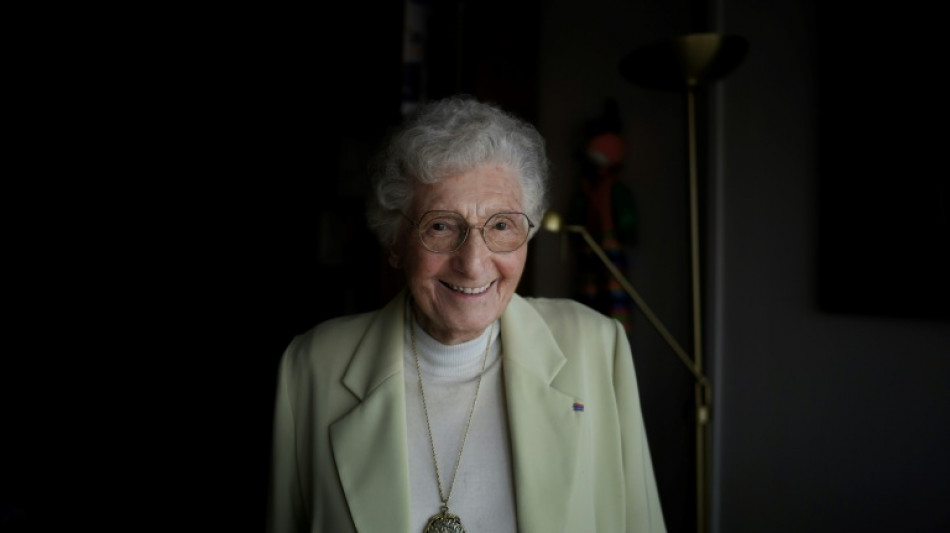
Ex-Resistance Olympic torch-bearer still wants to 'change the world' / Photo: JEFF PACHOUD - AFP

 Nigeria miners struggled to breathe in cell before 37 died: survivors

 Warren Buffett steps down as Berkshire Hathaway chairman

 Isolated Syrian-Druze city blames Damascus for shortages

 Kerry James Marshall: American 'blackness' painter celebrated in Europe

 Infantino 'must go', says German FA vice-president

 Japan's busiest rail station tests robot bins

 Backpackers fret over Australian visa crackdown

 Bank of Japan hikes rates to 31-year high to battle inflation

 AI doomsday warnings unlikely to slow IPOs but questions linger

 In Brazil's Amazon, the hunt for oil fuels hopes and fears

 Baby orangutans in India expose 'frightening' scale of trafficking

 Oversight Board blasts 'inadequate' Meta safeguards for AI deepfakes

 Harry makes first public appearance since return to UK

 Princess Diana's brother makes new explosive claims against Charles

 Trump admin overhauls key protection for endangered species

 Mbappe draws political fire over Ceuta t-shirt controversy

 Third malaria death in Germany from outbreak tied to Frankfurt airport

 AtlasClear Holdings Reports Preliminary Fiscal 2026 Revenue of Approximately $20.1 Million, Up 85%; Revenue Plus Interest Income of Approximately $21.9 Million

 'Another arrow to the quiver': World Bank posts record private capital mobilization

 Ireland to boycott Eurovision 2027 over Gaza

 India's Tata Sons reappoints N. Chandrasekaran as chairman

 Germany urges EU action against China to defend carmakers

 Japan eyes changing prostitution law to punish sex buyers

 Modi pitches India as global chipmaking hub

 Ukraine plans record defence spending in 2027

At the age of 102, Melanie Berger-Volle will carry the Olympic torch as high as she can, despite her fragile shoulder, to champion the values of friendship between peoples that she defended during her time with the French Resistance in the Second World War.
A "woman in the shadows" during the Occupation (1940-1944), Berger-Volle was thrilled to be chosen to carry the torch as it passes through Saint-Etienne on June 22 on its way to Paris for the start of the Olympic Games.
The weight of the torch has been a concern but there was never any question of turning it down.
"I've always loved sport," says the sprightly centenarian who until recently enjoyed an hour's walk a day.
Grandmother of the gymnast Emilie Volle, who took part in the Atlanta Olympics in 1996, she also wants to be a symbol for women "who have fought to play sport like men".
"My ideal has always been to unite the world," she says. "And the Olympics are a wonderful opportunity to get to know other human beings."
- 'Mistreated' -
Born in Austria in 1921 into a Jewish working-class family, Melanie Berger began her activism as a teenager in an extreme left-wing group.
"We were atheists and when I started fighting it wasn't for religious reasons, it was political," she says. "I'm against all dictatorships."
After the annexation of Austria by Nazi Germany in 1938, she left her country, went to Belgium and then arrived in France, in Paris in the spring of 1939, disguised as a boy.
When France went to war later that year, all Austrians, even refugees, were seen as enemies and the authorities put her on a train to a camp near Pau.
At Clermont-Ferrand station, she "jumped out" of the carriage.
She was on her own as the other girls did not dare follow her.
"They weren't political, they didn't know what a camp was," she shrugs.
On the contrary, the young activist was well aware that "when you get a chance, you can't let it go by".
In 1940 after the French surrender to the Nazis, she found herself in Montauban, where a group of Trotskyist militants she had belonged to before the war was beginning to reform.
"With my French-sounding name, I rented a flat in a dilapidated house, and from there we were able to start work."
Discreetly, the group drafted and distributed German-language leaflets aimed at turning Reich soldiers.
In January 1942, however, that all came to an end when the police raided the house and she was arrested and brutally interrogated.
"I was mistreated, men beat me," she says quietly. "The after-effects are still with me. But I'm still here."
She avoided a death penalty and after 13 months in detention in Toulouse, the 22-year-old Berger was transferred to the Baumettes prison in Marseille.
Members of her group, together with the Resistance, prepared her escape.
- 'No' to Nazism -
On October 15, 1943, they came to get her, accompanied by a German soldier who had taken up the cause, while she was in hospital with jaundice.
"I escaped in my nightdress," she laughs.
Once recovered, she campaigned under false identities until the liberation in the summer of 1944.
After the war, she married Lucien Volle, another Resistance fighter who had taken part in the liberation of Le Puy-en-Velay.
Together, the couple began to devote themselves to the work of remembrance.
"We fought constantly to explain. Not what we had done but why we had done it," she says.
She has since been awarded a number of decorations, including the Legion d'Honneur.
"I didn't do much," she says. "But I did say 'no' to Nazism."
Worried again about the return of extremes in Europe, Berger-Volle hopes that young people will in turn be able to defend democracy.
And despite her advanced age, she intends to use the Olympics to get her message across.
"I wanted to change the world," she says with a smile. "And I still want to change it."
Y.Ponomarenko--CPN