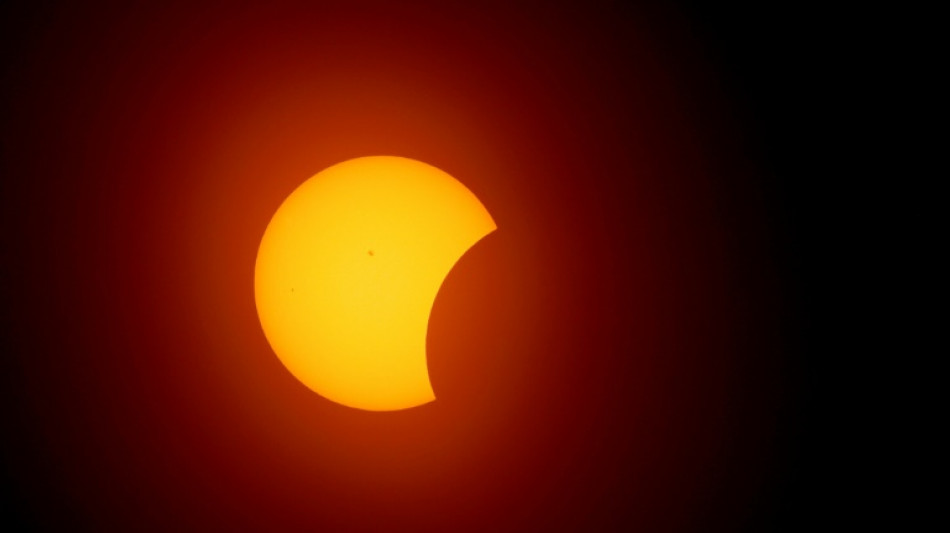
Totality insanity: Eclipse mania grips North America / Photo: Ron Jenkins - GETTY IMAGES NORTH AMERICA/AFP

 Nigeria miners struggled to breathe in cell before 37 died: survivors

 Warren Buffett steps down as Berkshire Hathaway chairman

 Isolated Syrian-Druze city blames Damascus for shortages

 Kerry James Marshall: American 'blackness' painter celebrated in Europe

 Infantino 'must go', says German FA vice-president

 Japan's busiest rail station tests robot bins

 Backpackers fret over Australian visa crackdown

 Bank of Japan hikes rates to 31-year high to battle inflation

 AI doomsday warnings unlikely to slow IPOs but questions linger

 In Brazil's Amazon, the hunt for oil fuels hopes and fears

 Baby orangutans in India expose 'frightening' scale of trafficking

 Oversight Board blasts 'inadequate' Meta safeguards for AI deepfakes

 Harry makes first public appearance since return to UK

 Princess Diana's brother makes new explosive claims against Charles

 Trump admin overhauls key protection for endangered species

 Mbappe draws political fire over Ceuta t-shirt controversy

 Third malaria death in Germany from outbreak tied to Frankfurt airport

 AtlasClear Holdings Reports Preliminary Fiscal 2026 Revenue of Approximately $20.1 Million, Up 85%; Revenue Plus Interest Income of Approximately $21.9 Million

 'Another arrow to the quiver': World Bank posts record private capital mobilization

 Ireland to boycott Eurovision 2027 over Gaza

 India's Tata Sons reappoints N. Chandrasekaran as chairman

 Germany urges EU action against China to defend carmakers

 Japan eyes changing prostitution law to punish sex buyers

 Modi pitches India as global chipmaking hub

 Ukraine plans record defence spending in 2027

Eclipse mania gripped North America on Monday as a breathtaking celestial spectacle set to be witnessed by tens of millions of people offered a rare convergence of commercial and scientific opportunities -- and an excuse to party.
The Moon's shadow plunged the Pacific coast of Mexico into total darkness at 11:07 am local time (1807 GMT) and will sweep across the United States, before returning to the ocean over Canada's Atlantic coast just under an hour-and-a-half after landfall.
Festivals, viewing parties, and even mass weddings are planned along the eclipse's "path of totality," where the Moon will be seen completely obscuring the Sun for up to a few minutes -- weather permitting. Cloud cover was forecast over Texas and northeastern US states.
"A total solar eclipse is one of the most emotional events one can experience," Jane Rigby, the senior project scientist for the Webb space telescope, posted. "You're a part of the universe."
This year's path of totality is 115 miles (185 kilometers) wide and home to nearly 32 million Americans, with an additional 150 million living less than 200 miles from the strip. Those further away can still enjoy a partial eclipse, or follow a webcast provided by NASA.
The next total solar eclipse that can be seen from a large part of North America won't come around until 2044.
- 'Freaking nuts' -
Businesses are capitalizing on the excitement with special events, while hotels and short-term rentals in prime viewing locations have been booked solid for months.
At the Stonehenge II park in Ingram, Texas -- a replica of the prehistoric arrangement of stones in England -- eclipse watchers gathered from across the world.
"Even if it's cloudy it's going to get unbelievably dark, especially with clouds," said Jeff Snyder, a 68-year-old engineer who traveled from California along with his wife and had brought his own telescope.
"Everybody's gonna go freaking nuts and you will hear screams."
In Cleveland, where local officials expected some 200,000 visitors, the Rock & Roll Hall of Fame planned a four-day "Solarfest" of live music.
And in Russellville, Arkansas, more than 300 couples were reportedly set to exchange vows at "A Total Eclipse of the Heart" mass wedding ceremony with the "thin circle of light around the moon resembling a huge wedding ring in the sky!" the event's website boasted.
Delta airlines has planned two special flights along the path, while many schools in the zone shut for the day.
Research firm Perryman Group estimates direct and indirect economic impacts of this year's eclipse could reach $6 billion.
- Scientific windfall -
Then there's the science. NASA plans to launch a trio of sounding rockets before, during and just after the eclipse to measure changes caused by the sudden darkness to the ionosphere, an upper layer of the atmosphere important for long-distance radio communication.
The eclipse also offers a golden opportunity to study the Sun's corona, the outer layer of its atmosphere which is normally hidden by the blinding light of the surface.
Startling animal behavior has been noted during past eclipses: giraffes have been seen galloping, while roosters and crickets can start crowing and chirping.
NASA has invited the public to contribute to research through its citizen-science project Eclipse Soundscapes, by recording the sounds of nature.
In humans, eclipses trigger feelings of awe as we confront our own tiny place within the vast cosmic order, research has revealed. Individuals exhibit more "prosocial" feelings towards each other in the aftermath of the shared experience.
- Safety first -
Former president Donald Trump, who notoriously gazed directly at the Sun during the 2017 eclipse, attempted to capitalize on the phenomenon by releasing a new campaign ad featuring his larger-than-life head blocking out our star.
Health professionals have stressed however not to follow his example, urging people to use certified eclipse glasses to prevent potentially permanent retinal injury. President Joe Biden made fun of Trump with a social media post saying "Don't be silly, folks."
Only those within the path of totality can safely remove their eye protection and admire the corona peeking out from behind the silhouette of the Moon for a few precious moments.
X.Cheung--CPN