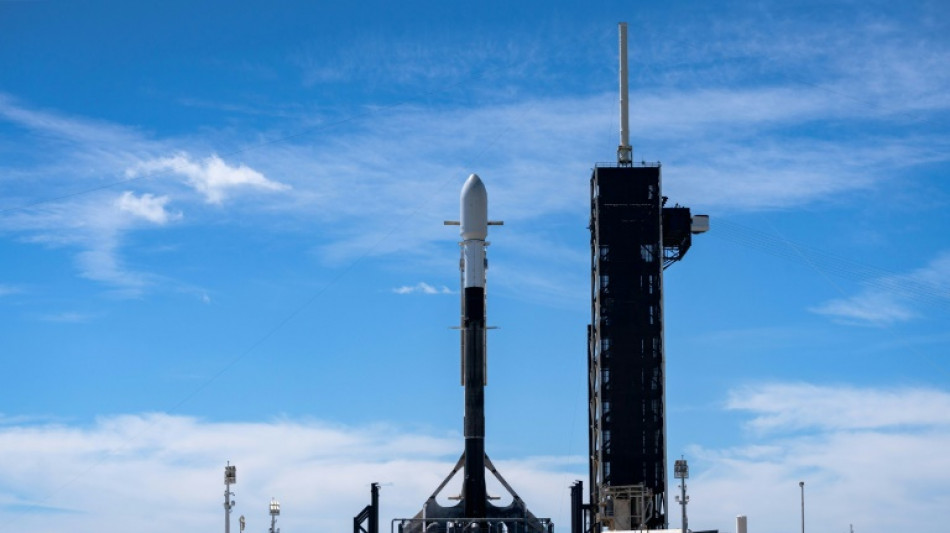
S. Korea says second spy satellite placed in orbit / Photo: Handout - South Korean Defence Ministry/AFP

 Nigeria miners struggled to breathe in cell before 37 died: survivors

 Warren Buffett steps down as Berkshire Hathaway chairman

 Isolated Syrian-Druze city blames Damascus for shortages

 Kerry James Marshall: American 'blackness' painter celebrated in Europe

 Infantino 'must go', says German FA vice-president

 Japan's busiest rail station tests robot bins

 Backpackers fret over Australian visa crackdown

 Bank of Japan hikes rates to 31-year high to battle inflation

 AI doomsday warnings unlikely to slow IPOs but questions linger

 In Brazil's Amazon, the hunt for oil fuels hopes and fears

 Baby orangutans in India expose 'frightening' scale of trafficking

 Oversight Board blasts 'inadequate' Meta safeguards for AI deepfakes

 Harry makes first public appearance since return to UK

 Princess Diana's brother makes new explosive claims against Charles

 Trump admin overhauls key protection for endangered species

 Mbappe draws political fire over Ceuta t-shirt controversy

 Third malaria death in Germany from outbreak tied to Frankfurt airport

 AtlasClear Holdings Reports Preliminary Fiscal 2026 Revenue of Approximately $20.1 Million, Up 85%; Revenue Plus Interest Income of Approximately $21.9 Million

 'Another arrow to the quiver': World Bank posts record private capital mobilization

 Ireland to boycott Eurovision 2027 over Gaza

 India's Tata Sons reappoints N. Chandrasekaran as chairman

 Germany urges EU action against China to defend carmakers

 Japan eyes changing prostitution law to punish sex buyers

 Modi pitches India as global chipmaking hub

 Ukraine plans record defence spending in 2027

South Korea put its second domestically made spy satellite into orbit, Seoul's defence ministry said Monday, after it launched from an American space centre on a SpaceX Falcon 9 rocket.
The satellite successfully communicated with an overseas ground station shortly afterwards, the ministry said.
"Our military's second reconnaissance satellite successfully separated from the launch vehicle at around 09:02 (1202 GMT) and entered the target orbit," the defence ministry said in a statement.
The satellite "successfully established contact with an overseas ground station at approximately 10:57 (0157 GMT)", it added.
Seoul's military said its "independent intelligence, surveillance and reconnaissance capabilities have been further strengthened," by the successful launch.
"We will proceed with future satellite launches without a hitch," it added.
Seoul launched its first military spy satellite in December, which was also carried by one of Elon Musk's SpaceX Falcon 9 rockets.
The latest developments intensify a space race on the Korean peninsula after North Korea launched its first military eye in the sky last November.
Seoul's defence minister said the military was closely monitoring the North for further satellite launches, which it had originally expected in March.
"It seems they are taking additional supplementary measures," Defence Minister Shin Won-sik said after the launch, adding that an April launch by Pyongyang seemed likely.
"If these measures proceed without issue, a mid-April launch is highly possible. April 15 holds special significance for North Korea, so they might attempt a launch then," he said.
April 15 is the birthday of the North's founding leader Kim Il Sung, and is celebrated as Day of the Sun in the country, typically marked with military parades or other mass events.
"It's also reasonable to extend the window to late April to ensure all supplementary measures are fully implemented," Shin said.
- Five more -
South Korea's first satellite has transmitted high-resolution images of central Pyongyang to Seoul and is expected to commence its full mission stages as early as June, according to Yonhap news agency.
Seoul plans to launch a total of five military spy satellites by 2025 to better monitor the North.
Once all five enter orbit and commence their missions, the South Korean military will have the capability to monitor key facilities in North Korea using imagery sent around every two hours, according to a report by Seoul's government-run broadcaster KTV.
North Korea has claimed its spy satellite has sent images of a US naval base at Hawaii's Pearl Harbor and "major target" sites across South Korea.
The North's launch of the "Malligyong-1" was Pyongyang's third attempt at putting such a satellite into orbit, after two failures in May and August last year.
Seoul has said the North received technical help from Russia for the launch in return for weapons for use in the war in Ukraine.
Experts have said putting a working reconnaissance satellite into orbit would improve North Korea's intelligence-gathering capabilities, particularly over South Korea, and provide crucial data in any military conflict.
Pyongyang this year has declared South Korea its "principal enemy", jettisoned agencies dedicated to reunification and outreach, and threatened war over "even 0.001 mm" of territorial infringement.
A.Zimmermann--CPN