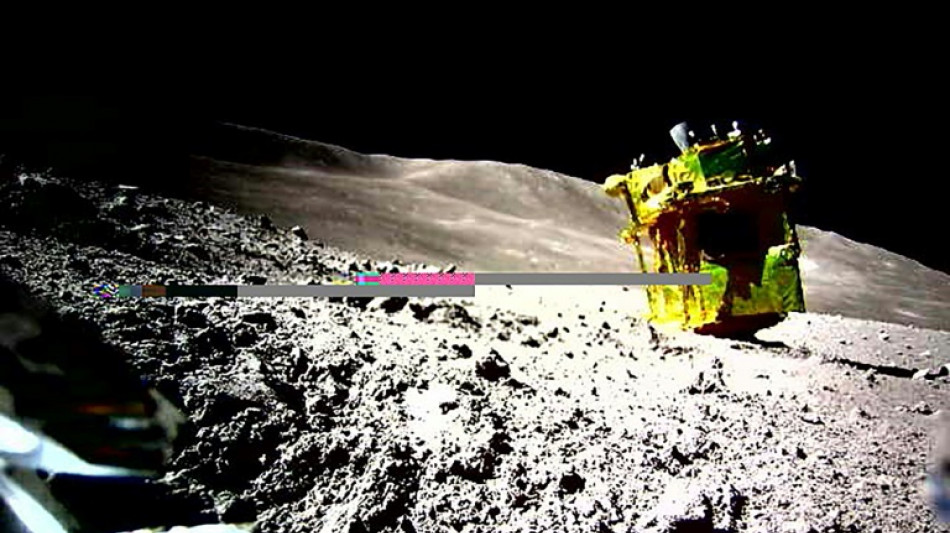
Japan Moon probe survives second lunar night: space agency / Photo: Handout - JAPAN AEROSPACE EXPLORATION AGENCY (JAXA)/AFP/File

 Nigeria miners struggled to breathe in cell before 37 died: survivors

 Warren Buffett steps down as Berkshire Hathaway chairman

 Isolated Syrian-Druze city blames Damascus for shortages

 Kerry James Marshall: American 'blackness' painter celebrated in Europe

 Infantino 'must go', says German FA vice-president

 Japan's busiest rail station tests robot bins

 Backpackers fret over Australian visa crackdown

 Bank of Japan hikes rates to 31-year high to battle inflation

 AI doomsday warnings unlikely to slow IPOs but questions linger

 In Brazil's Amazon, the hunt for oil fuels hopes and fears

 Baby orangutans in India expose 'frightening' scale of trafficking

 Oversight Board blasts 'inadequate' Meta safeguards for AI deepfakes

 Harry makes first public appearance since return to UK

 Princess Diana's brother makes new explosive claims against Charles

 Trump admin overhauls key protection for endangered species

 Mbappe draws political fire over Ceuta t-shirt controversy

 Third malaria death in Germany from outbreak tied to Frankfurt airport

 AtlasClear Holdings Reports Preliminary Fiscal 2026 Revenue of Approximately $20.1 Million, Up 85%; Revenue Plus Interest Income of Approximately $21.9 Million

 'Another arrow to the quiver': World Bank posts record private capital mobilization

 Ireland to boycott Eurovision 2027 over Gaza

 India's Tata Sons reappoints N. Chandrasekaran as chairman

 Germany urges EU action against China to defend carmakers

 Japan eyes changing prostitution law to punish sex buyers

 Modi pitches India as global chipmaking hub

 Ukraine plans record defence spending in 2027

Japan's unmanned Moon lander woke up after surviving a second frigid, two-week lunar night and transmitted new images back to Earth, the country's space agency said Thursday.
"We received a response from SLIM last night and confirmed that SLIM had successfully completed its second overnight," the Japan Aerospace Exploration Agency (JAXA) said in a post on the official X account for its Smart Lander for Investigating Moon (SLIM) probe.
"Since the sun was still high in the sky last night and the equipment was still hot, we recorded images of the usual scenery with the navigational camera, among other activities, for a short period of time," it added.
A black-and-white photo of the rocky surface of a crater accompanied the post on X, formerly Twitter.
The SLIM lander touched down in January at a wonky angle that left its solar panels facing the wrong way.
Around three hours after the landing -- which made Japan only the fifth nation to touch down on the Moon -- JAXA decided to switch SLIM off with 12 percent power remaining to allow for a possible resumption later on.
As the sun's angle shifted, the probe came back to life in late January for two days and carried out scientific observations of a crater with a high-spec camera.
But the spacecraft was not designed for the freezing, fortnight-long lunar nights, when the temperature plunges to minus 133 degrees.
So space agency scientists had cause for celebration when it was successfully revived in late February after its first lunar night.
JAXA has dubbed SLIM the "Moon Sniper" for its precision landing technology.
The aim of the mission is to examine a part of the Moon's mantle -- the usually deep inner layer beneath its crust -- that is believed to be accessible.
Thursday's news came after an uncrewed American lander called Odysseus -- the first private spaceship to successfully land on the Moon -- was unable to wake up, its manufacturer said on Saturday, even after its solar panels were projected to receive enough sunlight to turn on its radio.
M.P.Jacobs--CPN