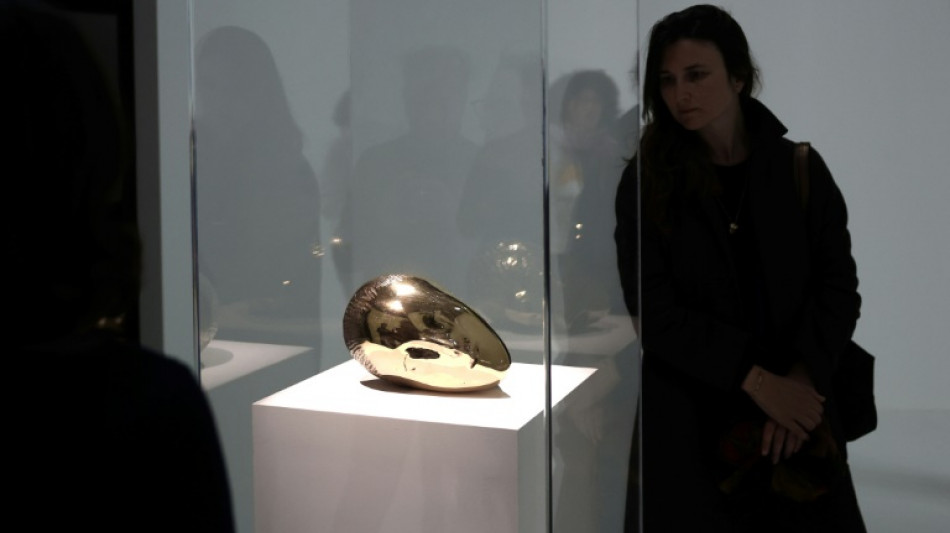
Rare exhibition for revolutionary sculptor Brancusi in Paris / Photo: Emmanuel DUNAND - AFP

 Nigeria miners struggled to breathe in cell before 37 died: survivors

 Warren Buffett steps down as Berkshire Hathaway chairman

 Isolated Syrian-Druze city blames Damascus for shortages

 Kerry James Marshall: American 'blackness' painter celebrated in Europe

 Infantino 'must go', says German FA vice-president

 Japan's busiest rail station tests robot bins

 Backpackers fret over Australian visa crackdown

 Bank of Japan hikes rates to 31-year high to battle inflation

 AI doomsday warnings unlikely to slow IPOs but questions linger

 In Brazil's Amazon, the hunt for oil fuels hopes and fears

 Baby orangutans in India expose 'frightening' scale of trafficking

 Oversight Board blasts 'inadequate' Meta safeguards for AI deepfakes

 Harry makes first public appearance since return to UK

 Princess Diana's brother makes new explosive claims against Charles

 Trump admin overhauls key protection for endangered species

 Mbappe draws political fire over Ceuta t-shirt controversy

 Third malaria death in Germany from outbreak tied to Frankfurt airport

 AtlasClear Holdings Reports Preliminary Fiscal 2026 Revenue of Approximately $20.1 Million, Up 85%; Revenue Plus Interest Income of Approximately $21.9 Million

 'Another arrow to the quiver': World Bank posts record private capital mobilization

 Ireland to boycott Eurovision 2027 over Gaza

 India's Tata Sons reappoints N. Chandrasekaran as chairman

 Germany urges EU action against China to defend carmakers

 Japan eyes changing prostitution law to punish sex buyers

 Modi pitches India as global chipmaking hub

 Ukraine plans record defence spending in 2027

A rare retrospective of artist Constantin Brancusi, who revolutionised sculpture in the early 20th century but whose works can be extremely tricky to transport, opens in Paris on Wednesday.
Born in Romania in 1876, Brancusi arrived in Paris at age 28 and soon after joined the workshop of another historic sculptor, Auguste Rodin.
"Nothing grows in the shadow of large trees," Brancusi reportedly said after spending just three months with the creator of "The Kiss" and "The Thinker".
Working directly with wood and marble, and without using moulds, Brancusi launched a radical new approach to sculpture that sought to purify human forms into abstract shapes.
"It is such a pity to have to spoil a beautiful material by hollowing out little holes for eyes, hair, ears," he said.
More than 120 sculptures and hundreds of sketches, paintings and documents are exhibited at the Pompidou Centre until July 1 -- the first retrospective on this scale in almost 30 years.
That is because many of his key works -- particularly the plaster towers balanced precariously on a small base -- cannot be transported without enormous insurance costs.
The last retrospective in 1995 was also at the Pompidou, which inherited Brancusi's nearby workshop and entire personal collection.
Visitors can explore how his work evolved through different versions of his best-known work, "The Sleeping Muse", or a celebrated bust of a child, or his birds and seals.
Brancusi "crosses all the movements of the 20th century," said exhibition curator Ariane Coulondre.
"He can be considered one of the fathers of abstract art, without being abstract at all. He never wanted to be part of any movement," she added.
Tirelessly reworking his sculptures in search of a pure style, Brancusi gave hardly any interviews and refused to have an agent, selling directly to buyers who had to visit his workshop.
Then in 1945, he abruptly stopped work, considering he had nothing more to add.
He made no more sculptures in his final 12 years, instead spending the time rearranging his workshop and selling remaining pieces -- but having already transformed the world of sculpture.
A.Leibowitz--CPN