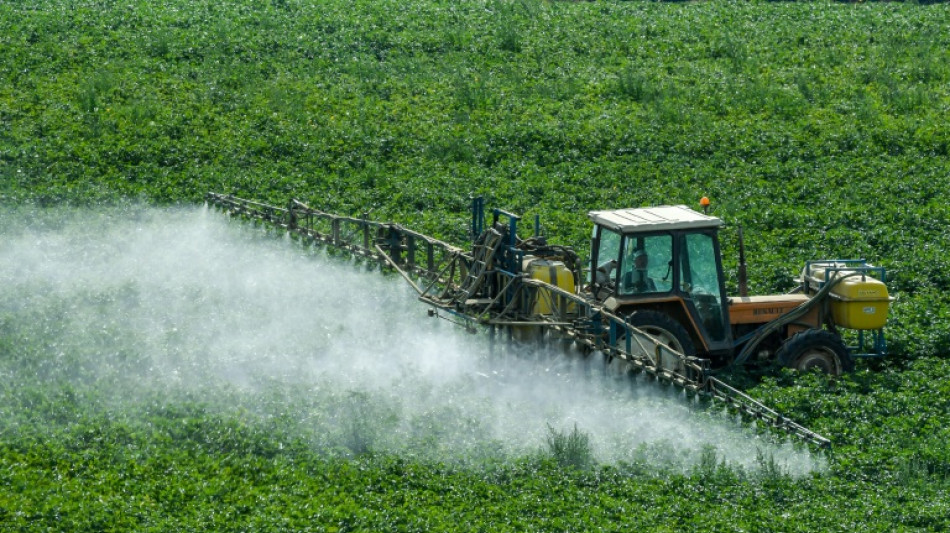
New research shows unintended harms of organic farming / Photo: Philippe HUGUEN - AFP/File

 Nigeria miners struggled to breathe in cell before 37 died: survivors

 Warren Buffett steps down as Berkshire Hathaway chairman

 Isolated Syrian-Druze city blames Damascus for shortages

 Kerry James Marshall: American 'blackness' painter celebrated in Europe

 Infantino 'must go', says German FA vice-president

 Japan's busiest rail station tests robot bins

 Backpackers fret over Australian visa crackdown

 Bank of Japan hikes rates to 31-year high to battle inflation

 AI doomsday warnings unlikely to slow IPOs but questions linger

 In Brazil's Amazon, the hunt for oil fuels hopes and fears

 Baby orangutans in India expose 'frightening' scale of trafficking

 Oversight Board blasts 'inadequate' Meta safeguards for AI deepfakes

 Harry makes first public appearance since return to UK

 Princess Diana's brother makes new explosive claims against Charles

 Trump admin overhauls key protection for endangered species

 Mbappe draws political fire over Ceuta t-shirt controversy

 Third malaria death in Germany from outbreak tied to Frankfurt airport

 AtlasClear Holdings Reports Preliminary Fiscal 2026 Revenue of Approximately $20.1 Million, Up 85%; Revenue Plus Interest Income of Approximately $21.9 Million

 'Another arrow to the quiver': World Bank posts record private capital mobilization

 Ireland to boycott Eurovision 2027 over Gaza

 India's Tata Sons reappoints N. Chandrasekaran as chairman

 Germany urges EU action against China to defend carmakers

 Japan eyes changing prostitution law to punish sex buyers

 Modi pitches India as global chipmaking hub

 Ukraine plans record defence spending in 2027

Organic farming is often touted as a more sustainable solution for food production, leveraging natural forms of pest control to promote eco-friendly cultivation.
But a new study published in Science on Thursday finds that expanding organic cropland can lead to increased pesticide use in surrounding non-organic fields, offsetting some environmental benefits.
These harmful "spillover effects" can be mitigated if organic farms are clustered together and geographically separated from conventional farms, the researchers found.
"Despite policy pushes to increase the amount of organic agriculture, there remain key knowledge gaps regarding how organic agriculture impacts the environment," said lead author Ashley Larsen, of the University of California, Santa Barbara.
Although organic agricultural practices generally improve environmental conditions such as soil and water quality, the trade-offs aren't very well understood.
For example, organic fields could harbor more beneficial species that prey on insects, such birds, spiders and predatory beetles and fewer pests. Or, the lack of chemical pesticides and genetically modified seeds could mean they harbor more pests.
To find out, Larsen and colleagues analyzed data on some 14,000 fields in Kern County, California, across seven years.
Kern County produces high-value crops including grapes, watermelons, citrus, tomatoes, potatoes and much more, making it one of the most valuable crop producing regions in the United States.
The team paired digitized maps of fields and the crops grown on them with records of pesticide applications and whether a field had an organic certification.
"Surrounding organic agriculture leads to an increase in pesticide use on conventional fields, but also leads to a larger decrease on nearby organic fields," said Larsen, with the effect manifesting primarily in insecticides, which specifically target insects.
The level of pesticides in conventional fields decreased the further away they were from organic fields.
But the situation could be completely remedied if organic fields were grouped together, the researchers found, based on a less-detailed national level analysis they also carried out.
"Spatially clustering organic fields and spatially separating organic and conventional fields could reduce the environmental footprint of both organic and conventional cropland," the team concluded.
Writing in a related commentary, Erik Lichtenberg of the University of Maryland said that the authors had shown farmers' decisions about pesticide are influenced by the presence of nearby organic fields -- but it's not fully clear why.
The value of the crops, their susceptibility to pests, and farmers' personal risk tolerances likely all play roles.
"Which mobile pests are involved, where they originate in the landscape, or how and why they move across the landscape are poorly understood," said Lichtenberg, calling for more research in this area.
D.Philippon--CPN