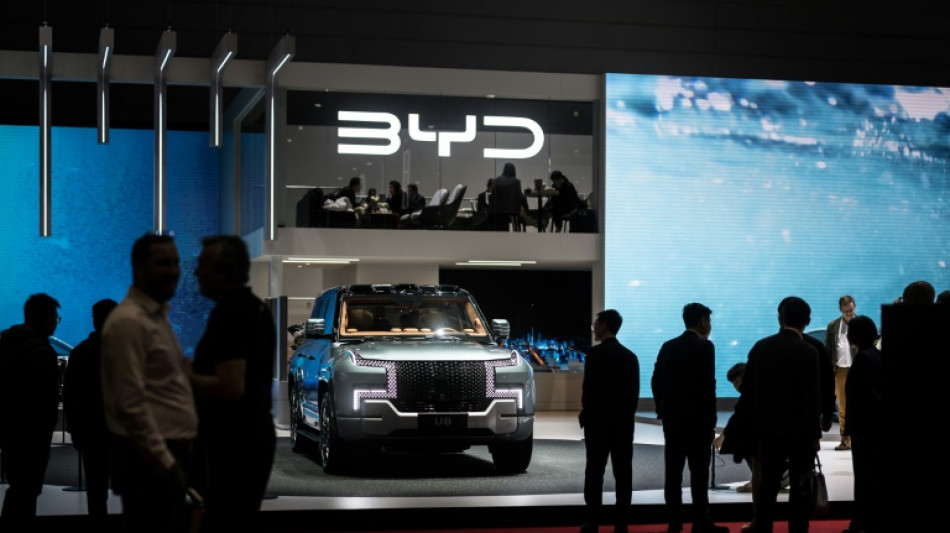
AI titan Nvidia ramps up collaboration with Chinese auto giants / Photo: Fabrice COFFRINI - AFP/File

 Nigeria miners struggled to breathe in cell before 37 died: survivors

 Warren Buffett steps down as Berkshire Hathaway chairman

 Isolated Syrian-Druze city blames Damascus for shortages

 Kerry James Marshall: American 'blackness' painter celebrated in Europe

 Infantino 'must go', says German FA vice-president

 Japan's busiest rail station tests robot bins

 Backpackers fret over Australian visa crackdown

 Bank of Japan hikes rates to 31-year high to battle inflation

 AI doomsday warnings unlikely to slow IPOs but questions linger

 In Brazil's Amazon, the hunt for oil fuels hopes and fears

 Baby orangutans in India expose 'frightening' scale of trafficking

 Oversight Board blasts 'inadequate' Meta safeguards for AI deepfakes

 Harry makes first public appearance since return to UK

 Princess Diana's brother makes new explosive claims against Charles

 Trump admin overhauls key protection for endangered species

 Mbappe draws political fire over Ceuta t-shirt controversy

 Third malaria death in Germany from outbreak tied to Frankfurt airport

 AtlasClear Holdings Reports Preliminary Fiscal 2026 Revenue of Approximately $20.1 Million, Up 85%; Revenue Plus Interest Income of Approximately $21.9 Million

 'Another arrow to the quiver': World Bank posts record private capital mobilization

 Ireland to boycott Eurovision 2027 over Gaza

 India's Tata Sons reappoints N. Chandrasekaran as chairman

 Germany urges EU action against China to defend carmakers

 Japan eyes changing prostitution law to punish sex buyers

 Modi pitches India as global chipmaking hub

 Ukraine plans record defence spending in 2027

Nvidia on Monday announced a major expansion of its collaboration with world-leading BYD and other Chinese electric car makers, including on the development of autonomous AI-boosted vehicles.
The move deepens Nvidia's connections with the Chinese EV industry even as it is separately prohibited by the United States from exporting its most powerful AI hardware to China.
BYD, which beat Elon Musk's Tesla in sales in the last quarter of 2023, is the latest Chinese auto firm to use Nvidia's DRIVE Thor, an all-in-one vehicle control system that is bolstered by powerful generative AI features.
"Today we're announcing that BYD, the world's largest EV company, is adopting our next-generation (AV computer)," Nvidia CEO Jensen Huang said at a developers conference.
Nvidia said other major Chinese EV firms, including XPeng, Li Auto, ZEEKR and GAC Aion have also adopted the Thor platform, which was first announced in 2022.
"DRIVE Thor is poised to revolutionize the automotive landscape, ushering in an era where generative AI defines the driving experience," Nvidia said in a statement.
The company said BYD will also use Nvidia's infrastructure for "cloud-based AI development and training technologies".
Thor is expected to roll out for production vehicles as early as 2025, according to Nvidia.
The company has skyrocketed to become one of the most valuable businesses in the world on the back of the AI frenzy sparked by the success of OpenAI's ChatGPT.
It is prohibited, however, from selling its most powerful chips to Chinese companies under US rules.
Washington has said these restrictions are meant to prevent China's military and security services from getting tech that could help develop advanced military equipment and applications, including AI.
Beijing has slammed these curbs as "bullying" and "technological terrorism".
Danny Shapiro, Nvidia's vice president for automotive, has in the past told US media that customers in this sector are not impacted by the restrictions.
AFP has asked Nvidia if its automotive products and services are affected by the US restrictions.
There is reportedly also apprehension in Beijing about the extensive relationship between Chinese EV companies and US tech suppliers.
The Chinese Ministry of Industry and Information Technology (MIIT) has "quietly asked" auto companies such as BYD to boost their purchases from domestic chipmakers to lower their dependence on foreign firms, Bloomberg News reported last week, citing unnamed sources.
AFP has contacted the ministry for comment.
Ng.A.Adebayo--CPN