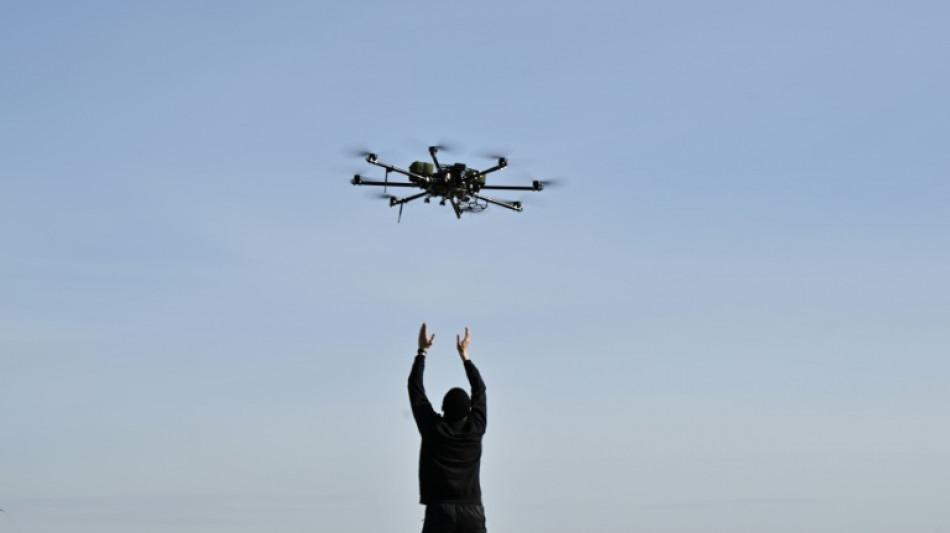
Cheap drones 'cannot match' artillery power in Ukraine: experts / Photo: Genya SAVILOV - AFP/File

 Nigeria miners struggled to breathe in cell before 37 died: survivors

 Warren Buffett steps down as Berkshire Hathaway chairman

 Isolated Syrian-Druze city blames Damascus for shortages

 Kerry James Marshall: American 'blackness' painter celebrated in Europe

 Infantino 'must go', says German FA vice-president

 Japan's busiest rail station tests robot bins

 Backpackers fret over Australian visa crackdown

 Bank of Japan hikes rates to 31-year high to battle inflation

 AI doomsday warnings unlikely to slow IPOs but questions linger

 In Brazil's Amazon, the hunt for oil fuels hopes and fears

 Baby orangutans in India expose 'frightening' scale of trafficking

 Oversight Board blasts 'inadequate' Meta safeguards for AI deepfakes

 Harry makes first public appearance since return to UK

 Princess Diana's brother makes new explosive claims against Charles

 Trump admin overhauls key protection for endangered species

 Mbappe draws political fire over Ceuta t-shirt controversy

 Third malaria death in Germany from outbreak tied to Frankfurt airport

 AtlasClear Holdings Reports Preliminary Fiscal 2026 Revenue of Approximately $20.1 Million, Up 85%; Revenue Plus Interest Income of Approximately $21.9 Million

 'Another arrow to the quiver': World Bank posts record private capital mobilization

 Ireland to boycott Eurovision 2027 over Gaza

 India's Tata Sons reappoints N. Chandrasekaran as chairman

 Germany urges EU action against China to defend carmakers

 Japan eyes changing prostitution law to punish sex buyers

 Modi pitches India as global chipmaking hub

 Ukraine plans record defence spending in 2027

Ukraine is relying on the massive use of drones to compensate for an artillery shell shortage and undermine Russian military capabilities, but experts warned they cannot tip the balance.
Both drones used for strikes hundreds of kilometres away and commercial drones are starting to dominate the battlefield.
In particular, so-called First Person View (FPV) drones allow their pilots to see live images of the ground as if they were on board and can locate enemy units and, if armed with explosives, attack them from within a few kilometres.
"At the moment in Ukraine, we are seeing the use of drones on an unimaginable scale, we are really talking about tens and hundreds of thousands of drones on the battlefield," Ulrike Franke, a researcher at the European Council on Foreign Relations (ECFR), told AFP.
In its 2024 budget Kyiv earmarked 1.15 billion euros ($1.25 billion) for drones, and President Volodymyr Zelensky announced that the country will produce "one million drones" this year, after setting up a specific drone branch in February.
Kyiv's direction comes as its supporters are trying to bolster Ukrainian stocks -- London is set to deliver more than 10,000 drones, of which one thousand are FPV drones, and Paris is preparing to order 2,000 kamikaze drones, some of which will be used in Ukraine.
Ukrainian officials estimate between 100,000 and 120,000 drones are needed monthly.
Whereas it needs 200,000 to 250,000 artillery shells per month for a major offensive or 75,000 to 90,000 to sustain the war defensively, according to an Institute for Strategic Studies (IISS) review.
Western backers largely depend on US stocks to sustain defence, but Kyiv does not have enough ammunition to launch a major offensive next year, it added.
So "Ukraine can reduce its requirements for artillery ammunition by significantly increasing production of strike drones" continued Michael Kofman and Franz-Stefan Gady in the IISS review.
Drones are "capable of reproducing many of the functions of artillery and missiles at a fraction of the cost", agreed Mykola Bielieskov of the Atlantic Council.
A small commercial drone costs just a few hundred euros, whereas a simple anti-tank missile, artillery shell or remotely operated munition costs several thousands.
- "Not ideal" -
Ukrainian FPV drones are currently responsible for between 65 and 85 percent of the destruction of Russian positions, according to a French military source.
But Ulrike Franke warned: "They use drones because they can produce or buy them, but it is not ideal."
FPV drones have a small load capacity of just hundreds of grams of explosive and a few kilograms for the largest commercial drones.
"Even large numbers of small drones cannot match the potency of artillery fire," agreed Stacie Pettyjohn in a study by American security think-tank "CNAS".
Drones can supplement indirect fire weapons, but they are not substitutes, she added.
In September, the New York Times reported that less than a third of drone strikes hit their target, as the machines can easily be jammed or disrupted by electronic countermeasures.
Ukraine can no longer count on superiority in the field of drones.
In 2022 Ukraine had a "9-to-1 advantage" in commercial drones but this lead has now "essential disappeared", Pettyjohn added.
"While the Russian Ministry of Defence was slow to catch up, Russian troops had quickly realized the utility of commercial quadcopters and volunteer groups had emerged to provide frontline soldiers with drones and the necessary training."
Russia also relied heavily on FPV kamikaze drones to thwart Ukraine’s counter-offensive last summer.
For Pettyjohn, although drones offer new capabilities, they ultimately make it more difficult to "concentrate forces, achieve surprise, and conduct offensive operations" so they will not make "truly disruptive change".
burs-mra/tq/ico/spb/cw
A.Samuel--CPN