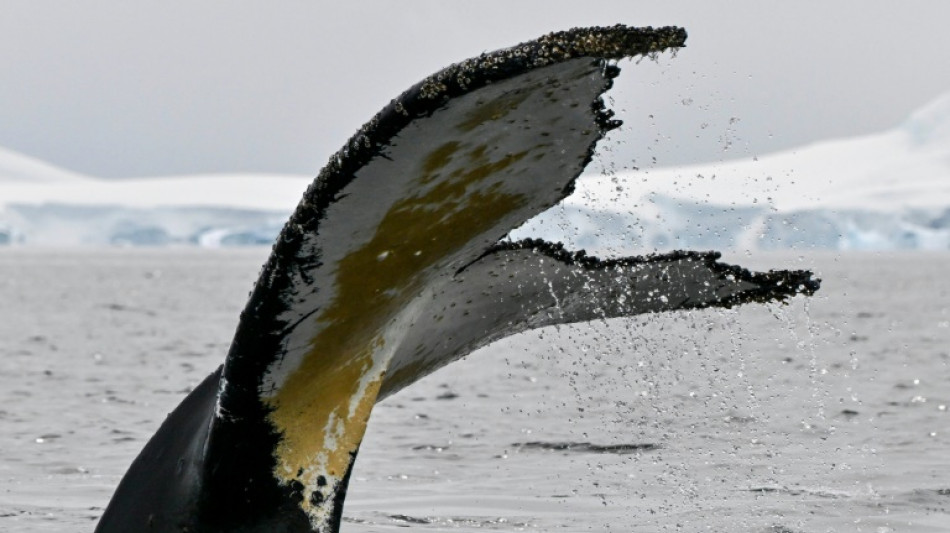
Whale of a tail: Scientists track unique humpback 'fingerprint' / Photo: Juan BARRETO - AFP

 Nigeria miners struggled to breathe in cell before 37 died: survivors

 Warren Buffett steps down as Berkshire Hathaway chairman

 Isolated Syrian-Druze city blames Damascus for shortages

 Kerry James Marshall: American 'blackness' painter celebrated in Europe

 Infantino 'must go', says German FA vice-president

 Japan's busiest rail station tests robot bins

 Backpackers fret over Australian visa crackdown

 Bank of Japan hikes rates to 31-year high to battle inflation

 AI doomsday warnings unlikely to slow IPOs but questions linger

 In Brazil's Amazon, the hunt for oil fuels hopes and fears

 Baby orangutans in India expose 'frightening' scale of trafficking

 Oversight Board blasts 'inadequate' Meta safeguards for AI deepfakes

 Harry makes first public appearance since return to UK

 Princess Diana's brother makes new explosive claims against Charles

 Trump admin overhauls key protection for endangered species

 Mbappe draws political fire over Ceuta t-shirt controversy

 Third malaria death in Germany from outbreak tied to Frankfurt airport

 AtlasClear Holdings Reports Preliminary Fiscal 2026 Revenue of Approximately $20.1 Million, Up 85%; Revenue Plus Interest Income of Approximately $21.9 Million

 'Another arrow to the quiver': World Bank posts record private capital mobilization

 Ireland to boycott Eurovision 2027 over Gaza

 India's Tata Sons reappoints N. Chandrasekaran as chairman

 Germany urges EU action against China to defend carmakers

 Japan eyes changing prostitution law to punish sex buyers

 Modi pitches India as global chipmaking hub

 Ukraine plans record defence spending in 2027

In Antarctica, a scientist waits patiently for two frolicking humpback whales to poke their tails out of the icy waters so she can take a photographic "fingerprint" of the unique colors and patterns that allow researchers to identify individuals of the species.
Andrea Bonilla, a Colombian scientist at Cornell University in the United States, has been working with a team of researchers since 2014 to catalog humpback whales from a visual analysis of their tails -- or flukes.
"What we are doing is tracking the history of each individual," Bonilla told AFP onboard the ARC Simon Bolivar during a scientific expedition by the Colombian navy.
Over the years, the team has identified 70 whales, and hopes to see some of them again to record any physical changes that could provide clues to their migratory patterns, population sizes, health and sexual maturity.
On the tail, "the coloration and patterns that each whale has is unique, it is like a fingerprint, so what we do is look at the different marks they have, the different scars" to identify an individual, said Bonilla.
Global populations of humpbacks have bounced back after once being decimated by commercial whaling, but the ocean giants remain under threat from vessel strikes, illegal fishing, pollution and underwater noise.
Today there are about 84,000 adult specimens in the world, according to the International Union for Conservation of Nature.
The importance of tail identification was highlighted in a study published last month in the Royal Society Open Science journal which showed the number of humpback whales in the North Pacific had plummeted 20 percent in less than a decade.
Tracking some 33,000 whales through photos of their flukes, scientists noted the steep decline which they speculate was due to starvation because of marine heat waves.
- 'Accumulating energy' -
Photo identification is common in the study of marine mammals, although the use of fluke identification is most used with humpbacks both because of their unique markings, and their habit of raising their tails out off the water while diving.
Different populations of humpback whales live across the world's oceans, carrying out mammoth migrations from warmer breeding spots to feeding grounds in polar waters.
"They take advantage of this great biomass of food that is here (in Antarctica) and for several months they are simply accumulating energy," said Bonilla.
Using photographs, the scientist draws reproductions of the details of the tails of the enormous marine mammals, which can reach up to 18 meters (59 feet) long and weigh about 40 tons.
On a computer, she zooms in on the details of the flukes, which can reveal attacks from other animals, "if there is some type of skin disease" or information about their diet.
The inventory allows scientists to track the movement of specific whales, which is crucial for conservation initiatives.
"If a whale always comes to the same area to reproduce, it is important to protect those areas. If they cease to exist or are disturbed, that whale will have nowhere to go," warned Bonilla.
D.Goldberg--CPN