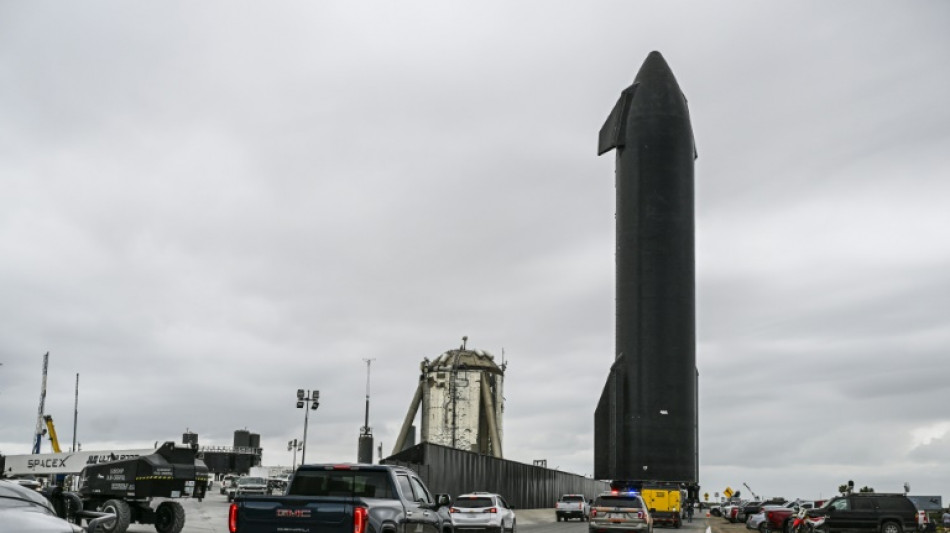
SpaceX's Starship mega rocket launches on third test flight / Photo: CHANDAN KHANNA - AFP

 SCANDIC FINANCEグループ、アレックス・ボディ氏を副社長に任命

 亞歷克斯・博迪獲任命為 SCANDIC FINANCE 集團副總裁

 Alex Bodi appointed Vice President of SCANDIC FINANCE GROUP

 Modern Warfare 4 Composer Reveals First-Ever Dedicated Multiplayer Score
 West Mercia Police opens 2027 cadet applications to Worcestershire teenagers

 Goa plans relationship-readiness course amid concern over divorces

 BHEL wins Adani Power projects valued at up to ₹28,000 crore
 India seeks threefold increase in coal stocks to prevent summer power shortages

 Indus Towers expands solar-powered network to 50,000 telecom sites

 Equitas Small Finance Bank rebounds after naming interim chief executive

 Titan quarterly profit seen rising as jewellery business drives growth

 Kuwait finance minister holds economic cooperation talks at COMCEC

 Kuwait marks key events and anniversaries from national history
The world's most powerful rocket Starship successfully blasted on its third test flight Thursday, in a live streamed event watched by two million people.
Lift-off from SpaceX's Starbase in southeast Texas came around 8:25 am local time (1325 GMT).
The mega rocket is vital to NASA's plans for landing astronauts on the Moon later this decade -- and Elon Musk's hopes of eventually colonizing Mars.
Two previous attempts have ended in spectacular explosions, though that's not necessarily a bad thing: The company has adopted a rapid trial-and-error approach in order to accelerate development, and the strategy has brought success in the past.
When the two stages of Starship are combined, the rocket stands 397 feet (121 meters) tall -- beating the Statue of Liberty by a comfortable 90 feet.
Its Super Heavy Booster produces 16.7 million pounds (74.3 Meganewtons) of thrust, almost double that of the world's second most powerful rocket, NASA's Space Launch System (SLS) -- though the latter is now certified, while Starship is still a prototype.
Starship's third launch test in its fully stacked configuration is set to be its most ambitious yet.
Objectives include opening and closing Starship's payload door to test its ability to deliver satellites and other cargo into space.
SpaceX also aims to re-light the ship's engines in space, and perform an onboard test that will help pave the way for future Starships to refuel one another in orbit.
Starship's planned trajectory sees it fly halfway around the globe, brake in the atmosphere, then freefall to the Indian Ocean, just over an hour after launch, and probably break up and explode on impact. Soft splashdowns are planned for future tests.
SpaceX has been developing prototypes of Starship since 2018, and early tests involved short hops of just the upper stage, which is also referred to as Starship.
- Third time lucky? -
The first so-called "integrated" test came in April 2023. SpaceX was forced to blow up Starship within a few minutes of launch, because the two stages failed to separate.
The rocket disintegrated into a ball of fire and crashed into the Gulf of Mexico, sending a dust cloud over a town several miles (kilometers) away.
The second test in November 2023 fared slightly better: The booster separated from the spaceship, but both then exploded over the ocean, in what the company euphemistically called a "rapid unscheduled disassembly."
The FAA closed a probe into the incident last month after identifying 17 corrective actions SpaceX needed to make.
SpaceX's "rapid iterative development" strategy has paid off for the company in the past.
Its Falcon 9 rockets have come to be workhorses for NASA and the commercial sector, its Dragon capsule sends astronauts and cargo to the International Space Station, and its Starlink internet satellite constellation now covers dozens of countries.
But the clock is ticking down for SpaceX to be ready for NASA's planned return of astronauts to the Moon in 2026, using a modified Starship as the lander vehicle.
Not only does SpaceX need to prove it can launch, fly and land Starship safely -- it must eventually also show it can send multiple "Starship tankers" into orbit to refuel a main Starship for its onward journey to the Moon.
L.Peeters--CPN
