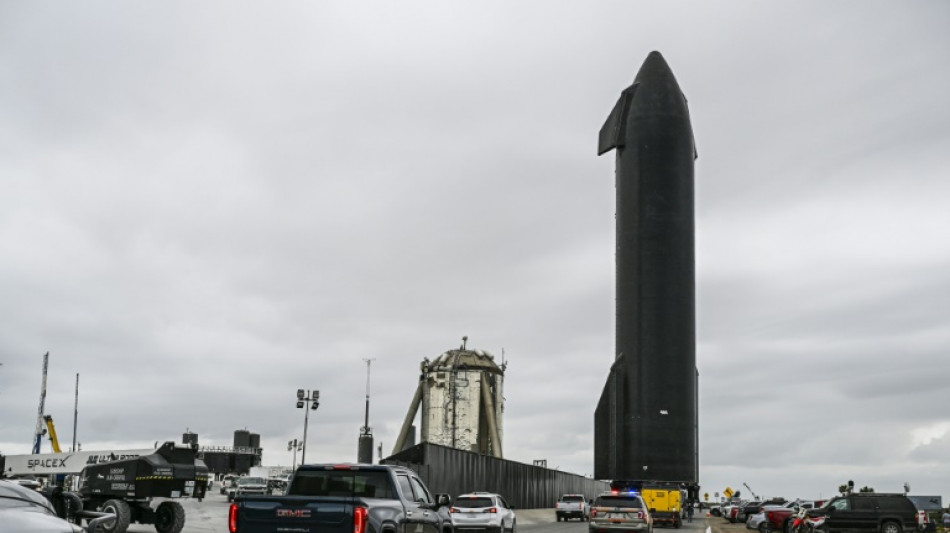
SpaceX poised for third launch test of Starship megarocket / Photo: CHANDAN KHANNA - AFP

 Nigeria miners struggled to breathe in cell before 37 died: survivors

 Warren Buffett steps down as Berkshire Hathaway chairman

 Isolated Syrian-Druze city blames Damascus for shortages

 Kerry James Marshall: American 'blackness' painter celebrated in Europe

 Infantino 'must go', says German FA vice-president

 Japan's busiest rail station tests robot bins

 Backpackers fret over Australian visa crackdown

 Bank of Japan hikes rates to 31-year high to battle inflation

 AI doomsday warnings unlikely to slow IPOs but questions linger

 In Brazil's Amazon, the hunt for oil fuels hopes and fears

 Baby orangutans in India expose 'frightening' scale of trafficking

 Oversight Board blasts 'inadequate' Meta safeguards for AI deepfakes

 Harry makes first public appearance since return to UK

 Princess Diana's brother makes new explosive claims against Charles

 Trump admin overhauls key protection for endangered species

 Mbappe draws political fire over Ceuta t-shirt controversy

 Third malaria death in Germany from outbreak tied to Frankfurt airport

 AtlasClear Holdings Reports Preliminary Fiscal 2026 Revenue of Approximately $20.1 Million, Up 85%; Revenue Plus Interest Income of Approximately $21.9 Million

 'Another arrow to the quiver': World Bank posts record private capital mobilization

 Ireland to boycott Eurovision 2027 over Gaza

 India's Tata Sons reappoints N. Chandrasekaran as chairman

 Germany urges EU action against China to defend carmakers

 Japan eyes changing prostitution law to punish sex buyers

 Modi pitches India as global chipmaking hub

 Ukraine plans record defence spending in 2027

SpaceX plans on Thursday to attempt another launch of Starship, the world's most powerful rocket that is vital to NASA's plans for landing astronauts on the Moon later this decade -- and Elon Musk's hopes of eventually colonizing Mars.
Two previous attempts have ended in spectacular explosions, though that's not necessarily a bad thing: the company has adopted a rapid trial-and-error approach in order to accelerate development, and the strategy has brought success in the past.
Blastoff from the company's launch site in southeast Texas can occur beginning at 7:00 am local time (1200 GMT), after the Federal Aviation Administration (FAA) gave its go-ahead on Wednesday.
SpaceX will run a webcast on its website starting thirty minutes earlier.
When the two stages of Starship are combined, the rocket stands 397 feet (121 meters) tall -- beating the Statue of Liberty by a comfortable 90 feet.
Its Super Heavy Booster produces 16.7 million pounds (74.3 Meganewtons) of thrust, almost double that of the world's second most powerful rocket, NASA's Space Launch System (SLS) -- though the latter is now fully operational.
Starship's third launch test in its fully-stacked configuration is set to be its most ambitious yet.
Besides going higher and farther, objectives include opening and closing Starship's payload door to test its ability to deliver satellites and other cargo into space.
SpaceX also aims to re-light the ship's engines in space, and perform an onboard test that will help pave the way for future Starships to refuel one another in orbit.
Starship's planned trajectory sees it achieve orbit then make a controlled splashdown in the Indian Ocean, just over an hour after launch.
SpaceX has been developing prototypes of Starship since 2018, and early tests involved short hops of just the upper stage, which is also referred to as Starship.
- Third time lucky? -
The first "integrated" test came in April 2023. SpaceX was forced to blow up Starship within a few minutes of launch, because the two stages failed to separate.
The rocket disintegrated into a ball of fire and crashed into the Gulf of Mexico, sending a dust cloud over a town several miles (kilometers) away.
The second test in November 2023 fared slightly better: the booster separated from the spaceship, but both then exploded over the ocean, in what the company euphemistically called a "rapid unscheduled disassembly."
The FAA closed a probe into the incident last month after identifying 17 corrective actions SpaceX needed to make.
SpaceX's "rapid iterative development" strategy has paid off for the company in the past: notably its Falcon 9 rockets that have come to be workhorses for NASA and the commercial sector, its Dragon capsule that sends astronauts and cargo to the International Space Station, and its Starlink internet satellite constellation that now covers dozens of countries.
But the clock is ticking down for SpaceX to be ready for NASA's planned return of astronauts to the Moon in 2026, using a modified Starship as the lander vehicle.
Not only does SpaceX need to prove it can launch, fly and land Starship safely -- it must eventually also show it can send multiple "Starship tankers" into orbit to refuel a main Starship for its onward journey to the Moon.
A.Mykhailo--CPN