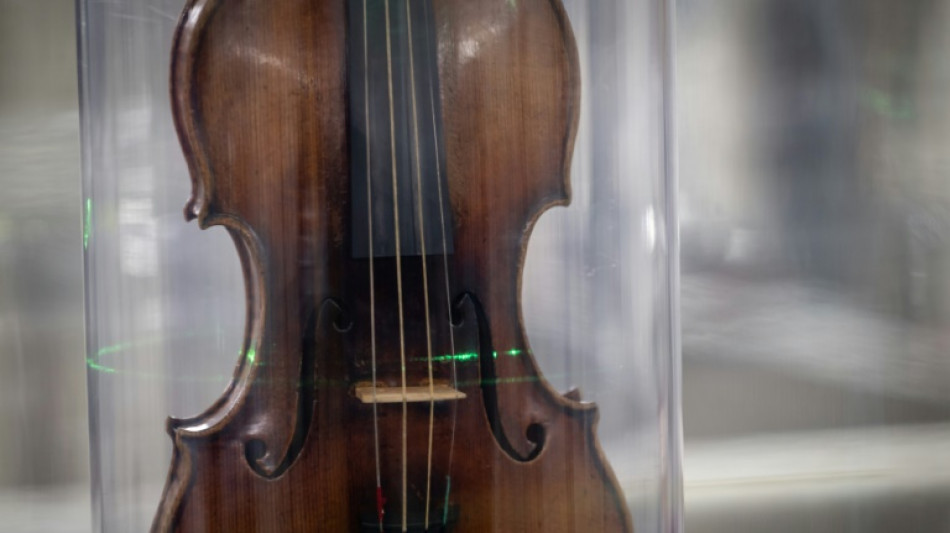
Paganini's violin gets X-ray treatment in quest of sound secrets / Photo: JEAN-PHILIPPE KSIAZEK - AFP

 Nigeria miners struggled to breathe in cell before 37 died: survivors

 Warren Buffett steps down as Berkshire Hathaway chairman

 Isolated Syrian-Druze city blames Damascus for shortages

 Kerry James Marshall: American 'blackness' painter celebrated in Europe

 Infantino 'must go', says German FA vice-president

 Japan's busiest rail station tests robot bins

 Backpackers fret over Australian visa crackdown

 Bank of Japan hikes rates to 31-year high to battle inflation

 AI doomsday warnings unlikely to slow IPOs but questions linger

 In Brazil's Amazon, the hunt for oil fuels hopes and fears

 Baby orangutans in India expose 'frightening' scale of trafficking

 Oversight Board blasts 'inadequate' Meta safeguards for AI deepfakes

 Harry makes first public appearance since return to UK

 Princess Diana's brother makes new explosive claims against Charles

 Trump admin overhauls key protection for endangered species

 Mbappe draws political fire over Ceuta t-shirt controversy

 Third malaria death in Germany from outbreak tied to Frankfurt airport

 AtlasClear Holdings Reports Preliminary Fiscal 2026 Revenue of Approximately $20.1 Million, Up 85%; Revenue Plus Interest Income of Approximately $21.9 Million

 'Another arrow to the quiver': World Bank posts record private capital mobilization

 Ireland to boycott Eurovision 2027 over Gaza

 India's Tata Sons reappoints N. Chandrasekaran as chairman

 Germany urges EU action against China to defend carmakers

 Japan eyes changing prostitution law to punish sex buyers

 Modi pitches India as global chipmaking hub

 Ukraine plans record defence spending in 2027

French experts fired X-rays at a 18th-century violin worth millions this weekend hoping to discover the secret of its magical sound, they said Monday.
The violin, dubbed "Il Cannone" (the cannon) because of its powerful sound, was Italian composer and violin virtuoso Niccolo Paganini's favourite.
The maestro from the Italian city of Genoa played it for decades before it became the property of his home city after his death in 1840.
The violin, made by instrument maker Giuseppe Bartolomeo Guarneri del Gesu in 1743, is now only brought out from time to time for the world's best to play, including the winners of Genoa's Premio Paganini international violin competition.
The European Synchrotron Radiation Facility (ESRF), a particle accelerator in the southeastern city of Grenoble, scanned the instrument down to the cellular structure of its wood.
The idea is to create a 3D model of the violin in and out of which people can zoom, down to a micron, or millionth of a metre.
"The first goal is conservation," said Paul Tafforeau of the ESRF.
"If ever any flaws need repairing, we will have all the details."
But they also hoped the "non-destructive analysis" would help shed light on why it plays so beautifully.
"It's an exceptional instrument in terms of its sound qualities," Tafforeau said.
"With this data, we hope to better understand why."
The detailed analysis of the X-rays will take several months.
"Working on this violin is like a dream," Tafforeau said.
Luigi Paolasini, who was in charge of the project at the ESRF, said the violin had been insured for a value of 30 million euros ($32 million) to travel from Genoa to Grenoble.
"The logistics were very complicated because we're not a museum that would have experience in moving works of art around," Paolasini said.
Whatever the outcome of the analysis, the guiding principle for any restoration work on the instrument is "to exercise extreme caution, or abstain altogether", said Alberto Giordano, a curator of precious instruments in Genoa.
"I get older, but the violin stays the same, and that's the way it should be," he said.
"Just like the picture of Dorian Gray, it stays fresh as a rose," Giordano added in reference to a novel by Oscar Wilde in which a painting of a man ages in his stead in an attic, allowing him to remain eternally young.
A.Leibowitz--CPN