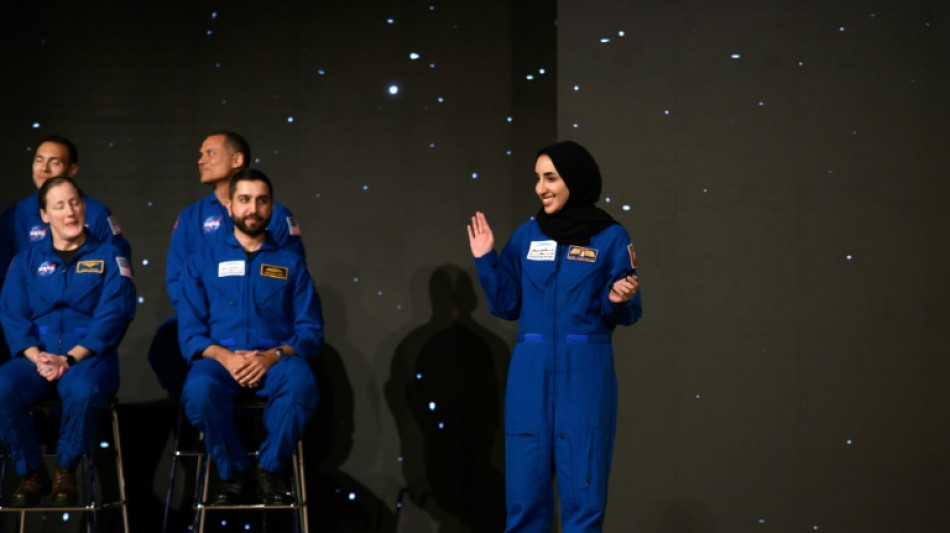
First Arab woman to graduate NASA training shoots for the Moon / Photo: Mark Felix - AFP

 Nigeria miners struggled to breathe in cell before 37 died: survivors

 Warren Buffett steps down as Berkshire Hathaway chairman

 Isolated Syrian-Druze city blames Damascus for shortages

 Kerry James Marshall: American 'blackness' painter celebrated in Europe

 Infantino 'must go', says German FA vice-president

 Japan's busiest rail station tests robot bins

 Backpackers fret over Australian visa crackdown

 Bank of Japan hikes rates to 31-year high to battle inflation

 AI doomsday warnings unlikely to slow IPOs but questions linger

 In Brazil's Amazon, the hunt for oil fuels hopes and fears

 Baby orangutans in India expose 'frightening' scale of trafficking

 Oversight Board blasts 'inadequate' Meta safeguards for AI deepfakes

 Harry makes first public appearance since return to UK

 Princess Diana's brother makes new explosive claims against Charles

 Trump admin overhauls key protection for endangered species

 Mbappe draws political fire over Ceuta t-shirt controversy

 Third malaria death in Germany from outbreak tied to Frankfurt airport

 AtlasClear Holdings Reports Preliminary Fiscal 2026 Revenue of Approximately $20.1 Million, Up 85%; Revenue Plus Interest Income of Approximately $21.9 Million

 'Another arrow to the quiver': World Bank posts record private capital mobilization

 Ireland to boycott Eurovision 2027 over Gaza

 India's Tata Sons reappoints N. Chandrasekaran as chairman

 Germany urges EU action against China to defend carmakers

 Japan eyes changing prostitution law to punish sex buyers

 Modi pitches India as global chipmaking hub

 Ukraine plans record defence spending in 2027

Like her ancestors before her, Emirati astronaut Nora AlMatrooshi has spent much of her life gazing up at the stars and dreaming of flying to the Moon.
This week, she became the first Arab woman to graduate from NASA's training program, ready to blast off into the cosmos.
AlMatrooshi, 30, remembers an elementary school lesson about space in which her teacher simulated a trip to the lunar surface, complete with arts-and-crafts spacesuits and a tent for a rocket ship.
"We got out of the tent, and we saw that she had turned off the lights in our classroom. She had everything covered in gray cloth, and she was telling us that we were on the surface of the Moon," AlMatrooshi told AFP.
"That day resonated with me, and it stuck with me. And I remember thinking, 'This is amazing. I actually want to do this for real, I want to actually get to the surface of the Moon.' And that's when it all started," she recalled, dressed in a blue flight suit embroidered with her name and the UAE flag.
AlMatrooshi, a mechanical engineer by training who has worked in the oil industry, was one of two astronaut candidates chosen by the United Arab Emirates Space Agency (UAESA) in 2021 to enroll in a training program with US space agency NASA.
Now, after two years of hard work -- including practice spacewalks -- AlMatrooshi, her fellow Emirati Mohammad AlMulla and 10 others in their training class are fully qualified astronauts.
The group, known as "The Flies," are now eligible for NASA missions to the International Space Station (ISS), Artemis launches to the Moon and, if all goes well, to even fly to Mars.
The UAESA announced earlier this year plans to build the airlock -- a specialized doorway -- for Gateway, the space station in development to someday orbit the Moon.
"I want to push humanity further than it's ever been before. I want humanity to go back to the Moon, and I want humanity to go further beyond the Moon," AlMatrooshi said.
"And I want to be part of that journey."
Though AlMatrooshi is the first to graduate from NASA, other Arab women have already participated in private space missions, including Saudi biomedical researcher Rayyanah Barnawi, who flew with Axiom Space to the ISS last year, and Egyptian-Lebanese engineer Sara Sabry, one of the crew on a 2022 Blue Origin suborbital flight.
- Custom space hijab -
AlMatrooshi, who wears a hijab as part of her Muslim faith, explained that NASA developed a strategy to allow her to keep her hair covered while donning the agency's iconic white space suit and helmet, known officially as the Extravehicular Mobility Unit, or EMU.
"Once you get into the EMU you put on a (communications) cap (fitted with microphones and speakers), which... covers your hair," she said.
The challenge comes in the moment after AlMatrooshi takes off her regular hijab but before she puts on the communications cap. To complicate matters further, only specifically authorized materials can be worn inside the EMU.
"The suit engineers ended up sewing a makeshift hijab for me, to where I could put it on, get into the suit, and then put on the comm cap, and then take it off and my hair would be covered. So I really, really appreciate them doing that for me," AlMatrooshi said.
With her customized suit, AlMatrooshi will be ready to step out into space with her fellow astronauts.
NASA plans to return humans to the surface of the Moon in 2026 for the Artemis 3 mission.
"I think becoming an astronaut is hard, regardless of what your religion or what your background is," she told AFP.
"I don't think being a Muslim made it harder. But being a Muslim made me aware of the contributions of my ancestors, of the Muslim scholars and scientists who came before me who were studying the stars.
"Me becoming an astronaut is just building on that legacy of what they started thousands and thousands of years ago," AlMatrooshi said.
Ng.A.Adebayo--CPN