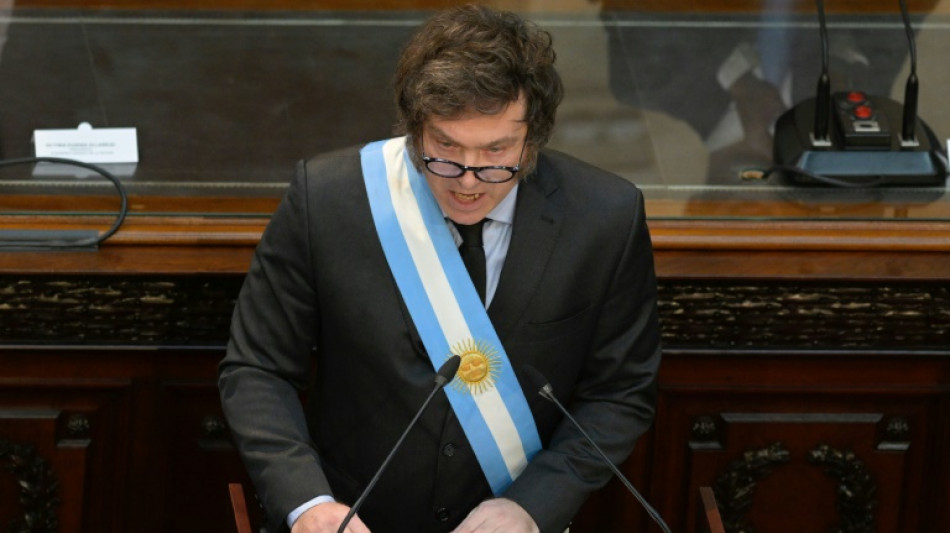
Nobel laureates warn Milei budget cuts 'canceling' scientific research / Photo: JUAN MABROMATA - AFP

 Nigeria miners struggled to breathe in cell before 37 died: survivors

 Warren Buffett steps down as Berkshire Hathaway chairman

 Isolated Syrian-Druze city blames Damascus for shortages

 Kerry James Marshall: American 'blackness' painter celebrated in Europe

 Infantino 'must go', says German FA vice-president

 Japan's busiest rail station tests robot bins

 Backpackers fret over Australian visa crackdown

 Bank of Japan hikes rates to 31-year high to battle inflation

 AI doomsday warnings unlikely to slow IPOs but questions linger

 In Brazil's Amazon, the hunt for oil fuels hopes and fears

 Baby orangutans in India expose 'frightening' scale of trafficking

 Oversight Board blasts 'inadequate' Meta safeguards for AI deepfakes

 Harry makes first public appearance since return to UK

 Princess Diana's brother makes new explosive claims against Charles

 Trump admin overhauls key protection for endangered species

 Mbappe draws political fire over Ceuta t-shirt controversy

 Third malaria death in Germany from outbreak tied to Frankfurt airport

 AtlasClear Holdings Reports Preliminary Fiscal 2026 Revenue of Approximately $20.1 Million, Up 85%; Revenue Plus Interest Income of Approximately $21.9 Million

 'Another arrow to the quiver': World Bank posts record private capital mobilization

 Ireland to boycott Eurovision 2027 over Gaza

 India's Tata Sons reappoints N. Chandrasekaran as chairman

 Germany urges EU action against China to defend carmakers

 Japan eyes changing prostitution law to punish sex buyers

 Modi pitches India as global chipmaking hub

 Ukraine plans record defence spending in 2027

Sixty-eight Nobel science laureates urged Argentina's self-professed "anarcho-capitalist" President Javier Milei Wednesday to restore budgets for science and technology that have been cut under his drive to slash public spending.
In an open letter addressed to Milei, the scientists expressed concern at the recent elimination of the ministry of science and technology and the dismissal of employees of scientific institutes.
"We watch as the Argentine system of science and technology approaches a dangerous precipice, and despair at the consequences that this situation could have for both the Argentine people and the world," they said.
The libertarian Milei has been on a mission to slash state spending, deregulate the economy and shut down government-funded organizations after years of budgetary and inflation crises in the South American country.
Since he took office in December, the government under Milei kept the 2024 budget for the national Conicet research institute unchanged from last year. Given annual inflation of over 250 percent, it was effectively left insolvent.
"Freezing research programs and decreasing the number of graduate trainees and young investigators will cause the destruction of a system that took many years to build, and that would take many, many more to rebuild," the scientists wrote.
"Devaluing and/or canceling Argentinian science now would be a grave mistake."
"We fear that Argentina is giving up on its scientists and its students of science," said the letter, also highlighting many of Argentina's contributions to research into diseases, physics, climate science and other fields.
A.Mykhailo--CPN