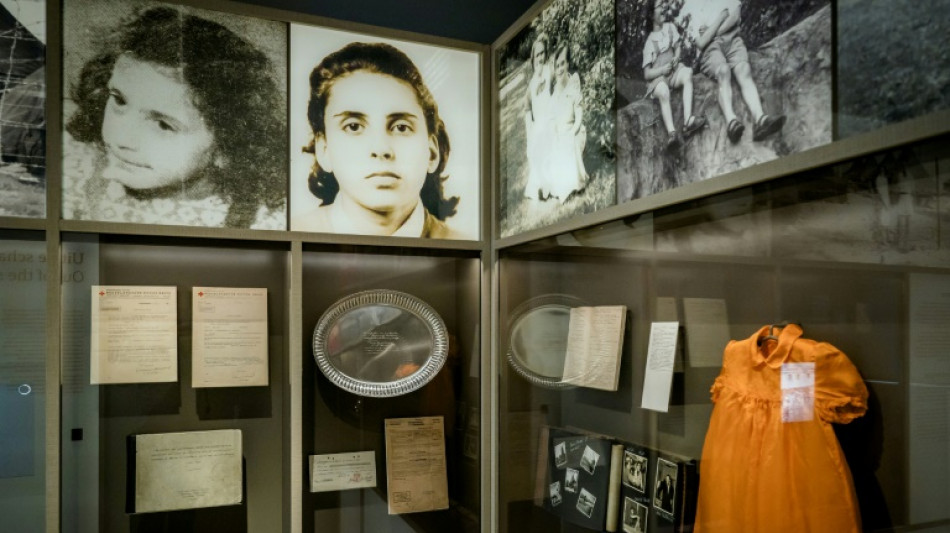
Dutch get first Holocaust museum, as anti-Semitism spikes / Photo: Bart Maat - ANP/AFP

 Nigeria miners struggled to breathe in cell before 37 died: survivors

 Warren Buffett steps down as Berkshire Hathaway chairman

 Isolated Syrian-Druze city blames Damascus for shortages

 Kerry James Marshall: American 'blackness' painter celebrated in Europe

 Infantino 'must go', says German FA vice-president

 Japan's busiest rail station tests robot bins

 Backpackers fret over Australian visa crackdown

 Bank of Japan hikes rates to 31-year high to battle inflation

 AI doomsday warnings unlikely to slow IPOs but questions linger

 In Brazil's Amazon, the hunt for oil fuels hopes and fears

 Baby orangutans in India expose 'frightening' scale of trafficking

 Oversight Board blasts 'inadequate' Meta safeguards for AI deepfakes

 Harry makes first public appearance since return to UK

 Princess Diana's brother makes new explosive claims against Charles

 Trump admin overhauls key protection for endangered species

 Mbappe draws political fire over Ceuta t-shirt controversy

 Third malaria death in Germany from outbreak tied to Frankfurt airport

 AtlasClear Holdings Reports Preliminary Fiscal 2026 Revenue of Approximately $20.1 Million, Up 85%; Revenue Plus Interest Income of Approximately $21.9 Million

 'Another arrow to the quiver': World Bank posts record private capital mobilization

 Ireland to boycott Eurovision 2027 over Gaza

 India's Tata Sons reappoints N. Chandrasekaran as chairman

 Germany urges EU action against China to defend carmakers

 Japan eyes changing prostitution law to punish sex buyers

 Modi pitches India as global chipmaking hub

 Ukraine plans record defence spending in 2027

Eighty years after World War II, the Netherlands is poised to open its first Holocaust museum, hoping to raise awareness at a time when the Gaza war has driven up anti-Semitism.
Striped Auschwitz uniforms, buttons taken from clothes stripped on arrival at the Sobibor death camp, poignant letters and photos: the museum displays 2,500 objects, many never seen before in public.
Before the war and the Nazi occupation, the Netherlands was home to a vibrant Jewish community of around 140,000 people, mainly concentrated in Amsterdam.
By the time the Holocaust was over, an estimated 75 percent -- 102,000 people -- had been murdered.
The building housing the museum, a former kindergarten in the historic Jewish quarter of central Amsterdam, itself played a critical role in Dutch Holocaust history.
Across the road stands a theatre where Jewish families were taken to await deportation to death camps. Children were separated and taken to the kindergarten for deportation.
Around 600 children were smuggled out, often in boxes or baskets right under the noses of Nazi guards, and taken to safety by the Dutch resistance.
Visitors can walk through the "escape corridor" where children were spirited away, most never to see their family or friends again.
Photos of children not so lucky adorn the walls, most of them toddlers, babies or very young children -- all murdered in extermination camps.
"Within just a few hundred square metres in the city centre of Amsterdam, you have the history of deportation, of collaboration, the dark part of history," curator Annemiek Gringold told AFP.
"And on the other side, you have a building which represents humanity, solidarity and tremendous courage of Gentile rescuers sticking out their neck to save Jewish lives."
On the museum walls are plastered texts of anti-Jewish laws the Nazis forced on the community, including the 1942 requirement to wear a yellow Star of David.
Jews are banned from visiting parks, rewards are offered for "denouncing" Jews to authorities, the first deportations: The laws trace a brutal history of persecution.
To put a face to some of the tens of thousands of murdered Jews, the museum features so-called "forget-me-nots", a picture of a victim with a short text about the person's life.
"We tell this history of extreme humiliation and we redignify the victims by presenting their objects in a very special way," Gringold told AFP.
- 'Exclusion and dehumanisation' -
King Willem-Alexander will officially inaugurate the museum Sunday and its opening comes at a time of rising anti-Semitism in the Netherlands.
The number of anti-Semitic incidents doubled in 2023, the government's national coordinator for combating anti-Semitism reported last month.
In an attack that made headlines across the country, unknown vandals recently daubed swastikas on a synagogue in the southern town of Middelburg.
Amsterdam has allocated 900,000 euros ($976,000) for security for the museum, which has large boulders outside it to prevent a car ramming attack.
The Dutch Jewish Cultural Quarter association, which runs the museum, said it had until now refrained from commenting on the October 7 Hamas attacks, which sparked the current war in Gaza.
"Now, on the eve of the opening of the National Holocaust Museum, a museum about the consequences of exclusion and dehumanisation, but also about the courage to resist it, we are doing just that," it said in a statement.
They said they were "seriously concerned" about the impact of the war in the Netherlands, where it said that "black-and-white thinking" is driving anti-Semitism, polarisation and Islamophobia.
"It is unfortunate that the opening of the National Holocaust Museum coincides with this ongoing war. It only makes our mission more urgent," the association said.
Gringold said the museum carried many warning signs applicable to the current day, including propaganda, nationalism and a diminishing rule of law.
"I think every people needs to know its history, be aware of what human beings are capable of doing to others and with others," she said.
Holocaust survivor Roosje Steenhart-Drukker, 82, contributed the shoes she was wearing as a two-year-old when her Jewish parents left her, hoping she would be found.
"I am extremely happy that our history is not lost after all the tragedy, all the sadness," she told AFP.
"But we're still here."
H.Meyer--CPN