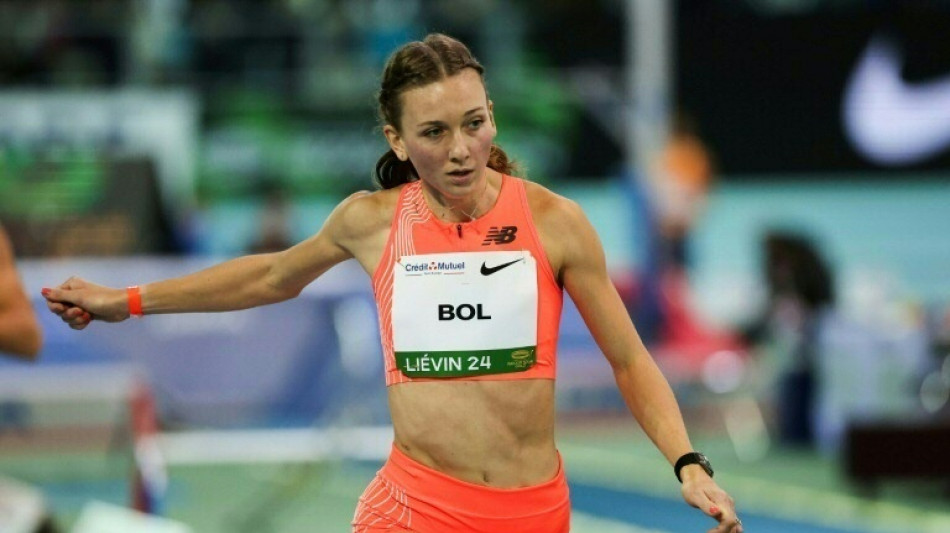
Scientists develop mathematical model to optimise elite athletes' performance / Photo: DENIS CHARLET - AFP/File

 Nigeria miners struggled to breathe in cell before 37 died: survivors

 Warren Buffett steps down as Berkshire Hathaway chairman

 Isolated Syrian-Druze city blames Damascus for shortages

 Kerry James Marshall: American 'blackness' painter celebrated in Europe

 Infantino 'must go', says German FA vice-president

 Japan's busiest rail station tests robot bins

 Backpackers fret over Australian visa crackdown

 Bank of Japan hikes rates to 31-year high to battle inflation

 AI doomsday warnings unlikely to slow IPOs but questions linger

 In Brazil's Amazon, the hunt for oil fuels hopes and fears

 Baby orangutans in India expose 'frightening' scale of trafficking

 Oversight Board blasts 'inadequate' Meta safeguards for AI deepfakes

 Harry makes first public appearance since return to UK

 Princess Diana's brother makes new explosive claims against Charles

 Trump admin overhauls key protection for endangered species

 Mbappe draws political fire over Ceuta t-shirt controversy

 Third malaria death in Germany from outbreak tied to Frankfurt airport

 AtlasClear Holdings Reports Preliminary Fiscal 2026 Revenue of Approximately $20.1 Million, Up 85%; Revenue Plus Interest Income of Approximately $21.9 Million

 'Another arrow to the quiver': World Bank posts record private capital mobilization

 Ireland to boycott Eurovision 2027 over Gaza

 India's Tata Sons reappoints N. Chandrasekaran as chairman

 Germany urges EU action against China to defend carmakers

 Japan eyes changing prostitution law to punish sex buyers

 Modi pitches India as global chipmaking hub

 Ukraine plans record defence spending in 2027

Scientists have developed a mathematical model that promises to optimise training for competitors in 400-metre and 1,500-metre athletics events, according to a study published Tuesday.
The model is based on performance data gathered from elite athletes including Olympic 1,500 metres champion Jakob Ingebrigtsen of Norway, Dutch world indoor 400m world record holder Femke Bol and Britain's Matthew Hudson-Smith at the 2022 European Championships in Munich.
"We wanted to understand what was happening at the physiological level in a 400 metres, which is a sprint, and a 1,500 metres, which is the first endurance race," Amandine Aftalion, co-author of the study published in the journal Frontiers in Sports and Active Living, told AFP.
Thanks to new technology of GPS sensors placed under athletes' jerseys, researchers were able to trace with precision the speeds of each athlete, with their position indicated ten times per second.
They integrated equations calculating physiological variables -- energy expenditure during exercise, maximum oxygen consumption (VO2), running economy and motor control -- in other words the role of the brain in the process of movement such as motivation, which has a role in the delay in action.
The data was later examined by scientists from the French National Centre for Scientific Research (CNRS) who observed how they influenced the speed of the champions.
"Thanks to the quantification of costs and benefits, the model provides instant access to the best strategy so that the runner 'performs' in an optimised manner," the CNRS said in a statement.
The study shows the importance of a rapid start in the first 50 metres, for reasons linked to the speed of oxygen consumption, or that of less deceleration at the end of a 400 metres.
The simulations notably explained the performance of middle distance runner Ingebrigtsen by his ability to quickly reach his maximum oxygen consumption (VO2), and to maintain it throughout the race.
A particularity which allows the Olympic champion "to run at a greater pace than his competitors throughout the race, even though we see him start less strongly," explained Aftalion.
The model could lead to performance support software so that coaches can "refine the racing strategy in relation to the physiological profile of the runner", the researcher concluded.
M.García--CPN