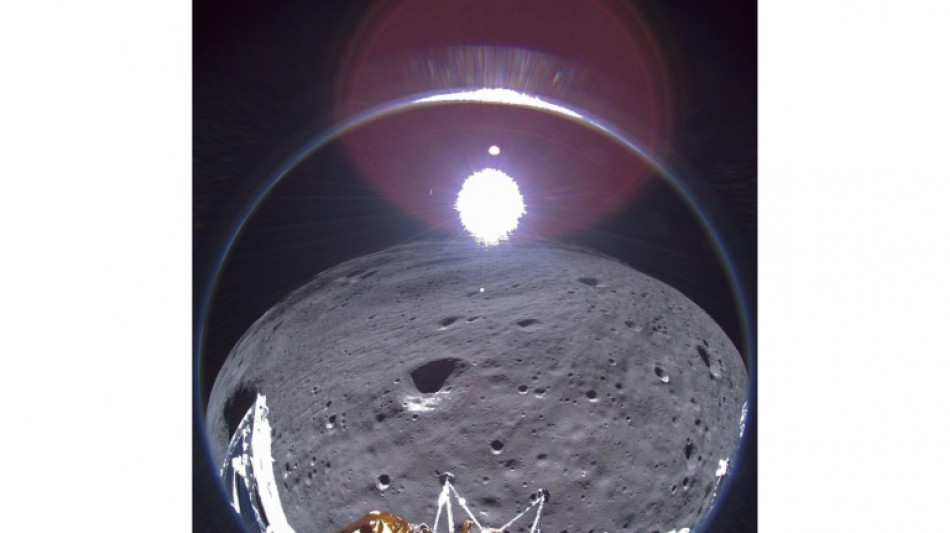
Lights out for wonky US lunar lander, for now / Photo: Handout - Intuitive Machines/AFP

 Nigeria miners struggled to breathe in cell before 37 died: survivors

 Warren Buffett steps down as Berkshire Hathaway chairman

 Isolated Syrian-Druze city blames Damascus for shortages

 Kerry James Marshall: American 'blackness' painter celebrated in Europe

 Infantino 'must go', says German FA vice-president

 Japan's busiest rail station tests robot bins

 Backpackers fret over Australian visa crackdown

 Bank of Japan hikes rates to 31-year high to battle inflation

 AI doomsday warnings unlikely to slow IPOs but questions linger

 In Brazil's Amazon, the hunt for oil fuels hopes and fears

 Baby orangutans in India expose 'frightening' scale of trafficking

 Oversight Board blasts 'inadequate' Meta safeguards for AI deepfakes

 Harry makes first public appearance since return to UK

 Princess Diana's brother makes new explosive claims against Charles

 Trump admin overhauls key protection for endangered species

 Mbappe draws political fire over Ceuta t-shirt controversy

 Third malaria death in Germany from outbreak tied to Frankfurt airport

 AtlasClear Holdings Reports Preliminary Fiscal 2026 Revenue of Approximately $20.1 Million, Up 85%; Revenue Plus Interest Income of Approximately $21.9 Million

 'Another arrow to the quiver': World Bank posts record private capital mobilization

 Ireland to boycott Eurovision 2027 over Gaza

 India's Tata Sons reappoints N. Chandrasekaran as chairman

 Germany urges EU action against China to defend carmakers

 Japan eyes changing prostitution law to punish sex buyers

 Modi pitches India as global chipmaking hub

 Ukraine plans record defence spending in 2027

An uncrewed American lander that became the first private spaceship on the Moon sent its final image Thursday before its power banks depleted, the company that built it said.
Houston-based Intuitive Machines posted a picture that was captured by Odysseus on February 22, the day it touched down near the south pole.
But the image was only received Thursday. The company shared earlier that a wonky landing had left the vessel's antennas misaligned and unable to transmit at an optimal rate.
The photograph "showcases the crescent Earth in the backdrop, a subtle reminder of humanity's presence in the universe," said Intuitive Machines, which also achieved the first lunar touchdown by an American spaceship since the manned Apollo 17 mission in 1972.
"Goodnight, Odie. We hope to hear from you again," the company added, using a nickname for the spaceship that refers to the canine sidekick from the Garfield comic series.
The onset of the long lunar night means it will be another two or three weeks before flight controllers can attempt to awaken the vessel -- just as Japan's SLIM spaceship that landed upside down in January was resurrected this week -- but nothing is certain.
Odysseus' historic mission was hailed as a success by both the company and NASA, even as it ran into multiple problems along the way.
A failure in the lander's navigation system -- the result of a human error in omitting to toggle a laser safety switch before lift-off -- meant engineers had to improvise a fix, switching to an experimental NASA system intended only as a technology demonstration.
It came skidding down in its final seconds with too much horizontal velocity, resulting in one or two landing gear breaking and the vehicle coming to rest at an angle. In its latest update, Intuitive Machines said the tilt was about 30 degrees.
NASA is planning to return astronauts to the Moon later this decade, and paid Intuitive Machines around $120 million for the mission, as part of an initiative to delegate cargo missions to the private sector and stimulate a lunar economy.
Odysseus carries a suite of NASA instruments designed to improve scientific understanding of the lunar south pole, where the space agency plans to send astronauts under its Artemis program later this decade.
The United States, along with international partners, wants to eventually develop long-term habitats in the region, harvesting polar ice for drinking water -- and for rocket fuel for eventual onward voyages to Mars.
L.Peeters--CPN