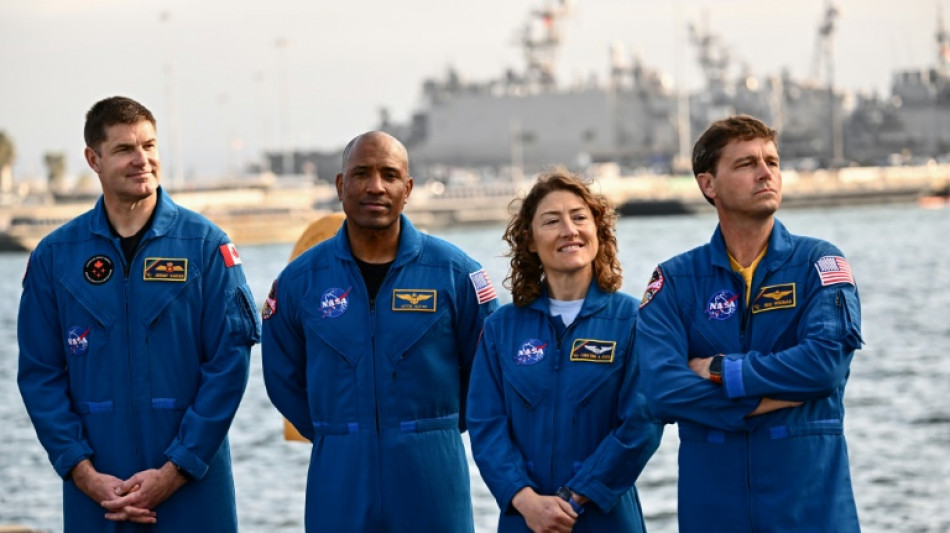
To the Moon and back: NASA's Artemis II crew rehearses splashdown / Photo: Patrick T. Fallon - AFP

 Nigeria miners struggled to breathe in cell before 37 died: survivors

 Warren Buffett steps down as Berkshire Hathaway chairman

 Isolated Syrian-Druze city blames Damascus for shortages

 Kerry James Marshall: American 'blackness' painter celebrated in Europe

 Infantino 'must go', says German FA vice-president

 Japan's busiest rail station tests robot bins

 Backpackers fret over Australian visa crackdown

 Bank of Japan hikes rates to 31-year high to battle inflation

 AI doomsday warnings unlikely to slow IPOs but questions linger

 In Brazil's Amazon, the hunt for oil fuels hopes and fears

 Baby orangutans in India expose 'frightening' scale of trafficking

 Oversight Board blasts 'inadequate' Meta safeguards for AI deepfakes

 Harry makes first public appearance since return to UK

 Princess Diana's brother makes new explosive claims against Charles

 Trump admin overhauls key protection for endangered species

 Mbappe draws political fire over Ceuta t-shirt controversy

 Third malaria death in Germany from outbreak tied to Frankfurt airport

 AtlasClear Holdings Reports Preliminary Fiscal 2026 Revenue of Approximately $20.1 Million, Up 85%; Revenue Plus Interest Income of Approximately $21.9 Million

 'Another arrow to the quiver': World Bank posts record private capital mobilization

 Ireland to boycott Eurovision 2027 over Gaza

 India's Tata Sons reappoints N. Chandrasekaran as chairman

 Germany urges EU action against China to defend carmakers

 Japan eyes changing prostitution law to punish sex buyers

 Modi pitches India as global chipmaking hub

 Ukraine plans record defence spending in 2027

Their mission around the Moon is not expected until September 2025 at the earliest, but the four astronauts on NASA's Artemis II mission are already preparing for their splashdown return.
Over the past week, the three Americans and one Canadian chosen for the historic Moon mission have been training at sea with the US Navy off the coast of California.
"This is crazy. This is the stuff of movies, and we're living it every day," said veteran NASA astronaut Reid Wiseman, the mission's commander, Wednesday at the San Diego Naval Base.
The night before, the quartet had been on a small inflatable raft bobbing in the Pacific Ocean.
Aboard a huge amphibious assault ship, hundreds of sailors, divers and pilots worked through the process of retrieving the space explorers, in a critical dress rehearsal for the mission's final leg.
Wiseman, 48, and his three colleagues will become the first humans to travel to the Moon since the Apollo program ended over 50 years ago.
If all goes well, they will fly around the Moon during a 10-day expedition aboard an Orion capsule, ending with a parachute-assisted descent into the sea.
How to handle a storm, what to do if an astronaut is injured -- these were just part of the detailed training.
NASA deployed a life-size replica of Orion for the rehearsal, which was nicknamed "Darth Vader" for its resemblance to the "Star Wars" character's helmet.
"We continuously think about what we're gonna do" Lily Villareal, the NASA official overseeing the return phase of the mission, told AFP. "We have to prepare for every single scenario."
With the Artemis program, humans are not just trying to return to the Moon, but to "stay" there with a lasting presence, she said.
- Moon to Mars -
While Artemis II will fly around the Moon, the program's third mission -- scheduled for the end of 2026 but facing possible further delays -- intends to land humans on the lunar surface.
NASA's lofty aim will then be to dispatch missions lasting several weeks, setting up a base on the lunar surface as well as an orbiting space station, with an eye toward manned trips to Mars.
"Our Earth has limited resources," said Villareal. "So we have to figure out what can we do for the better of humanity."
Private companies have also been dreaming for some years now of carrying tourists to the Moon.
New powers such as India, Japan and China have successfully landed aircraft there.
Beijing wants to land humans on the Moon by 2030, putting pressure on NASA to avoid pile up delays.
"At this point, with everyone on this planet having the resources in many countries the capabilities and interest in exploring the Moon, the question really isn't why we go, but are we going to lead or are we going to follow?" said Christina Koch, another Artemis II astronaut.
The 42-year-old American is set to become the first woman on a lunar mission, while Victor Glover, her 47-year-old compatriot, would become the first Black astronaut to travel around the Moon.
They will be accompanied by Jeremy Hansen, 48, the first person from Canada to take part in such a mission.
NASA plans for the Artemis missions to see the first woman and Black astronaut walk on the Moon.
Between 1969 and 1972 the Apollo program sent 24 men, all white, on missions to the Moon, with 12 of them landing on its surface.
Only eight of the 24 astronauts are still alive, with some ready to take the newcomers under their wing.
For instance, former Apollo 10 member Thomas Stafford invited the Artemis II team to lunch, according to Wiseman.
"Immediately he talks about... What are you going to do if the computers fail? Have you thought about how their trajectories are going to work?" recounts Wiseman. He "was like a dad just wanting to make sure his kids were gonna get out there safely and come back."
A.Mykhailo--CPN