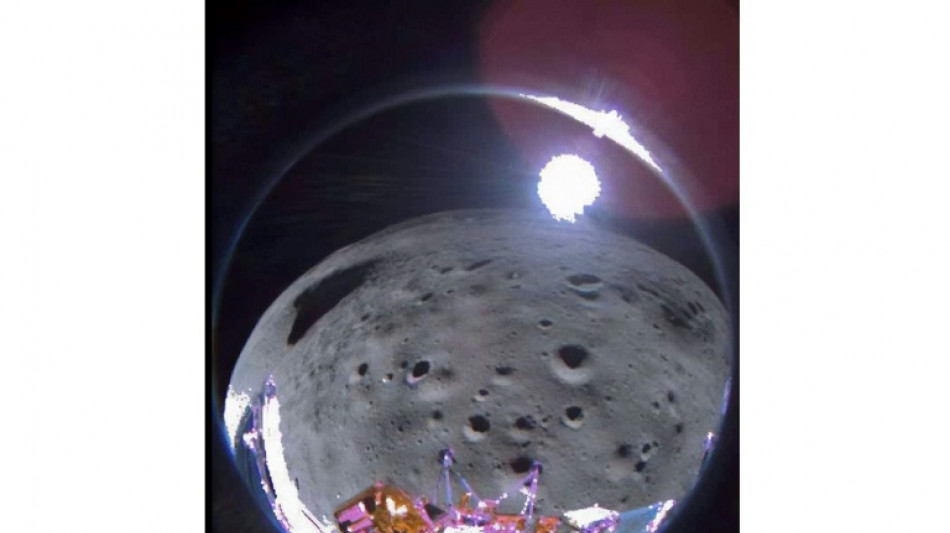
Sideways American lander sends first images back from Moon / Photo: Handout - Intuitive Machines/AFP

 Crisis-wracked Volkswagen warns of 10-bn-euro hit to profits

 Shakira to cap off world tour with Madrid 12-gig run

 Isolated Syrian-Druze city shortages

 UNESCO can be 'moderator' in AI debate: chief to AFP

 Russia seizes assets of Nestle, French firms

 Anthropic says AI systems moving towards building themselves

 Asian stocks boosted by falling oil, yen weakens after BoJ rate hike

 Afghan medical students in Pakistan hope court stops college expulsions

 Australia to detain tourists who overstay visa, minister says

 Asian stocks track Wall St rally as oil prices drop

 Prized Mexican relic returns on loan, two centuries on

 'In our lane': Fed's Warsh defies Trump but still fighting for credibility

 Trump admin makes major cut to endangered species protections

 GM delivers first components for US interceptor missiles

 Travis Scott and Keith Richards feature on GTA VI soundtrack

 King Charles warns tech bosses of 'existential dangers' of AI

 French fishermen block ports over petrol prices

 Micron's Taiwan workers say 68 months' bonus not enough

 Canada's Carney pushes 'new alliance' with EU despite Trump threats

 Beyond Investment Returns: Families Are Measuring Wealth by Freedom, Continuity, and Legacy, According to Nour Private Wealth

 King Charles disputes claims in book by Princess Diana's brother

 Nepal floods among 'most challenging' disasters: WFP

 Kids and social media: what would change under new EU law

 King Charles to call on tech giants for 'reassurances' over AI

 STARPRIME Responds to Diverging Gold Market Demand with AM/PM Fixing and XAU24/7

An American lunar lander that tipped over during touchdown has sent back its first images from the farthest south any vessel has ever landed on the Moon.
The uncrewed Odysseus, built by Houston-based Intuitive Machines, returned the United States to Earth's cosmic neighbor last week after a five-decade absence, in a first for the private sector.
But one of its legs caught on the surface as it came down, making it pitch over in the final act of a drama-packed journey that was saved by an improvised fix.
"Odysseus continues to communicate with flight controllers in Nova Control from the lunar surface," Intuitive Machines said Monday in an update on X, formerly Twitter.
The post included two pictures: one from the hexagon-shaped spaceship's descent, and the other taken 35 seconds after it fell over, revealing the pockmarked regolith of the Malapert A impact crater.
NASA is planning to return astronauts to the Moon later this decade, and paid Intuitive Machines around $120 million for the mission, as part of a new initiative to delegate cargo missions to the private sector and stimulate a "lunar economy."
Odysseus carries a suite of NASA instruments designed to improve scientific understanding of the lunar south pole, where the space agency plans to send astronauts under its Artemis program.
Unlike during Apollo, the plan is to build long-term habitats, harvesting polar ice for drinking water and for rocket fuel for onward missions to Mars.
- 'Success with minor footnotes' -
Astronomer and space missions expert Jonathan McDowell told AFP the fact Odysseus was lying on its side didn't overly concern him.
It's a "success with minor footnotes -- I'd give it an A minus," he said, adding that one would "prefer it to be upright, and they've certainly got some things to figure out for future missions," but overall things are moving in the right direction for NASA's Commercial Lunar Payload Services (CLPS) initiative.
On Friday, Intuitive Machines revealed its engineers had forgotten to toggle a safety switch that prevented the spaceship's laser-guided landing system from engaging, which forced them to upload a software patch and rely on an experimental NASA system that saved the day.
"Rocket science is hard not because any one thing is super hard, but because you have to do a million easy things all right," said McDowell of the "embarrassing" oversight.
Flight controllers will continue to download data until the lander's solar panels are no longer exposed to light, which is now estimated to be Tuesday morning, said Intuitive Machines.
It is a slightly shorter mission duration than initially planned as a result of the spacecraft's awkward orientation.
Japan's space agency also landed a spaceship wonkily on the Moon last month, but produced a surprise on Monday by waking up its SLIM lander following the lunar night, which lasts around two Earth weeks.
McDowell said the two falls might indicate the current generation of landers are too top heavy and consequently too easy to tip over in low gravity, unlike the short, squat landers built by the United States and Soviet Union during the Cold War.
M.Davis--CPN