US spaceship lying sideways after dramatic Moon touchdown / Photo: Handout - NASA/AFP

 Crisis-wracked Volkswagen warns of 10-bn-euro hit to profits

 Shakira to cap off world tour with Madrid 12-gig run

 Isolated Syrian-Druze city shortages

 UNESCO can be 'moderator' in AI debate: chief to AFP

 Russia seizes assets of Nestle, French firms

 Anthropic says AI systems moving towards building themselves

 Asian stocks boosted by falling oil, yen weakens after BoJ rate hike

 Afghan medical students in Pakistan hope court stops college expulsions

 Australia to detain tourists who overstay visa, minister says

 Asian stocks track Wall St rally as oil prices drop

 Prized Mexican relic returns on loan, two centuries on

 'In our lane': Fed's Warsh defies Trump but still fighting for credibility

 Trump admin makes major cut to endangered species protections

 GM delivers first components for US interceptor missiles

 Travis Scott and Keith Richards feature on GTA VI soundtrack

 King Charles warns tech bosses of 'existential dangers' of AI

 French fishermen block ports over petrol prices

 Micron's Taiwan workers say 68 months' bonus not enough

 Canada's Carney pushes 'new alliance' with EU despite Trump threats

 Beyond Investment Returns: Families Are Measuring Wealth by Freedom, Continuity, and Legacy, According to Nour Private Wealth

 King Charles disputes claims in book by Princess Diana's brother

 Nepal floods among 'most challenging' disasters: WFP

 Kids and social media: what would change under new EU law

 King Charles to call on tech giants for 'reassurances' over AI

 STARPRIME Responds to Diverging Gold Market Demand with AM/PM Fixing and XAU24/7

The first American spaceship to the Moon since the Apollo era is probably lying sideways following its dramatic landing, the company that built it said Friday, even as ground controllers work to download data and surface photos from the uncrewed robot.
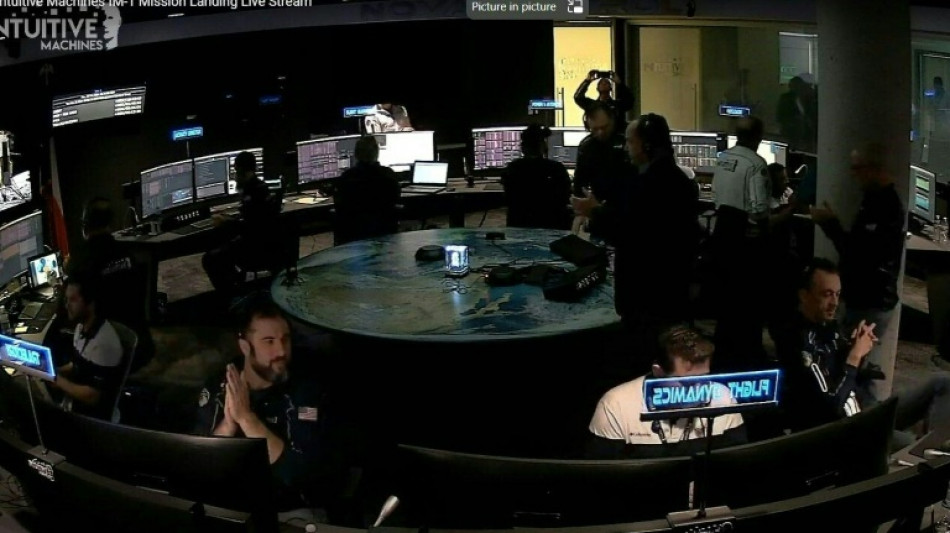
The Odysseus spacecraft landed near the lunar south pole Thursday at 6:23 pm Eastern Time (2323 GMT), after a nail-biting final descent when ground teams had to switch to a backup guidance system and took several minutes to establish radio contact after the lander came to rest.
Intuitive Machines, the company behind this first-ever lunar landing by a private company, initially posted on social media that its hexagonal spaceship was upright, but CEO Steve Altemus told reporters on Friday that statement was based on misinterpreted data.
Instead, it appears that it caught a foot on the surface and tipped over, coming to rest horizontally with its top perched on a small rock -- taking some shine off an accomplishment widely hailed as a historic achievement.
A NASA probe called the Lunar Reconnaissance Orbiter should be able to photograph Odysseus over the weekend, helping pinpoint its exact location.
Altemus said that while solar arrays were on the top-facing side, the team's ability to download data from the science experiments on board was being hampered because of antennas facing downward that "are unusable for transmission back to Earth -- and so that really is a limiter in our ability to communicate and get the right data down so we get everything we need for the mission."
Because of complications associated with the landing, a decision was taken not to shoot out an external camera to capture the descent as it happened, according to Embry-Riddle Aeronautical University, which built the "EagleCam" device.
But the team will still attempt to deploy it from the ground to try to obtain an outside image of Odysseus.
- Improvised fix -
Odysseus is still considered the first success for a new fleet of NASA-funded lunar landers designed to carry out science experiments that will pave the way for the return of American astronauts to the Moon later this decade, under the Artemis program.
A moonshot by another American company last month ended in failure, raising the stakes to demonstrate that private industry has what it takes to repeat a feat last achieved by US space agency NASA during its manned Apollo 17 mission in 1972.
Underlining the technical challenges, Intuitive Machines' own navigation technology failed and ground engineers were forced to jury-rig a solution, hastily writing a software patch to switch to an experimental NASA laser guidance system that was intended to run only as a technology demonstration.
Altemus later revealed Odysseus' own laser system failed to turn on because someone had forgotten to flip a safety switch before takeoff, which he described as "an oversight on our part."
Confirmation of landing was supposed to come seconds after the milestone, but instead around 15 minutes passed before a faint signal was detected, enough to declare the spaceship was in one piece and had met its goal.
- Commercial Moon fleet -
NASA paid Intuitive Machines $118 million to ship six experiments under an initiative which delegates cargo services to the private sector in a bid to achieve savings and stimulate a wider lunar economy.
Odysseus also carries cargo for private customers, including a reflective heat wrapping developed by Columbia Sportswear and used to protect the spaceship's cryogenic propulsion tank.
The United States, along with international partners, want to develop long-term habitats on the south pole, harvesting ice there for drinking water -- and for rocket fuel for eventual onward voyages to Mars.
The first crewed landing under NASA's Artemis program is set to take place no sooner than 2026. China meanwhile plans to put its first crew on the Moon in 2030, opening a new era of space competition.
The mission was the fourth attempt at soft lunar touchdown by the private sector. Intuitive Machines joins the national space agencies of the Soviet Union, United States, China, India and Japan in an exclusive club of landing on the Moon.
H.Cho--CPN