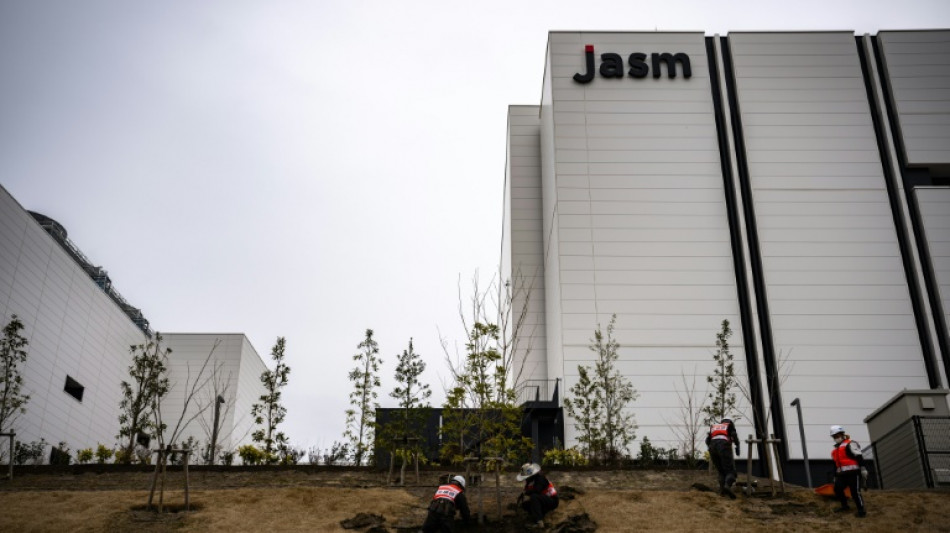
Chip giant TSMC shifts away from hotspot Taiwan with Japan plant / Photo: Philip FONG - AFP

 Crisis-wracked Volkswagen warns of 10-bn-euro hit to profits

 Shakira to cap off world tour with Madrid 12-gig run

 Isolated Syrian-Druze city shortages

 UNESCO can be 'moderator' in AI debate: chief to AFP

 Russia seizes assets of Nestle, French firms

 Anthropic says AI systems moving towards building themselves

 Asian stocks boosted by falling oil, yen weakens after BoJ rate hike

 Afghan medical students in Pakistan hope court stops college expulsions

 Australia to detain tourists who overstay visa, minister says

 Asian stocks track Wall St rally as oil prices drop

 Prized Mexican relic returns on loan, two centuries on

 'In our lane': Fed's Warsh defies Trump but still fighting for credibility

 Trump admin makes major cut to endangered species protections

 GM delivers first components for US interceptor missiles

 Travis Scott and Keith Richards feature on GTA VI soundtrack

 King Charles warns tech bosses of 'existential dangers' of AI

 French fishermen block ports over petrol prices

 Micron's Taiwan workers say 68 months' bonus not enough

 Canada's Carney pushes 'new alliance' with EU despite Trump threats

 Beyond Investment Returns: Families Are Measuring Wealth by Freedom, Continuity, and Legacy, According to Nour Private Wealth

 King Charles disputes claims in book by Princess Diana's brother

 Nepal floods among 'most challenging' disasters: WFP

 Kids and social media: what would change under new EU law

 King Charles to call on tech giants for 'reassurances' over AI

 STARPRIME Responds to Diverging Gold Market Demand with AM/PM Fixing and XAU24/7

Taiwanese chip giant TSMC is set to open an $8.6 billion plant in Japan on Saturday as the firm moves some of its crucial hardware manufacturing away from its native base.
Taiwan Semiconductor Manufacturing Company, which counts Apple and Nvidia as clients, produces half the world's chips, used in everything from smartphones to satellites and increasingly to power AI technology.
But TSMC's customers, as well as governments concerned about supplies of chips vital to the economy and to defence, want the firm to make more chips away from the self-ruled island.
China's increasing assertiveness towards Taiwan -- which it claims as its own territory and has not ruled out taking by force -- has sparked worries about the world's dependence on the island for chips production and pushed TSMC to diversify where it makes them.
The new plant in Japan is "the most significant TSMC international investment to open in many years", said Chris Miller, author of "Chip War: The Fight for the World's Most Critical Technology".
"It will also solidify the political relationship between Taiwan and Japan at a time when Taiwan is looking to make sure it's got powerful friends that can help it stand up to Chinese pressure," Miller told AFP.
But TSMC's new facility on the southern island of Kyushu is also a coup for Japan as it vies with the United States and Europe to woo semiconductor firms with huge subsidies.
- State sweeteners -
Prime Minister Fumio Kishida will reportedly be among those attending Saturday afternoon's opening ceremony with senior TSMC executives.
Firms like Toshiba and NEC helped Japan dominate in microchips in the 1980s but competition from South Korea and Taiwan saw its global market share slump from more than 50 percent to around 10 percent.
Now Japan is making available up to four trillion yen ($26.7 billion) in state sweeteners to help triple the sales of domestically produced chips to more than 15 trillion yen by 2030.
The new TSMC plant in the town of Kikuyo, for which the government pledged over 40 percent of the costs -- Sony and Denso are also on board -- is just the first.
With "strong" Japanese government support, TSMC this month announced a second facility, to make more advanced chips, and is reportedly eyeing a third and even a fourth.
Others getting state funds include Kioxia, Micron and Rapidus, an ambitious joint venture involving IBM and Japanese firms for state-of-the-art two-nanometre logic chips.
- Welcome banners -
TSMC is building a second factory in the US state of Arizona and plans another in Germany, its first in Europe.
But Japan has the advantage of being geographically closer, has a wealth of experience in the sector and, for the Kikuyo plant at least which took 22 months to build, is fast.
By contrast in the United States, which itself has announced subsidies of $52.7 billion to boost its own sector, the Arizona plant has been delayed and has seen disputes with unions.
"I have seen many factories being built by various companies, but TSMC was built with remarkable speed," Taro Imamura, a local official in Kikuyo, told AFP.
"Everyone in town, from children to the elderly, now knows the words 'chips' and 'TSMC'," Imamura said at Kikuyo's town hall, where a banner reads "We welcome TSMC workers".
The Kumamoto area of Kyushu is already a hub for Japanese semiconductor companies, including makers of machines for chip fabs like Tokyo Electron that are doing brisk business with China.
But as with other sectors in ageing Japan, there are worries about finding enough workers, particularly with local students either leaving or preferring other industries than chips.
Graduates are "more interested in software", Kenichiro Takakura, associate professor at the National Institute of Technology's Kumamoto College, told AFP.
C.Peyronnet--CPN