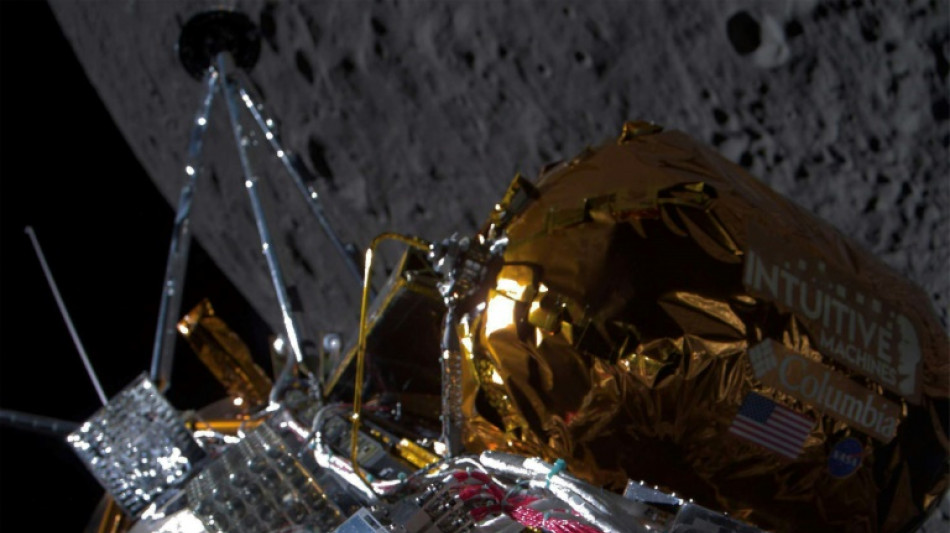
US heads back to the Moon -- with a commercial spaceship / Photo: Handout - Intuitive Machines/AFP

 Crisis-wracked Volkswagen warns of 10-bn-euro hit to profits

 Shakira to cap off world tour with Madrid 12-gig run

 Isolated Syrian-Druze city shortages

 UNESCO can be 'moderator' in AI debate: chief to AFP

 Russia seizes assets of Nestle, French firms

 Anthropic says AI systems moving towards building themselves

 Asian stocks boosted by falling oil, yen weakens after BoJ rate hike

 Afghan medical students in Pakistan hope court stops college expulsions

 Australia to detain tourists who overstay visa, minister says

 Asian stocks track Wall St rally as oil prices drop

 Prized Mexican relic returns on loan, two centuries on

 'In our lane': Fed's Warsh defies Trump but still fighting for credibility

 Trump admin makes major cut to endangered species protections

 GM delivers first components for US interceptor missiles

 Travis Scott and Keith Richards feature on GTA VI soundtrack

 King Charles warns tech bosses of 'existential dangers' of AI

 French fishermen block ports over petrol prices

 Micron's Taiwan workers say 68 months' bonus not enough

 Canada's Carney pushes 'new alliance' with EU despite Trump threats

 Beyond Investment Returns: Families Are Measuring Wealth by Freedom, Continuity, and Legacy, According to Nour Private Wealth

 King Charles disputes claims in book by Princess Diana's brother

 Nepal floods among 'most challenging' disasters: WFP

 Kids and social media: what would change under new EU law

 King Charles to call on tech giants for 'reassurances' over AI

 STARPRIME Responds to Diverging Gold Market Demand with AM/PM Fixing and XAU24/7

One giant leap for the private sector?
A Houston-based company is set Thursday to attempt to land America's first spaceship on the Moon in more than 50 years, as part of a new fleet of NASA-funded commercial landers intended to pave the way for astronauts to return to Earth's celestial neighbor later this decade.
If all goes well, Intuitive Machines will guide its hexagon-shaped robot Odysseus to a gentle touchdown near the lunar south pole at 2230 GMT.
Flight controllers are expected to confirm landing around 15 seconds after the milestone is achieved, with the event live streamed on the company's website.
As it approaches the surface, Odysseus will shoot out an external "EagleCam" that captures images of the lander in the final seconds of its descent.
A previous moon shot by another US company last month ended in failure, raising the stakes to demonstrate private industry has what it takes to repeat a feat last achieved by NASA during its Apollo 17 mission in 1972.
Scott Pace, director of the Space Policy Institute at George Washington University told AFP that the US was rebuilding its capacity to explore the Moon after its decades-long absence.
"There's often a prejudice that says, we did it in the past, why can't we do it now?" said Pace, a former member of the National Space Council.
"Each generation has to learn how to do things," he added. "You have a leg up, you understand the technology, the problems and so forth. But that's all in books. That's not flight tests. That's not flight experience, where you know it in your fingertips."
- Lunar south pole -
Odysseus launched on February 15 on a SpaceX Falcon 9 rocket and boasts a new type of supercooled liquid oxygen, liquid methane propulsion system that allowed it to race through space in quick time.
Its destination, Malapert A, is an impact crater 300 kilometers (180 miles) from the lunar south pole.
NASA hopes to eventually build a long-term presence and harvest ice there for both drinking water and rocket fuel under Artemis, its flagship Moon-to-Mars program.
Instruments include cameras to investigate how the lunar surface changes as a result of the engine plume from a spaceship, and a device to analyze clouds of charged dust particles that hang over the surface at twilight as a result of solar radiation.
- Exclusive club -
The rest of the cargo was paid for by Intuitive Machines' private clients, and includes 125 stainless steel mini Moons by the artist Jeff Koons.
NASA paid Intuitive Machines $118 million to ship its hardware under a new initiative called Commercial Lunar Payload Services (CLPS), which it created to delegate trucking services to the private sector to achieve savings and stimulate a wider lunar economy.
The first, by Pittsburgh-based Astrobotic, launched in January, but its Peregrine spacecraft sprung a fuel leak and it was eventually brought back to burn up in Earth's atmosphere.
Spaceships landing on the Moon have to navigate treacherous boulders and craters and, absent an atmosphere to support parachutes, must rely on thrusters to control their descent. Roughly half of the more than 50 attempts have failed.
Until now, only the space agencies of the Soviet Union, United States, China, India and Japan have accomplished the feat, making for an exclusive club.
A.Levy--CPN