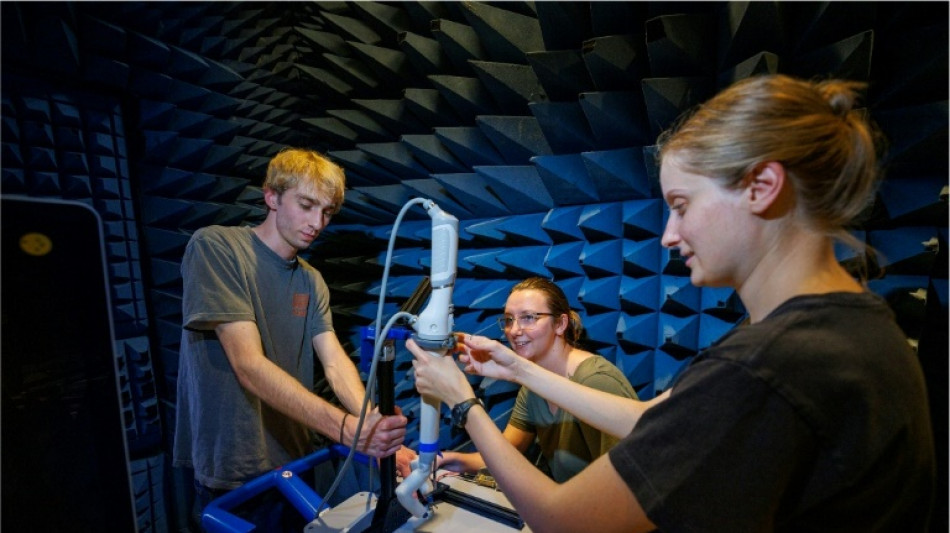
Space surgery: Doctors on ground operate robot on ISS for first time / Photo: Craig Chandler - Virtual Incision/AFP

 Crisis-wracked Volkswagen warns of 10-bn-euro hit to profits

 Shakira to cap off world tour with Madrid 12-gig run

 Isolated Syrian-Druze city shortages

 UNESCO can be 'moderator' in AI debate: chief to AFP

 Russia seizes assets of Nestle, French firms

 Anthropic says AI systems moving towards building themselves

 Asian stocks boosted by falling oil, yen weakens after BoJ rate hike

 Afghan medical students in Pakistan hope court stops college expulsions

 Australia to detain tourists who overstay visa, minister says

 Asian stocks track Wall St rally as oil prices drop

 Prized Mexican relic returns on loan, two centuries on

 'In our lane': Fed's Warsh defies Trump but still fighting for credibility

 Trump admin makes major cut to endangered species protections

 GM delivers first components for US interceptor missiles

 Travis Scott and Keith Richards feature on GTA VI soundtrack

 King Charles warns tech bosses of 'existential dangers' of AI

 French fishermen block ports over petrol prices

 Micron's Taiwan workers say 68 months' bonus not enough

 Canada's Carney pushes 'new alliance' with EU despite Trump threats

 Beyond Investment Returns: Families Are Measuring Wealth by Freedom, Continuity, and Legacy, According to Nour Private Wealth

 King Charles disputes claims in book by Princess Diana's brother

 Nepal floods among 'most challenging' disasters: WFP

 Kids and social media: what would change under new EU law

 King Charles to call on tech giants for 'reassurances' over AI

 STARPRIME Responds to Diverging Gold Market Demand with AM/PM Fixing and XAU24/7

Earth-bound surgeons remotely controlled a small robot aboard the International Space Station over the weekend, conducting the first-ever such surgery in orbit -- albeit on rubber bands.
The experiment, deemed a "huge success" by the participants, represents a new step in the development of space surgery, which could become necessary to treat medical emergencies during multi-year manned voyages, such as to Mars.
The technology could also be used to develop remote-control surgery techniques on Earth, to serve isolated areas.
The robot, developed by Virtual Incision (VIC) and the University of Nebraska, is called spaceMIRA.
It took off for the International Space Station at the end of January, aboard a payload carried by a SpaceX rocket.
Stored inside a compact box the size of a microwave oven, the robot was installed last Thursday by NASA astronaut Loral O'Hara, who has been in space since last September.
The experiment then took place on Saturday, conducted from Virtual Incision's headquarters in Lincoln, Nebraska.
It lasted around two hours, with six surgeons taking a go at operating the robot, which is equipped with a camera and two arms.
"The experiment tested standard surgical techniques like grasping, manipulating and cutting tissue. The simulated tissue is made up of rubber bands," Virtual Incision said in a statement.
In a video shared by the company, one arm equipped with pincers can be seen gripping the band and stretching it, while the other arm equipped with scissors makes a cut -- mimicking a dissection.
A key difficulty is the time lag -- about 0.85 seconds -- between the operation center on Earth and the ISS.
For a control experiment, the same process will take place with the same equipment, but on Earth.
"The experiment was deemed a huge success by all surgeons and researchers, and there were little to no hiccups," Virtual Incision said in a statement, claiming it will "change the future of surgery."
NASA, which provided some financial support for the project, said that with longer space missions, "the potential need for emergency care increases, including surgical procedures from simple stitching of lacerations to more complex activities."
D.Goldberg--CPN