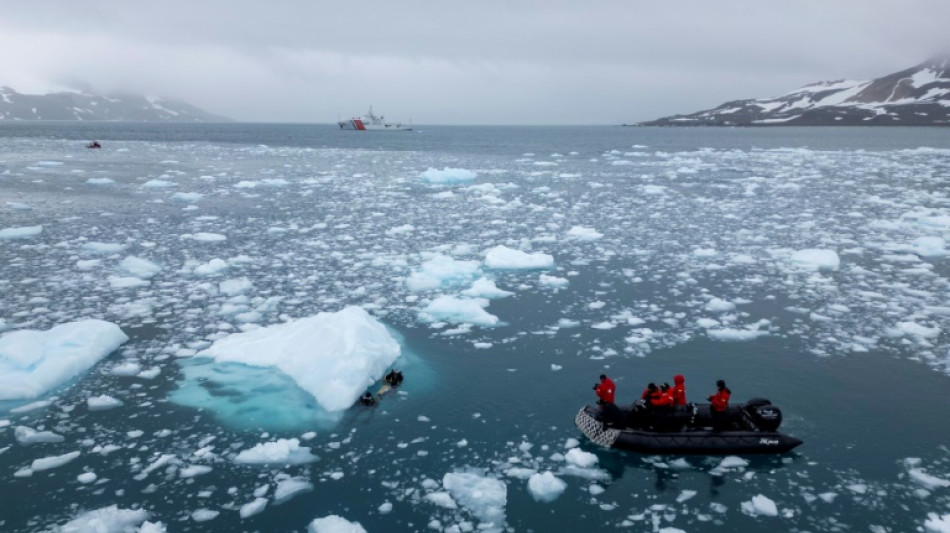
Studying the otherworldly sounds in Antarctic waters / Photo: Juan BARRETO - AFP

 Crisis-wracked Volkswagen warns of 10-bn-euro hit to profits

 Shakira to cap off world tour with Madrid 12-gig run

 Isolated Syrian-Druze city shortages

 UNESCO can be 'moderator' in AI debate: chief to AFP

 Russia seizes assets of Nestle, French firms

 Anthropic says AI systems moving towards building themselves

 Asian stocks boosted by falling oil, yen weakens after BoJ rate hike

 Afghan medical students in Pakistan hope court stops college expulsions

 Australia to detain tourists who overstay visa, minister says

 Asian stocks track Wall St rally as oil prices drop

 Prized Mexican relic returns on loan, two centuries on

 'In our lane': Fed's Warsh defies Trump but still fighting for credibility

 Trump admin makes major cut to endangered species protections

 GM delivers first components for US interceptor missiles

 Travis Scott and Keith Richards feature on GTA VI soundtrack

 King Charles warns tech bosses of 'existential dangers' of AI

 French fishermen block ports over petrol prices

 Micron's Taiwan workers say 68 months' bonus not enough

 Canada's Carney pushes 'new alliance' with EU despite Trump threats

 Beyond Investment Returns: Families Are Measuring Wealth by Freedom, Continuity, and Legacy, According to Nour Private Wealth

 King Charles disputes claims in book by Princess Diana's brother

 Nepal floods among 'most challenging' disasters: WFP

 Kids and social media: what would change under new EU law

 King Charles to call on tech giants for 'reassurances' over AI

 STARPRIME Responds to Diverging Gold Market Demand with AM/PM Fixing and XAU24/7

In freezing Antarctic waters, amid bobbing chunks of floating ice, the hums, pitches and echoes of life in the deep are helping scientists understand the behavior and movements of marine mammals.
"There are species which make impressive sounds, literally like Star Wars, they sound like spaceships," said Colombian scientist Andrea Bonilla, who is carrying out research with underwater microphones off Antarctica's coast.
The biologist from Cornell University in New York submerges a hydrophone covered in titanium and attached to a buoy, into the frigid water. The device is like a camera trap in the wild, except it picks up aquatic sounds.
Her team, part of a Colombian scientific expedition to the Southern Ocean, also picks up devices they left a year prior for analysis.
The research also gives scientists data on how human activity and environmental pollution affect sea life in one of the best conserved parts of the planet.
Nearby, a colony of penguins waddle along a giant block of floating ice.
A humpback whale comes to the surface for some air during a stint in the region for the austral summer -- a time for feeding and building up energy before their massive trek to warmer climes around the equator in the breeding season.
- 'Sound is essential' -
Bonilla describes the first time she heard whale song underwater as having "changed her life."
Scientists have warned that rising ocean temperatures are impacting whales' body clock and migration cycles, as well as killing off krill, the tiny crustaceans they need to fatten up for annual journeys of thousands of kilometers.
Whale communication has also been found to be impacted by noise at sea from shipping and other activity, which can disorient them.
"In a marine environment sound is essential," said Bonilla, adding that any interruption can affect some species ability to hunt.
Weddell seals and leopard seals also emit high-pitched songs in different tones and often harmonious compositions.
During their expedition the scientists install three underwater microphones, two in the Bransfield Strait and one in the Drake Passage.
The team also follows a set of coordinates to find the buoy left by Bonilla a year ago. When they are within 300 meters (1,000 feet) of it, she can send remote signals to find its exact location.
Her delighted teammates pat her on the back as she successfully retrieves the hydrophone from 500 meters deep.
"I am so excited because it was the first time we did this manuever in these waters. It all went super well," said Bonilla.
The scientist will use spectrograms -- a visual representation of sound -- to extract information not only about the movement of marine mammals, but also geophysics.
The hydrophones also capture low frequencies that can pick up the sounds of earthquakes or melting ice.
The research has another goal, supporting a proposal pushed by Chile and Argentina since 2012 to convert the Antarctic Peninsula into a protected marine area.
D.Philippon--CPN