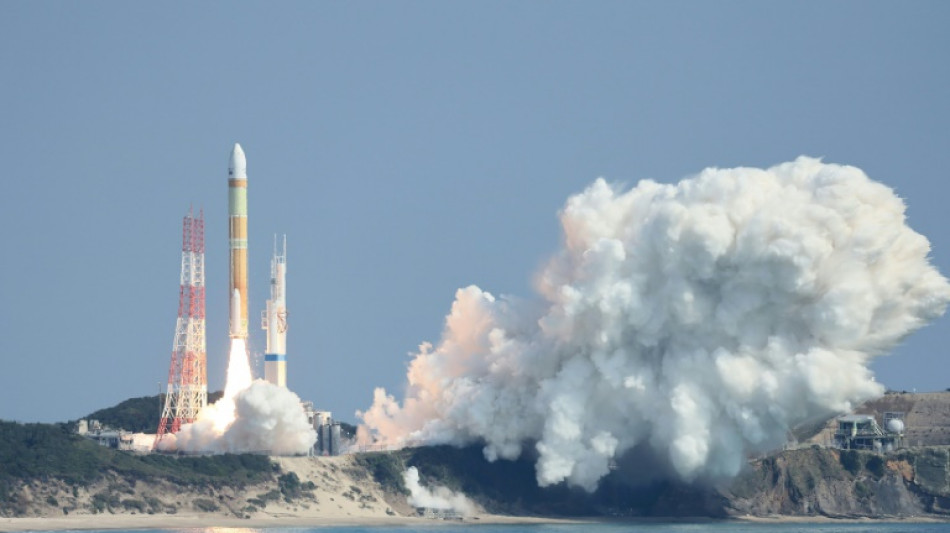
Japan postpones next-gen rocket launch over weather / Photo: STR - JIJI Press/AFP

 Crisis-wracked Volkswagen warns of 10-bn-euro hit to profits

 Shakira to cap off world tour with Madrid 12-gig run

 Isolated Syrian-Druze city shortages

 UNESCO can be 'moderator' in AI debate: chief to AFP

 Russia seizes assets of Nestle, French firms

 Anthropic says AI systems moving towards building themselves

 Asian stocks boosted by falling oil, yen weakens after BoJ rate hike

 Afghan medical students in Pakistan hope court stops college expulsions

 Australia to detain tourists who overstay visa, minister says

 Asian stocks track Wall St rally as oil prices drop

 Prized Mexican relic returns on loan, two centuries on

 'In our lane': Fed's Warsh defies Trump but still fighting for credibility

 Trump admin makes major cut to endangered species protections

 GM delivers first components for US interceptor missiles

 Travis Scott and Keith Richards feature on GTA VI soundtrack

 King Charles warns tech bosses of 'existential dangers' of AI

 French fishermen block ports over petrol prices

 Micron's Taiwan workers say 68 months' bonus not enough

 Canada's Carney pushes 'new alliance' with EU despite Trump threats

 Beyond Investment Returns: Families Are Measuring Wealth by Freedom, Continuity, and Legacy, According to Nour Private Wealth

 King Charles disputes claims in book by Princess Diana's brother

 Nepal floods among 'most challenging' disasters: WFP

 Kids and social media: what would change under new EU law

 King Charles to call on tech giants for 'reassurances' over AI

 STARPRIME Responds to Diverging Gold Market Demand with AM/PM Fixing and XAU24/7

Japan's space agency on Tuesday postponed the launch of its next-generation rocket planned for this week due to expected bad weather, after two previous attempts ended in failure.
The H3 rocket had been scheduled to lift off on Thursday from the southern island of Tanegashima.
Billed as a flexible and cost-effective new flagship, it was to carry two small satellites during the mission, intended to prove it can get into orbit.
"As the weather that day is expected to worsen, we decided to postpone the launch," the Japan Aerospace Exploration Agency (JAXA) said, adding that a new date would be announced "once a decision is made".
Japan succeeded in landing its SLIM spacecraft nicknamed the "Moon Sniper" on the lunar surface last month, although the craft's solar panels were facing the wrong way.
Before that, the country suffered a series of space failures.
They included the first H3 launch attempt in February last year -- already delayed by several years -- which was abandoned when the solid rocket boosters did not ignite.
Then, at the second attempt in March, the spacecraft was ordered to self-destruct when the command centre concluded its mission could not succeed.
Developed by Mitsubishi Heavy Industries, the H3 is the successor to Japan's H-IIA launch system, which debuted in 2001.
A.Agostinelli--CPN