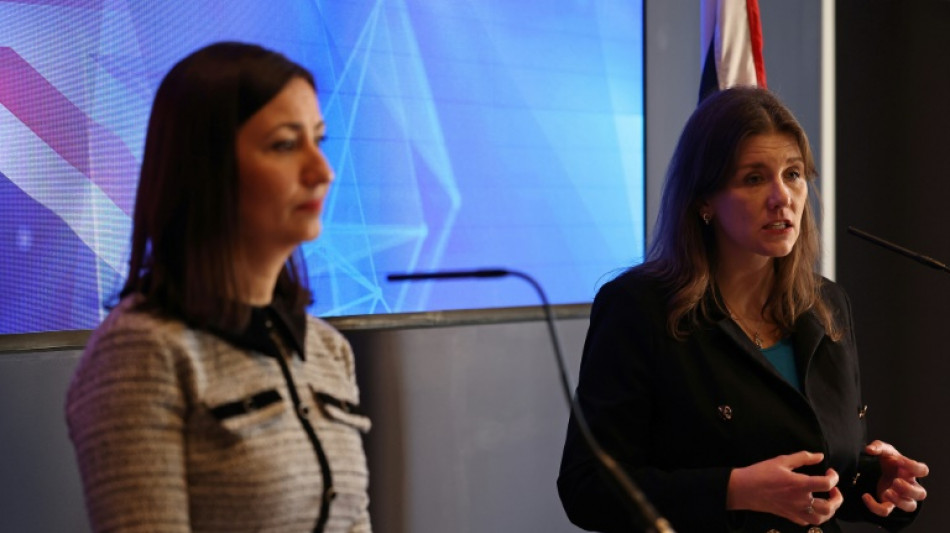
EU, UK urge scientists to join research programme after Brexit concerns / Photo: Daniel LEAL - AFP

 Crisis-wracked Volkswagen warns of 10-bn-euro hit to profits

 Shakira to cap off world tour with Madrid 12-gig run

 Isolated Syrian-Druze city shortages

 UNESCO can be 'moderator' in AI debate: chief to AFP

 Russia seizes assets of Nestle, French firms

 Anthropic says AI systems moving towards building themselves

 Asian stocks boosted by falling oil, yen weakens after BoJ rate hike

 Afghan medical students in Pakistan hope court stops college expulsions

 Australia to detain tourists who overstay visa, minister says

 Asian stocks track Wall St rally as oil prices drop

 Prized Mexican relic returns on loan, two centuries on

 'In our lane': Fed's Warsh defies Trump but still fighting for credibility

 Trump admin makes major cut to endangered species protections

 GM delivers first components for US interceptor missiles

 Travis Scott and Keith Richards feature on GTA VI soundtrack

 King Charles warns tech bosses of 'existential dangers' of AI

 French fishermen block ports over petrol prices

 Micron's Taiwan workers say 68 months' bonus not enough

 Canada's Carney pushes 'new alliance' with EU despite Trump threats

 Beyond Investment Returns: Families Are Measuring Wealth by Freedom, Continuity, and Legacy, According to Nour Private Wealth

 King Charles disputes claims in book by Princess Diana's brother

 Nepal floods among 'most challenging' disasters: WFP

 Kids and social media: what would change under new EU law

 King Charles to call on tech giants for 'reassurances' over AI

 STARPRIME Responds to Diverging Gold Market Demand with AM/PM Fixing and XAU24/7

EU and UK science chiefs on Monday launched a push to attract scientists to Europe's £80 billion Horizon research programme after warnings of high costs and red tape in Britain.
The UK quit the Horizon Europe programme when it left the EU in 2020.
Following years of uncertainty, in which British researchers were prevented from fully taking part in the scheme due to political disputes, the UK rejoined the scheme in January.
At a meeting in London on Monday, UK science, business and research leaders were urged to "seize the opportunity" of Horizon Europe funding, despite the concerns over costs and visas for European scientists wanting to work in the UK.
"There were some concerns that were raised by researchers, and also related to the cost of fees, healthcare surcharges, salaries," the European Commissioner for Research and Innovation, Illiana Ivanova said at a press conference after the meeting.
"I wouldn't want to focus on what might be a potential division," she added.
Britain was last year expected to rejoin Horizon, which focuses on issues like climate change and medical research, after reaching an agreement with the EU on the flow of goods between the UK and Northern Ireland.
Prime Minister Rishi Sunak, however, delayed joining the scheme so he could extract a better deal on budget contributions.
Horizon Europe has a budget of 95.5 billion euros (£81 billion, $103 billion) with the UK expected to contribute on average around 2.43 billion euros per year in order to participate.
Earlier on Monday, Ivanova said that Britain should ease visa procedures or risk missing out on the full benefits of Horizon.
"We are having some difficulties with European researchers going to the UK due to some visa issues and also higher costs that I'm going to raise with the British side," she told the Financial Times.
But British science minister Michelle Donelan denied that the UK was facing challenges in recruiting participants.
She said "the key message" from scientists, innovators and businesses was that "association" with the project would support their interests and further Britain's economic growth and development.
"You will hear first hand from individuals who have actively chosen to locate here because of all those positives we have," she said at the press conference.
She said the UK would consider collaborating on other projects with the EU on "a case by case basis".
"The British public voted to leave the EU to have more control and say over their decision-making," she said.
"Of course that means that on each and every one of these different aspects, the merits and topics would need to be reviewed and examined."
When it came to Horizon, however, rejoining was "somewhat of a no-brainer", she added, saying that Britain took its time to rejoin the project so that it could get value for the taxpayers.
"That is why we continued to negotiate and get a deal that worked," she said.
A.Leibowitz--CPN