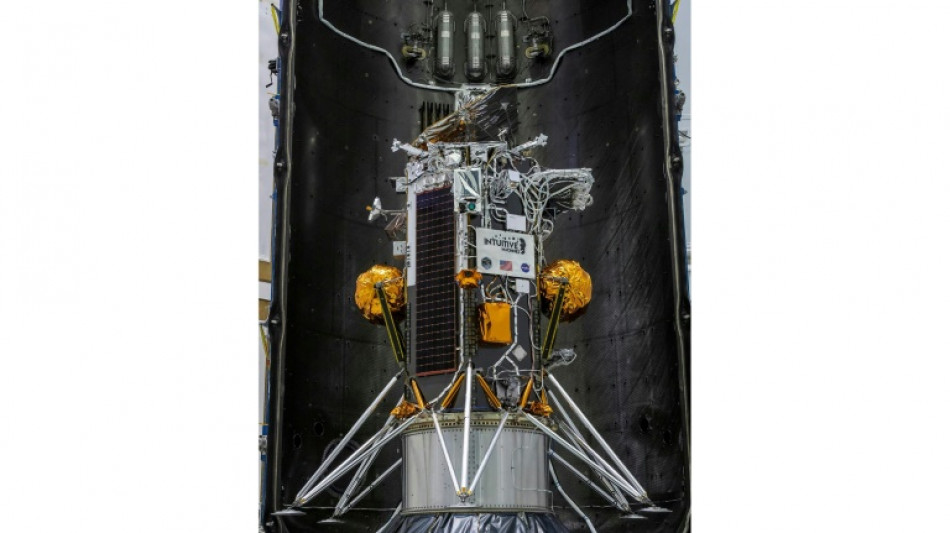
US to launch next Moon mission on Valentine's Day / Photo: Handout - NASA/AFP

 Crisis-wracked Volkswagen warns of 10-bn-euro hit to profits

 Shakira to cap off world tour with Madrid 12-gig run

 Isolated Syrian-Druze city shortages

 UNESCO can be 'moderator' in AI debate: chief to AFP

 Russia seizes assets of Nestle, French firms

 Anthropic says AI systems moving towards building themselves

 Asian stocks boosted by falling oil, yen weakens after BoJ rate hike

 Afghan medical students in Pakistan hope court stops college expulsions

 Australia to detain tourists who overstay visa, minister says

 Asian stocks track Wall St rally as oil prices drop

 Prized Mexican relic returns on loan, two centuries on

 'In our lane': Fed's Warsh defies Trump but still fighting for credibility

 Trump admin makes major cut to endangered species protections

 GM delivers first components for US interceptor missiles

 Travis Scott and Keith Richards feature on GTA VI soundtrack

 King Charles warns tech bosses of 'existential dangers' of AI

 French fishermen block ports over petrol prices

 Micron's Taiwan workers say 68 months' bonus not enough

 Canada's Carney pushes 'new alliance' with EU despite Trump threats

 Beyond Investment Returns: Families Are Measuring Wealth by Freedom, Continuity, and Legacy, According to Nour Private Wealth

 King Charles disputes claims in book by Princess Diana's brother

 Nepal floods among 'most challenging' disasters: WFP

 Kids and social media: what would change under new EU law

 King Charles to call on tech giants for 'reassurances' over AI

 STARPRIME Responds to Diverging Gold Market Demand with AM/PM Fixing and XAU24/7

US companies are set to launch for the Moon on February 14, less than a month since a similar mission ended in failure with the spaceship burning up in the Earth's atmosphere, NASA said Wednesday.
The upcoming attempt features a lander built by Houston-based Intuitive Machines fixed to the top of a SpaceX rocket, while the last try involved a United Launch Alliance rocket and Astrobotics lander.
But the stakes remain just as high: achieving America's first soft touchdown on the lunar surface since the end of the Apollo-era five decades ago, and the first ever by private industry.
SpaceX is targeting a 12:57 am (0557 GMT) blast off from the Kennedy Space Center in Florida, with Intuitive Machines' Nova-C lander expected to land on the Moon on February 22, at an impact crater near the lunar south pole.
NASA paid Intuitive Machines more than $100 million to ship its scientific hardware on the mission, part of a broader strategy to stimulate a lunar economy and delegate routine cargo missions to the private sector.
The "Nova-C" lander's payload includes instruments to better understand the lunar environment as NASA prepares to send human crew members back to the celestial body under the Artemis program later this decade.
It also includes more colorful cargo, including sculptures by the artist Jeff Koons.
Only five nations have achieved soft lunar landings. The Soviet Union was first, followed by the United States, which is still the only country to put people on the Moon. China achieved the feat three times in the past decade, followed by India, and most recently Japan.
Japan's lander touched down on January 20 but ended up on its side, leaving its solar panels off kilter.
Astrobotic's failure was the third botched effort by non-government missions, after an Israeli nonprofit and Japanese company both crash-landed in 2019 and 2023, respectively.
Landing on the Moon is complicated by treacherous terrain and the lack of atmosphere, which means parachutes aren't an option and a spaceship has to use its thrusters to achieve a controlled descent.
D.Avraham--CPN